Practice Human Evolution SAC - Unit 4, Outcome 1
star
star
star
star
star
Last updated about 6 years ago
10 Nsɛmmisa
2
3
1
1
1
3
1
1
2
4
Introduction
Information about the evolutionary past of humans can be obtained from the studying of fossils, formed from the remains of our ancient ancestors. A different approach taken by some scientists is to study the evolution of the parasitic lice that have infected humans. Lice have existed and have infected all humans, ancestral humans and all other primates for millions of years.
There is generally only one species of louse that lives on each species of primate host (humans are an exception). The species of louse tends to be reproductively isolated and only stays with one particular host species. When a primate host diverges and becomes two different species, the louse also speciates.
As lice stay with their host species this allows for observations of co- evolution, where the lice adapt to changes and evolve in order to keep feeding on their hosts. Each of the different ape species alive today has one species of louse that infects them. The exception to this rule is humans who have three different species of louse that use us as a host. These species are shown in Figure 1.
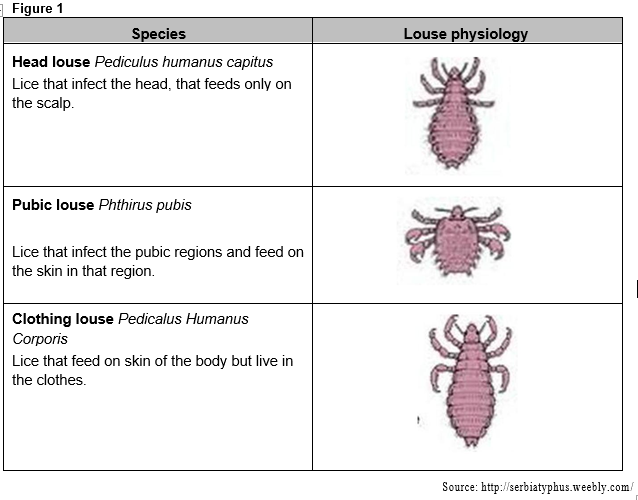
Lice from Humans (Homo sapiens) and Chimpanzees (Pan troglodytes) have been studied to help support conclusions about the evolution of humans and other primates. The evidence from the lice helps with our understanding and classifications of the different species.
Question 1
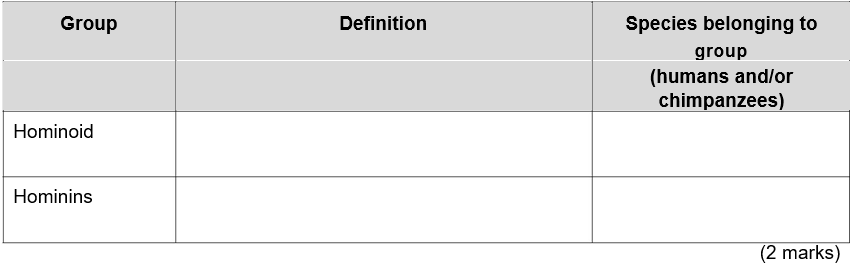
Humans and chimpanzees can be defined as being hominoids and /or hominins. Define hominoid and hominin and correctly classify the chimpanzees and humans.
Question 2
Explain how the chimpanzee louse Pediculus schaeffi and the human head louse Pediculusv humanus capitus became two separate species. (3 marks)
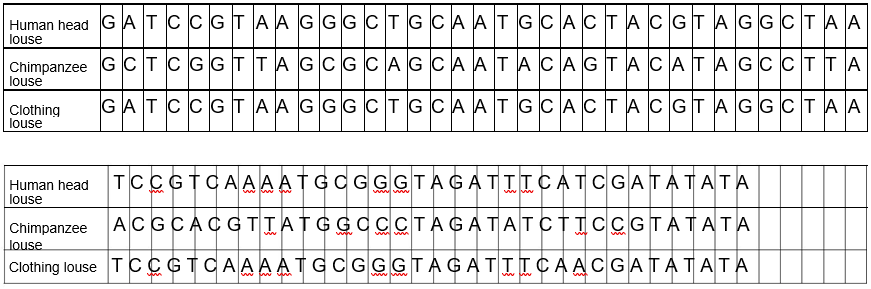
Scientists are trying to estimate how long the head lice and clothing lice have been separate species. The ND4 gene found in the mitochondrial DNA was used as the basis for the analysis between the lice. A molecular clock could be constructed using this information as a calibration point i.e. the number of differences between the human and chimpanzee louse species would tell us how many mutations have occurred in a 5 million year period.
DNA sequence results for ND4 for human head louse, chimpanzee louse and the human clothing louse are shown below.
Question 3
Calculate the number of base pair mutations that have occurred between the human head louse and the chimpanzee louse. Use this information to determine a molecular clock for how many years it takes for 1 base to mutate. (1 mark)
Question 4
Use your molecular clock (in Question 3) and the DNA sequence data above to determine the approximate time when human head louse diverged from the clothing louse. (1 mark)
Question 5
Construct a phylogenetic tree (cladogram) to show your results of the human head louse, clothing louse and chimpanzee louse. (1 mark)
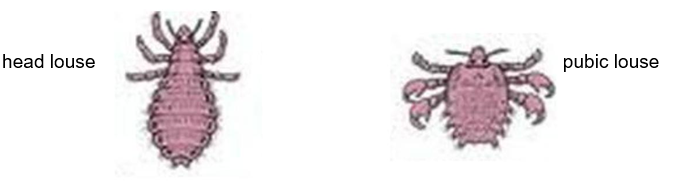
The pubic louse has larger claws when compared to the head louse and other human species.
They are specifically adapted for clasping coarse and thicker hair.
Question 6
Explain how natural selection would have acted on the claws of the louse. (3 marks)
Question 7
Further investigation into the origins of the pubic louse Phthirus pubis were investigated using DNA comparisons. The results of this found that this species did not diverge from the head louse line, but has likely diverged from a separate species that infected gorillas.
Give a possible explanation for the origins of how the pubic louse came to use humans as a host. (1 mark)
Question 8
The African line of head louse contains 3.31% of differences in their DNA when it was tested. (Compared with non-African head lice)
Explain what has caused these differences in the DNA. (1 mark)
Question 9
Explain how the non-African line of louse could be described as a founder population.
Question 16
Analysis of human DNA and Neanderthal DNA has suggested that interbreeding between the species has occurred. With access to the DNA of lice that infected the Neanderthals, design an experiment to help support the hypothesis that interbreeding occurred between the Neanderthal and ancestral humans (who were not of African origin). (4 marks)