Ch 3 Day 3 Unit 2 Quiz #1 Quantitative Data Displays

Last updated over 4 years ago
17 questions
4

The graph below displays a fire department’s response time, which measures the time from when the alarm is sounded at the firehouse to the time the first fire engine leaves the station.
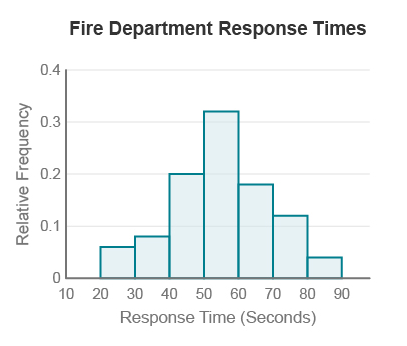
Which of the following describes the distribution?
Select all that apply, there are 3.

4

The graph below displays a fire department’s response time, which measures the time from when the alarm is sounded at the firehouse to the time the first fire engine leaves the station.

What percent of the response times were less than 50 seconds?
Notice the histogram gives relative frequencies as decimals (look carefully at the histogram intervals).
4

The graph below displays a fire department’s response time, which measures the time from when the alarm is sounded at the firehouse to the time the first fire engine leaves the station.

Which interval contains the median (middle) response time?

4

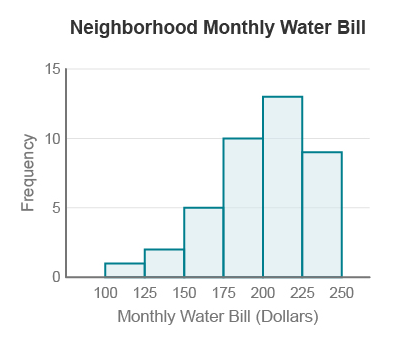
Residents in a city are charged for water usage every three months. The water bill is computed from a common fee, along with the amount of water the customers use.
The last water bills for 40 neighborhood residents are displayed in the histogram below.


Which of the following describes the distribution?
Select all that apply, there are 3.

4

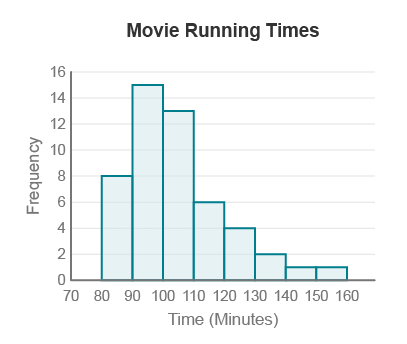
Alex records the running time—the number of minutes a movie lasts from start to finish—of 50 popular movies. The distribution of times, in minutes, is shown in the histogram below.

Describe the SHAPE of the histogram.
Hint: you need to tell me two things about the shape. Separate them by 'and' or a comma.

4

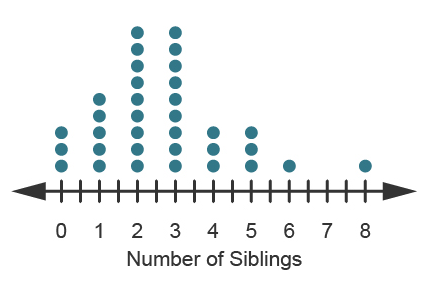
Thirty-four high school students were surveyed and asked how many siblings they have. The dotplot below displays the distribution of responses.

Describe the distribution, select all that apply, there are 3.

4

Thirty-four high school students were surveyed and asked how many siblings they have. The dotplot below displays the distribution of responses.

Of the 34 students that were surveyed, what percent have at least four siblings?
Round your percent to 1 place past the decimal. Ex. 76.3%

4

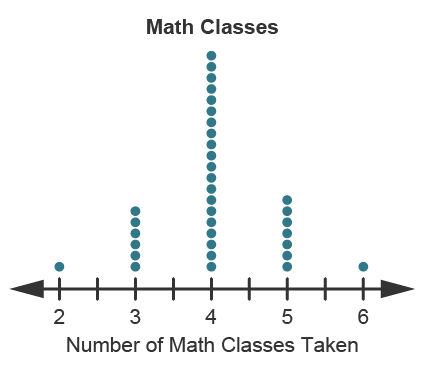
The dotplot below displays the number of math classes taken by a random sample of students at a high school.

Select the best description for the dot plot data distribution.

4

The dotplot below displays the number of math classes taken by a random sample of students at a high school.

What is the mode for the number of math classes?
Enter the number below.

4

The dotplot below displays the number of math classes taken by a random sample of 35 students at a high school.

What percent of the students took less than 4 math classes?
Enter your percent below.
Round to one place past the decimal if needed. Ex. 85.3%

4

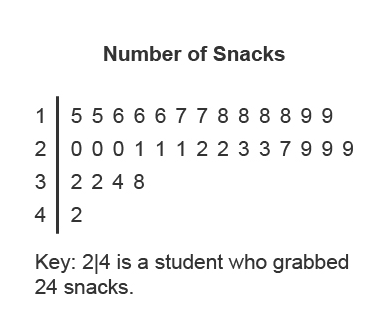
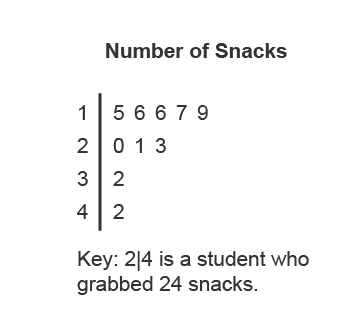
The stemplot below represents the number of bite-size snacks grabbed by 32 students in an activity for a statistics class.


What percentage of the students grabbed more than 21 snacks?
Round your percentage to one place past the decimal. Ex. 78.5%

4

The stemplot below represents the number of bite-size snacks grabbed by 32 students in an activity for a statistics class.


What is the mode for this data set? (which number occurred the most?)
Look carefully, enter your answer below.

4

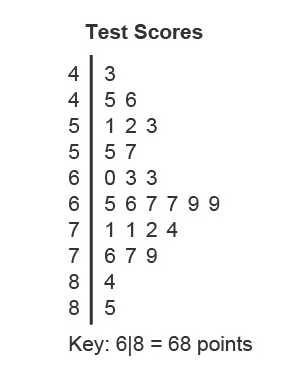
The stemplot displays 26 students’ scores on a 90-point statistics test.


How would you describe the shape of this data set?

Select the one that applies the best.
Remember we look at data from smallest to the largest values, from left to right. (you may need to tilt your head)

4

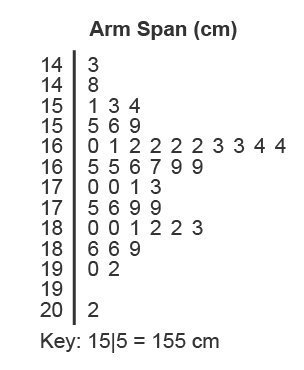
The stemplot below displays the arm spans, in centimeters, for 44 students.

What percent of the students have an arm span of at least 170 cm?

Enter your percent below.
Round the percent to one place past the decimal point. Ex. 23.7%

4

The stemplot below represents the number of bite-size snacks grabbed by 10 students in an activity for a statistics class.


Which could be the list of data for this stemplot?

4

What is the benefit of using a dot plot or stemplot over a histogram?
Select all that apply. (there are five).

2

What are the acronyms we used in class to remember what to include in the description of quantitative data distributions?