Ch 4 Day 4 Quiz Review: Comparing Quantitative Data Displays
star
star
star
star
star
Last updated over 4 years ago
22 questions
4 points
4
Question 1
1.
In 1995 the Educational Testing service (ETS) adjusted the scores of the SAT tests. Before ETS recentered the SAT Verbal test, the mean of all test scores was 450.
If each score was increased by 50 points.
Is this a shift or a scale?
How do you know?
Select 2 correct answers below
4 points
4
Question 2
2.
In 1995 the Educational Testing service (ETS) adjusted the scores of the SAT tests. Before ETS recentered the SAT Verbal test, the mean of all test scores was 450.
The standard deviation was 100 points before the scores were adjusted.
What will the new standard deviation be after the scores are adjusted by adding 50 points?
Enter your answer below.
4 points
4
Question 3
3.
In 1995 the Educational Testing service (ETS) adjusted the scores of the SAT tests. Before ETS recentered the SAT Verbal test, the mean of all test scores was 450.
The scores were adjusted by adding 50 points to each.
Which statistics will NOT change?
Select all correct answers below.
4 points
4
Question 4
4.
A company manufacturers wheels for skate boards. The diameters of the wheels have a mean of 3 inches adn a standard deviation of 0.1 inches. Because so many of their customers use the metric system, the company decided to report their production statistics in millimeters.
1 inch = 25.4 mm
Is this a shift or a scale?
Why?
Select both correct answers below.
4 points
4
Question 5
5.
A company manufacturers wheels for skate boards. The diameters of the wheels have a mean of 3 inches adn a standard deviation of 0.1 inches. Because so many of their customers use the metric system, the company decided to report their production statistics in millimeters.
1 inch = 25.4 mm
What will the standard deviation of the wheel diameters be in millimeters?
Keep all decimal places.
4 points
4
Question 6
6.
A company manufacturers wheels for skate boards. The diameters of the wheels have a mean of 3 inches adn a standard deviation of 0.1 inches. Because so many of their customers use the metric system, the company decided to report their production statistics in millimeters.
1 inch = 25.4 mm
Which of the statistics listed below will change?
Select the ones that will change.
4 points
4
Question 7
7.
A class of fourth graders takes a diagnostic reading test, and the scores are reported by reading grade level. The five-number summaries for the 14 boys and 11 girls are shown:
Min: Q1: Med: Q3: Max:
Boys: 2.0 3.9 4.3 4.9 6.0
Girls: 2.8 3.8 4.5 5.2 5.9
Which group had the highest center? What was it?
Select both answers below.
4 points
4
Question 8
8.
A class of fourth graders takes a diagnostic reading test, and the scores are reported by reading grade level. The five-number summaries for the 14 boys and 11 girls are shown:
Min: Q1: Med: Q3: Max:
Boys: 2.0 3.9 4.3 4.9 6.0
Girls: 2.8 3.8 4.5 5.2 5.9
Which group had the greatest interquartile range? What was it?
Select both answers below.
4 points
4
Question 9
9.
A class of fourth graders takes a diagnostic reading test, and the scores are reported by reading grade level. The five-number summaries for the 14 boys and 11 girls are shown:
Min: Q1: Med: Q3: Max:
Boys: 2.0 3.9 4.3 4.9 6.0
Girls: 2.8 3.8 4.5 5.2 5.9
If 1.5 points were added to all the scores, what would the new IQR be for the boys?
4 points
4
Question 10
10.
A class of fourth graders takes a diagnostic reading test, and the scores are reported by reading grade level. The five-number summaries for the 14 boys and 11 girls are shown:
Min: Q1: Med: Q3: Max:
Boys: 2.0 3.9 4.3 4.9 6.0
Girls: 2.8 3.8 4.5 5.2 5.9
Using the information above, can you calculate the mean and standard deviation for each group?
Why and how, or why not?
Select two answer.
4 points
4
Question 11
11.
Consider the question of whether women tend to pay more for a haircut than do men. Some students were asked to report the total cost of their most recent haircut. Their results follow with amounts recorded to the nearest dollar.
Add the data to your Ti-84 calculator, enter female prices into L1 and male prices into L2. (Stat, Edit)
Calculate 1-VarStats (Stat, Calc, 1-VarStats, L1.
Then again for L2, use 2nd 2 to change the list to L2.
1. What is the mean for female hairprices?
2. What is the mean for male hairprices?
3. What is the interpretation of the mean haircut price?
Select three answers.
4 points
4
Question 12
12.
Consider the question of whether women tend to pay more for a haircut than do men. Some students were asked to report the total cost of their most recent haircut. Their results follow with amounts recorded to the nearest dollar.
Add the data to your Ti-84 calculator, enter female prices into L1 and male prices into L2.
Calculate 1-VarStats for the female haircut prices. (Stat, Calc, 1-VarStats, L1)
Then again for L2, use 2nd 2 to change the list to L2.
1.What is the standard deviation for male haircut prices?
2. What is the standard deviation for female haircut prices?
3. What is the interpretation of standard deviation?
Select three answers.
4 points
4
Question 13
13.
Consider the question of whether women tend to pay more for a haircut than do men. Some students were asked to report the total cost of their most recent haircut. Their results follow with amounts recorded to the nearest dollar.
Add the data to your Ti-84 calculator, enter female prices into L1 and male prices into L2.
Create stacked boxplots using Stat Plot (2nd, y=).
1. Turn plot #1 ON, select the modified boxplot (right next to the histogram), use L1 for the female data so it will be on top.
2. Turn plot #2 ON, select the modified boxplot (right next to the histogram), use L2 for the male data so it will be on the bottom.
Use Zoom, 9 to display the two boxplots.
Using the quartiles (remember each represents 25% of the data) compare the boxplots for the haircut prices.
Select all the statements that are true when comparing the cost of haircuts for men vs women.
4 points
4
Question 14
14.
The EPA (Environmental Protection Agency) provides fuel economy and pollution information on over 2000 car models. Below are boxplots of combined fuel economy (using an average of driving conditions) in miles per gallon by vehicle type (midsize car, standard pickup truck or SUV) for 2012 model vehicles.
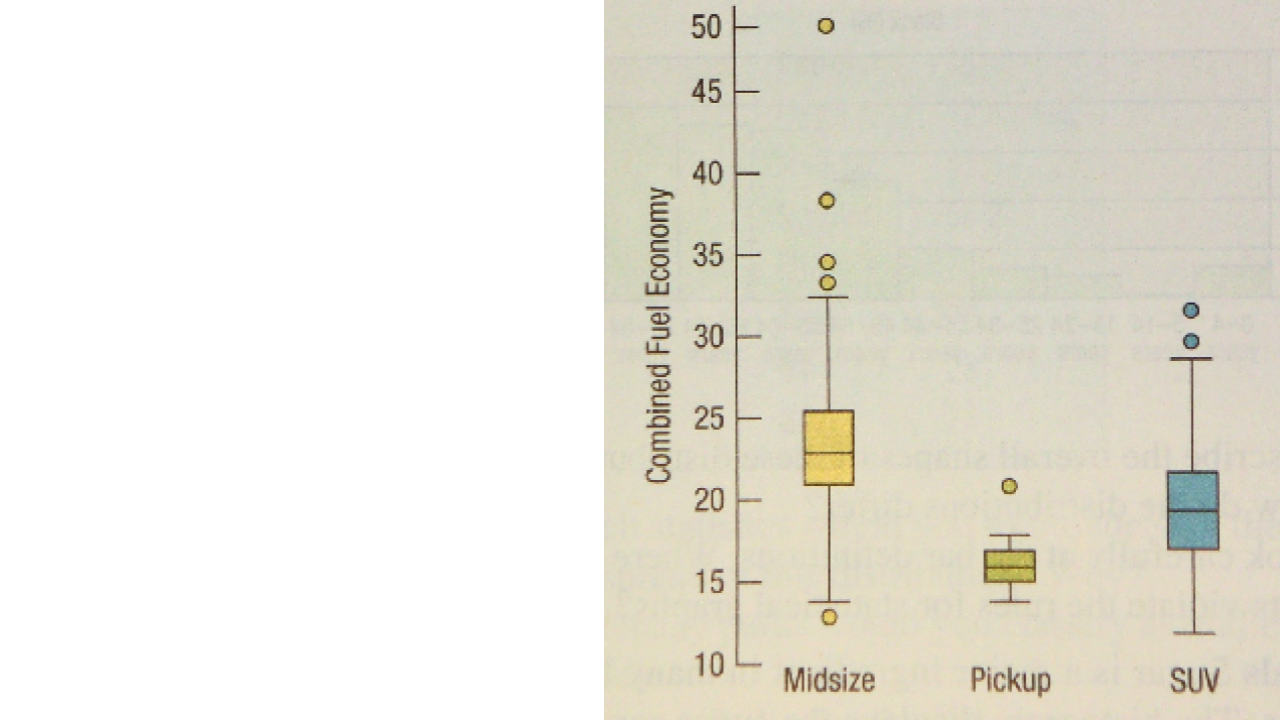
Compare the boxplots for the three classes of vehicles.
Which class has the the most variability for fuel efficiency? Why?
Make sure to explain your answer.
I will be checking answers to give full credit.
4 points
4
Question 15
15.
The EPA (Environmental Protection Agency) provides fuel economy and pollution information on over 2000 car models. Below are boxplots of combined fuel economy (using an average of driving conditions) in miles per gallon by vehicle type (midsize car, standard pickup truck or SUV) for 2012 model vehicles.
Compare the boxplots for the three classes of vehicles.
Which class has the the most consistency for fuel efficiency? Why?
Make sure to explain your answer.
I will be checking explanations to give full credit.
4 points
4
Question 16
16.
The EPA (Environmental Protection Agency) provides fuel economy and pollution information on over 2000 car models. Below are boxplots of combined fuel economy (using an average of driving conditions) in miles per gallon by vehicle type (midsize car, standard pickup truck or SUV) for 2012 model vehicles.
Compare the boxplots for the three classes of vehicles.
What percent of the SUVs have poorer fuel efficiency than 75% of the midsized cars?
Hint: use the quartiles so you answer should be 25%, 50%, 75% or 100%
4 points
4
Question 17
17.
The EPA (Environmental Protection Agency) provides fuel economy and pollution information on over 2000 car models. Below are boxplots of combined fuel economy (using an average of driving conditions) in miles per gallon by vehicle type (midsize car, standard pickup truck or SUV) for 2012 model vehicles.
Compare the boxplots for the three classes of vehicles.
What percent of the Pickups have poorer fuel efficiency than 25% of the SUVs?
4 points
4
Question 18
18.
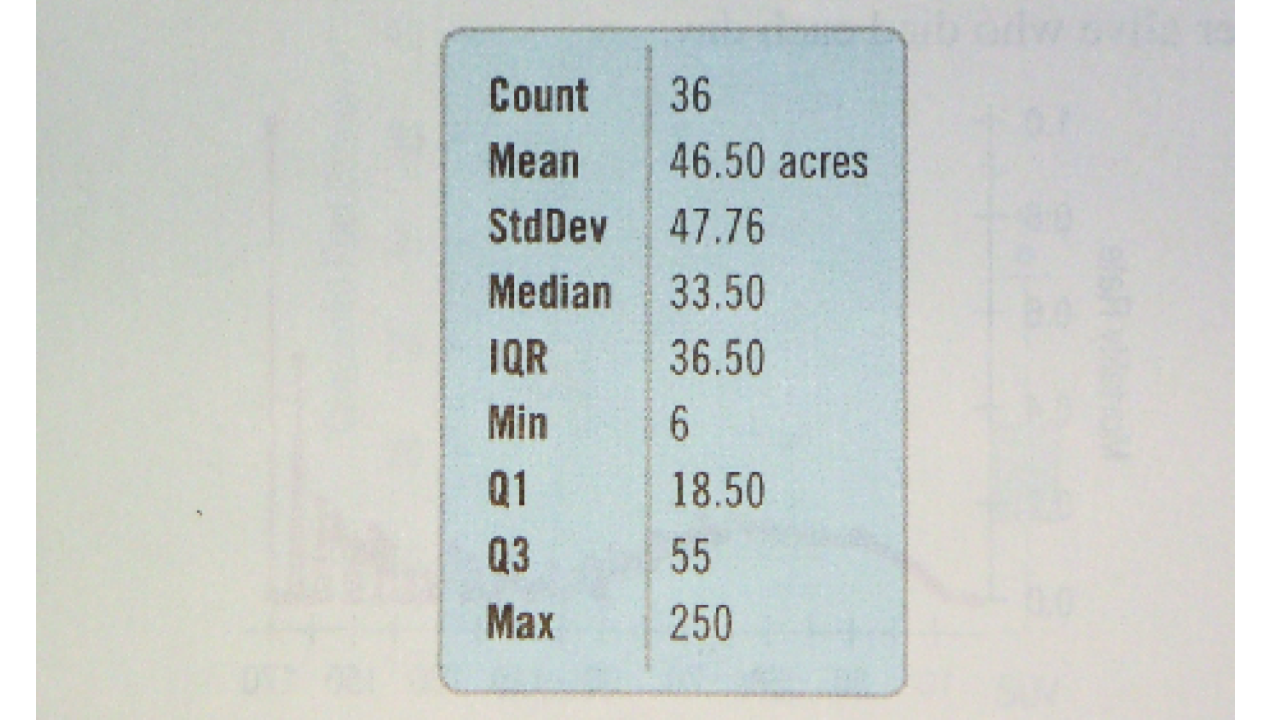
Data on American vineyards in the Finger Lakes Region was collected. Summary Statistics were calculated and are listed below:
1. Compare the mean to the median, which is larger?
2. Use this information to determine information about the shape of the histogram for the data.
Choose two correct answers below.
4 points
4
Question 19
19.
Data on American vineyards in the Finger Lakes Region was collected. Summary Statistics were calculated and are listed below:
1. Calculate the upper fence: Q3 + 1.5(IQR).
2. Calculate the lower fence: Q1 - 1.5(IQR).
3. Are there any outliers in this data set? (yes/no)
Choose three correct answers below.
4 points
4
Question 20
20.
Data from a sample of 39 male patients and 35 female patients on length of stay (in days) are displayed by the two histograms.
Compare the the two distributions.
Select the correct answers below.
4 points
4
Question 21
21.
Data from a sample of 39 male patients and 35 female patients on length of stay (in days) are displayed by the two histograms.
Compare the the two distributions.
For both histograms, which would be larger: mean or median? Or would they be equal?
Explain why.
Select two answers.
4 points
4
Question 22
22.
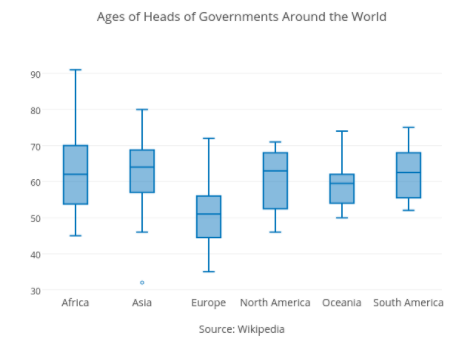
Data was collect in the 1990's about the ages of Heads of Government around the world and posted on Wikipedia. While not being a highly reliable source it does provide an interesting group of boxplots for us to compare:
Notice: Q3 and the median for Africa, Asia, North America and South America all appear to be similar.
Compare their boxplots to Q3 for Oceania.
What percent of the government leaders from Africa, Asia, North America and South America are older than 75% of the government leaders from Oceania?