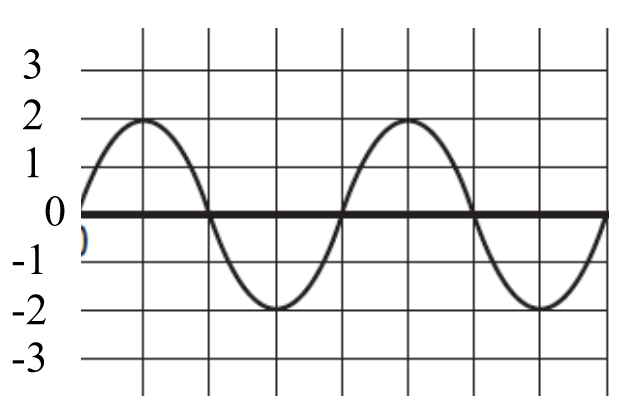
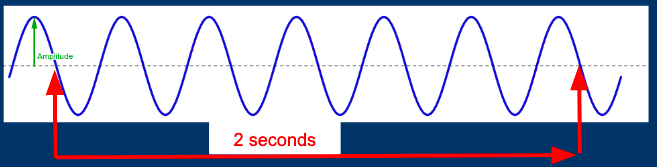
Use the diagram of a wave below to answer questions 15-17. Assume each box is equal to 1 meter.
Draw and label all parts of a transverse wave. Show below by choosing "Show Your Work" then use the tools on the left bar to draw and add text.
What kind of wave is this?
What type of wave is shown?
The number of wavelengths that pass a point each per second is:
A mechanical wave cannot travel through...
If the frquency increases, the wavelength __________?
Mrs. Liu goes swimming in the lake that is 60 m away. As she swims the wave has a frequency of 0.25 Hz. the water has a wavelength of 2.0 m and Mrs. Liu is swimming at 15m/s. What is the speed of the wave? Show your work below.
What does a wave carry?
Which is the speed of a wave equation?
A 220 Hz wave has a wavelength of 0.50 m. What is the velocity of the wave? Show your work below
Match the vocabulary term to its correct definition by dragging the definition next to the correct term.
| Draggable item | arrow_right_alt | Corresponding Item |
|---|---|---|
A disturbance that transfers energy from one location to another location | arrow_right_alt | Amplitude |
The height of a wave from the rest position (middle) | arrow_right_alt | Crest |
The highest point of the wave | arrow_right_alt | Frequency |
The lowest point of the wave (bottom) | arrow_right_alt | Trough |
The number of waves that pass a point per unit of time | arrow_right_alt | Wave |
The distance between two similar points in a wave (crest to crest) | arrow_right_alt | Wavelength |
Use the diagram of a wave below to answer questions 15-17. Assume each box is equal to 1 meter.
What is the amplitude (in m) of the wave above?
How many waves are shown in the wave diagram above?
Draw a wave with an amplitude equal to 3 meters and wavelength equal to 5 meters. You should have at least two full waves drawn. Assume each box is equal to 1 meter.
What is the frequency of this wave?
Label the diagram to indicate the difference between the hypocenter and epicenter of an earthquake.
Most earthquakes happen
Sequence the different layers of Earth by moving them to match the order presented on the illustration, from the start of the arrow down through the center.
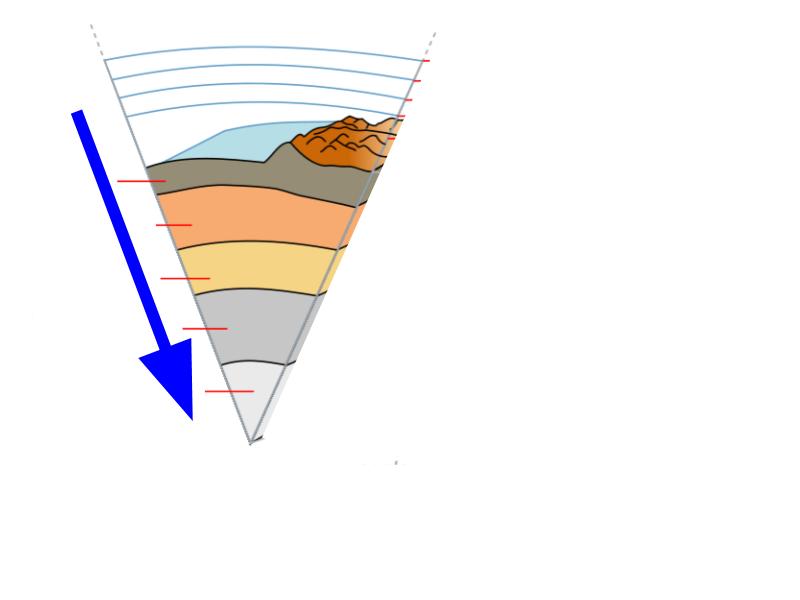
atmosphere
lithosphere
mantle
outer core
inner core
Add an arrow and the labels "lower density" and "higher density" to show which direction of density increase through the layers of Earth.
What are the two metals that mostly compose the core?
______ waves travel through the interior of the Earth. ______ waves arrive first at a seismic station and _______ waves will arrive second.
Secondary or S
Body
Primary or P
Use the drawing tools to label the P-wave, S wave, and surface waves on the seismogram.
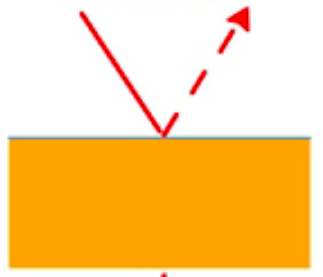
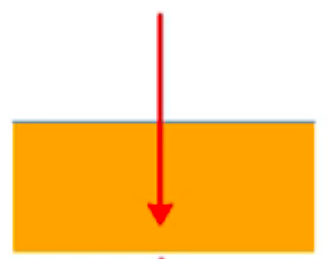
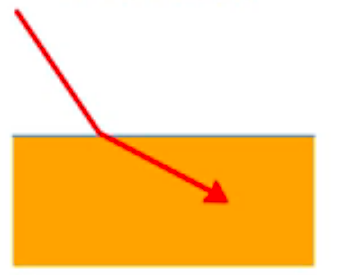
Match the wave behavior with the correct term for that behavior.
| Draggable item | arrow_right_alt | Corresponding Item |
|---|---|---|
Waves bounce off an object
| arrow_right_alt | Refraction |
Waves travel in the same direction through an object
| arrow_right_alt | Reflection |
Waves change speed and direction because c mediums have different densities
| arrow_right_alt | Transmission |
What type of EQ wave is a longitudinal wave?