9/17 Step 3 Phosphorus Cycle CFU AP
star
star
star
star
star
Last updated about 1 year ago
14 Nsɛmmisa
1
1
1

1
1
1
1
Match the terms with their definitions
| Draggable item | arrow_right_alt | Corresponding Item |
|---|---|---|
Decomposition | arrow_right_alt | The main phosphorus reservoir |
Phosphates in water | arrow_right_alt | Water moving over rocks, washing phosphorus into rivers and streams |
Marine sedimentation | arrow_right_alt | Where phosphorus mixes with oxygen to make phosphates |
Erosion | arrow_right_alt | Water containing phosphates is absorbed |
Rocks and soil | arrow_right_alt | Plants are eaten to get the phosphate they need |
Plant absorbtion | arrow_right_alt | Phosphorus is broken down in waste and returned to water or soil |
Animal consumption | arrow_right_alt | Large amounts of phosphorus is carried by waterways into the ocean where it concentrates at the bottom as rocks |
Humans can alter the phosphorus cycle in many ways, including in the cutting of tropical rain forests and through the use of agricultural fertilizers. Rainforest ecosystems are supported primarily through the recycling of nutrients, with little or no nutrient reserves in their soils. As the forest is cut and/or burned, nutrients originally stored in plants and rocks are quickly washed away by heavy rains, causing the land to become unproductive.
Phosphorus is naturally weathered out of rocks and slowly gets transported to the oceans. Mining phosphate rock can accelerate this process and also leave scars on the landscape if the mining companies don't do reclamation. Exposed phosphate rock will also weather and erode more quickly, again speeding up the delivery of phosphorous to the oceans.
Exposed and eroding phosphate rock and fertilizer run-off, can also cause a bloom of bacteria along the coastlines, leading to "dead zones," where very little, if any, life is found. Agricultural runoff provides much of the phosphate found in waterways. Crops often cannot absorb all of the fertilizer in the soils, causing excess fertilizer runoff and increasing phosphate levels in rivers and other bodies of water. At one time the use of laundry detergents contributed to significant concentrations of phosphates in rivers, lakes, and streams, but most detergents no longer include phosphorus as an ingredient.
Why does deforestation impact the phosphorus cycle?
Phosphorus normally erodes over a long period of time, leading to a small amount of phosphorus in aquatic ecosystems. Which process speeds up the delivery of phosphorus into the environment?
The black dots on the map signify dead zones around the world. Explain where they are located.
What is the cause of these dead zones?
What is the plant and animal life like in a dead zone?
What is the reason for your answer above?
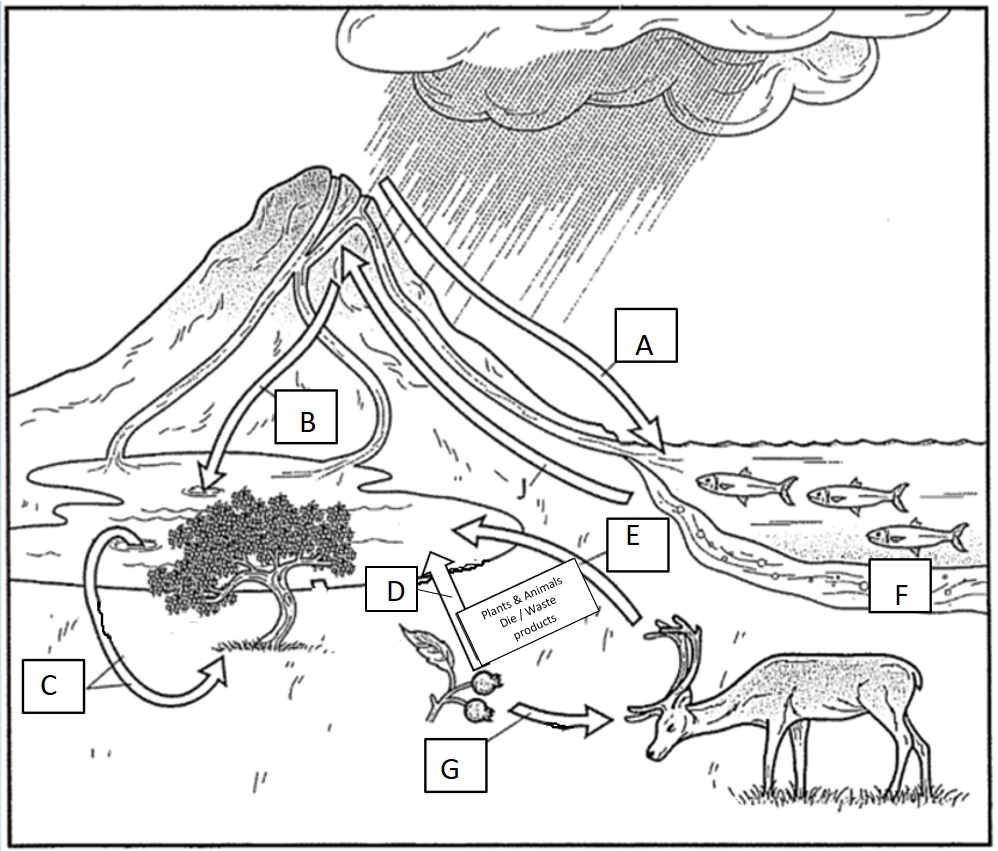
What part of the phosphorus cycle does letter A represent?
What part of the phosphorus cycle does letter B represent?
What part of the phosphorus cycle does letter C represent?
What part of the phosphorus cycle does letter D represent?
What part of the phosphorus cycle does letter E represent?
What part of the phosphorus cycle does letter F represent?
What part of the phosphorus cycle does letter G represent?