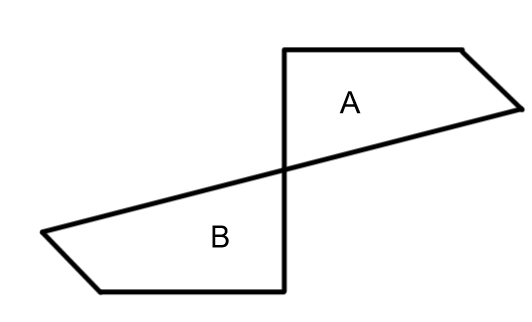
In which pair(s) of figures can Figure A be taken to Figure B by a reflection?
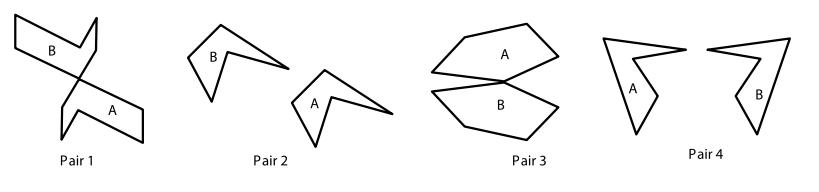
Select all that apply!
In which pair(s) of figures can Figure A be taken to Figure B by a reflection?
Select all that apply!
In which pair(s) of figures can Figure A be taken to Figure B by a reflection?
Select all that apply!
∆FGH with vertices F(1, 3), G(2, 4), and H(3, 2) is translated 3 units left and 1 unit down. The vertices of the image is F'( ‒2, 2), G'( ‒1, 3), H'(0, 1).
A rectangle has vertices A(1,1), B(1,3), C(4,3), D(4,1). Identify the vertices of the image after a reflection over the y-axis.,
What type of transformation takes figure A to figure B?
You need to move a figure to the right 3 units and down 4 units.
What is the coordiante notation for this rule?
What does the following rule describe?
(x, y) → (x-2, y+5)
If the pre-image is located at (0,4), where would the image be located if you followed the translate (x+2, y-4)?
What are the possible transformations are taking place if A is the preimage and B is the image.

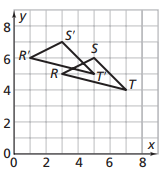
Which of the following shows the rule in coordinate notation for the transformation below?
Select the image that is congruent to C.

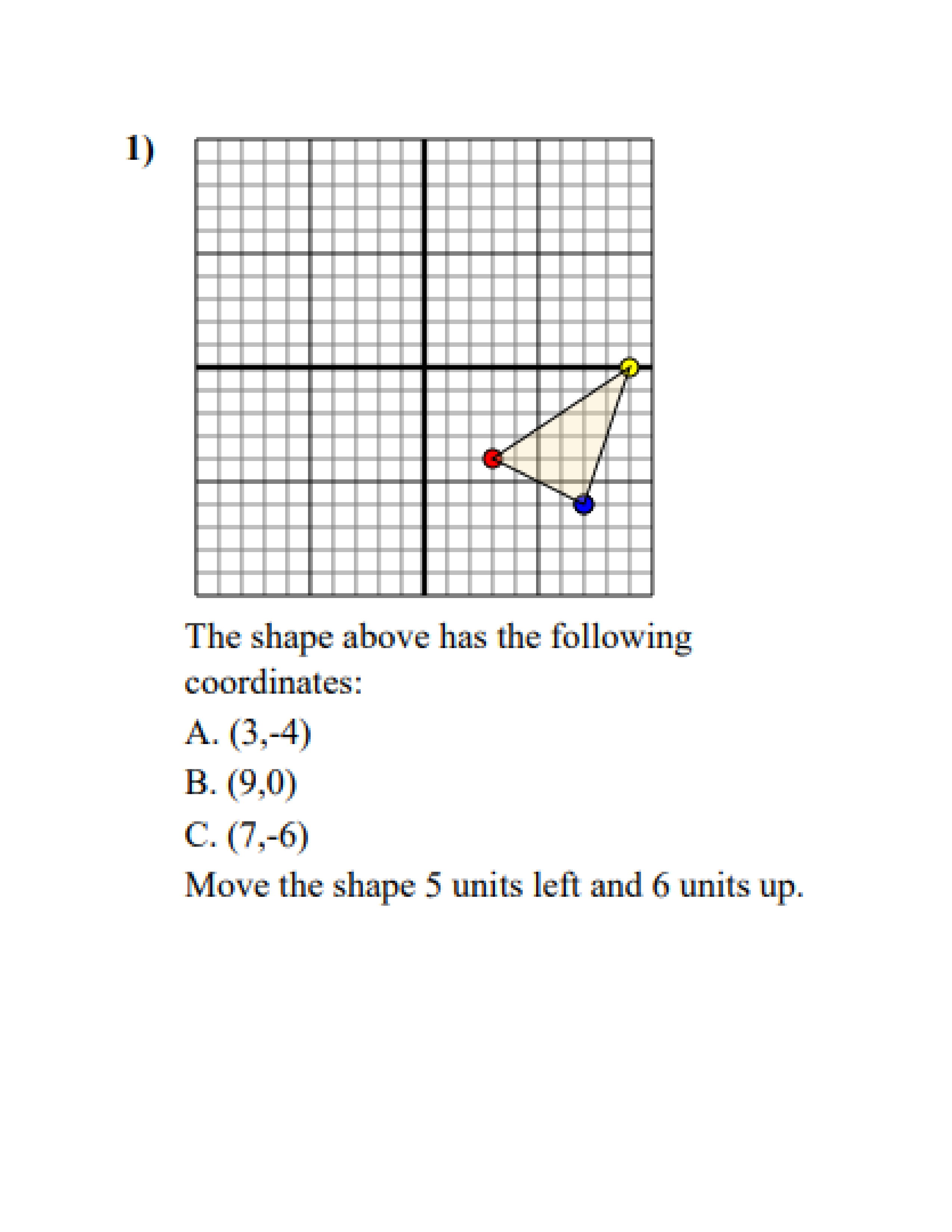
What is the coordinates for A' ?
Name the RULE for the Translation
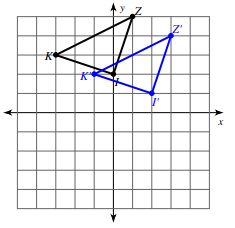
What is the coordinates for B' ?
What is the coordinates for C' ?