Benchmark Unit 1 Test

Last updated about 5 years ago
22 questions

Danger: Children at Work

  1. During the late 1800s, a great change took place in the United States. People moved from farms into cities in huge numbers. They wanted to work in factories, where they could earn steady paychecks. Whole families moved to look for jobs. But there were very few laws to protect those who found work. There weren’t even laws that kept children from working very long hours.
  2. Factory owners, in fact, preferred to hire children. They were easier to manage. They were less likely to go on strike. They worked for much lower wages than their parents. Often, their smaller hands could better handle certain machines and tools. Their smaller bodies could fit into small spaces in factories and mines.
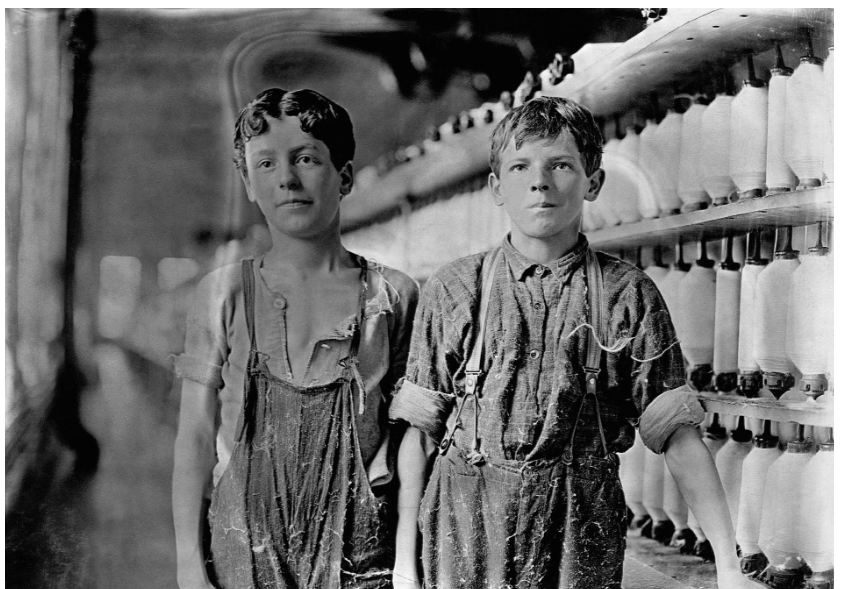
  3. By 1900, 18 percent of all American workers were under the age of sixteen. That’s more than two million children. Some children worked in mines, mills, and canneries. Others delivered messages, sold newspapers, and shined shoes. In Southern cotton mills, 25 percent of the workers were under fifteen. Half of those were below age twelve. Some of these children worked twelve hours a day in hot, enclosed places filled with soot, dust, and loud noise. Many worked six days a week to earn a dollar. They had little time for school or play and often became ill. Yes, the United States was beginning to hum with industry. But shamefully, its engines were driven in part by tiny hands.
  4. Things began to change in the early 1900s. By then, adult workers all over the country were demanding better treatment. States such as Massachusetts and New York had already passed laws limiting children’s workdays to ten hours. The laws also barred children from certain jobs. But change came slowly. It wasn’t until 1904 that the National Child Labor Committee formed, led by reformers including Jane Addams, Florence Kelley, and Lillian Wald. In 1924 and 1937, Congress passed federal laws to regulate child labor. But the states would not ratify them. The states held on to their own laws, which varied a lot from state to state.
  5. Finally, in 1938, the Fair Labor Standards Act was passed. This new law set minimum ages of sixteen for work during school hours, fourteen for certain jobs after school, and eighteen for dangerous work. It also limited the number of hours that children could work in a week.
  6. It’s hard to believe that young children were once lowered into coal mines to work twelve-hour days. And there was nothing anyone could do to stop it. There are still parts of the country where children work hard (on farms, for example). But our current laws help keep children in school and protect them from hard labor.
This question has two parts. First, answer Part A. Then answer Part B.
1

Part A
Which sentence states a main idea in the passage?

1

Part B
Which sentence from the passage supports the central idea in Part A?

1

In paragraph 4, what is the meaning of the word regulate?

1

Which sentence from the passage would best fit as a caption for the photograph?

1

Which phrase from paragraph 3 shows the author’s attitude toward U.S. child labor practices in the 1800s? Underline the phrase you choose.

2

Based on the passage, choose two reasons factory owners preferred to hire children.

5

Read the events listed below. Put the events in chronological order

  1. Millions of Americans moved from farms to the cities.
  2. The Fair Labor Standards Act set limits on age and hours.
  3. Massachusetts and New York passed laws to limit children’s workdays.
  4. Children worked in mines, mills, and canneries.
  5. Factory owners hired huge numbers of children.
On July 22, 1905, Florence Kelley gave a speech. Read this passage adapted from her speech. Then answer the questions.

A Speech by Florence Kelley

1. We have, in this country, two million children under the age of sixteen years
who are earning their bread. They vary in age. They are six and seven years
in the cotton mills of Georgia. They are eight, nine, and ten years in the coal
mines of Pennsylvania. They are fourteen, fifteen, and sixteen years in more
enlightened states. . . .

2. Tonight while we sleep, several thousand little girls will be working in textile
mills, all the night through. They will work in the deafening noise of the spindles
and the looms. They will spin and weave cotton and wool, silks, and ribbons for
us to buy. . . .

3. In Georgia there is no restriction whatever! A girl of six or seven years, just
tall enough to reach the bobbins, may work eleven hours by day or by night.
And they will do so tonight, while we sleep.

4. Nor is it only in the South that these things occur. Alabama does better than
New Jersey. For Alabama limits the children’s work at night to eight hours. New
Jersey permits it all night long.

5. Last year New Jersey took a long backward step. A good law was repealed.
It had required women and children to stop work at six in the evening and at
noon on Friday. But now, in New Jersey, boys and girls after their fourteenth
birthday enjoy the pitiful privilege of working all night long.

6. In Pennsylvania, until last May it was lawful for children thirteen years of age
to work twelve hours at night. . . .

7. The children make our shoes in the shoe factories. They knit our stockings,
our knitted underwear in the knitting factories. They spin and weave our cotton
underwear in the cotton mills. Children braid straw for our hats. They spin and
weave the silk and velvet we trim our hats with. They stamp buckles and metal
ornaments of all kinds, as well as pins and hat pins. . . .

8. We do not wish this. We prefer to have our work done by men and women.
But we are almost powerless. Not wholly powerless, however, are citizens who
enjoy the right of petition. For myself, I shall use this power in every possible
way until the right to the ballot is granted. And then I shall continue to
use both.

9. What can we do to free our consciences? There is one line of action by which
we can do much. We can enlist the workingmen on behalf of our cause just as
we strive with them to free the children. No labor organization in this country
ever fails to respond to an appeal for help in the freeing of the children.

10. For the sake of the children . . . we should enlist the workingmen voters,
with us, in this task of freeing the children from toil!
__________
1. Women did not have the right to vote until 1920.
1

What is the meaning of the word repealed in paragraph 5?

This question has two parts. First, answer Part A. Then answer Part B.
1

Part A
How is this passage different from “Danger: Children at Work”?

1

Part B
Which sentence from the passage supports the answer to Part A?

1

Why does the writer include the footnote referring to paragraph 8?

1

In paragraph 4, the ur in occur is pronounced the same as the —

1

In paragraph 9, the ea in appeal is pronounced like the e in —

This question has two parts. First, answer Part A. Then answer Part B.
1

Part A
What is the main idea of Florence Kelley’s speech?

2

Part B
Reread the paragraphs below. Choose two sentences from these paragraphs that support the main idea in
Part A.

2

Based on these two passages, describe the kinds of jobs children did in the early 1900s in U.S. cities. Use details from both passages to support your ideas.

Read this paragraph. It contains some mistakes in grammar. Then answer the questions about revising and editing the paragraph.

1

What is the best way to write sentence 2?

1

Which part of sentence 4 contains an error and needs to be revised?

1

What is the best way to revise sentence 5?

1

What is the best way to write sentence 7?

1

Which part of sentence 8 contains an error and needs to be revised?

1

Based on “Danger: Children at Work” and “A Speech by Florence Kelley,” what were working conditions like for children in the late 1800s and early 1900s in the United States? Write an informative/explanatory response describing the working conditions for children and the efforts made to protect children from unsafe, unhealthy labor. Use details from both passages to support your ideas. Be sure to use complete sentences and follow the conventions of standard English.