09.14.20 (Async) - Coulomb's Law, Part 1

Last updated about 5 years ago
12 questions

Coulomb's Law, Part 1


You recently learned about the subatomic particles that make up atoms. While protons and neutrons are located in the nucleus of an atom, electrons are located outside of the nucleus.

This begs the questions you will answer in this simulation: What keeps the electrons in an atom? What prevents the electrons from leaving atoms?

Objectives: Students will...
  • state Coulomb’s law.
  • describe factors that influence the force of attraction or repulsion between two objects that are charged.
Check out the 'Coulomb's Law' Simulation. (click on that link!)

(Note: you may have to change settings on your computer to allow Flash to run)
1

Explore the simulation. Write down three observations.

1

Categorize the following charge pairs as having an attraction or repulsion between particles.

  • + and -
  • + and +
  • - and -
  • attraction
  • repulsion
1

What do Angstroms (Ã…) measure in the simulation?

1

What to Newtons (N) measure in the simulation?

1

Place the following numbers in order from largest to smallest.
(You do not need the simulation to answer this question. It may seem random, but thinking through this will help you later in this assignment!)

  1. 1.1 x 10⁻⁸
  2. 6.4 x 10⁻¹⁰
  3. 3.8 x 10⁻⁹
  4. 9.6 x 10⁻¹⁰
  5. 3.5 x 10⁻⁸
1

You will now use the simulation to investigate the role of the amount of charge and the distance between oppositely charged particles.

First, reset the simulation.

Next, investigate the impact of charge on the attractive force between particles. Record your data in the tables below.
(Remember - if we are looking at attractive forces, should the charges of the ions be the same or opposite?)

1

Which of the following best describes the impact of charge on the attractive force between particles?

1

Does changing the charge on the stationary ion have the same impact on attractive force as changing the charge on the mobile ion? Justify your answer with evidence from the simulation.

1

You will now use the simulation to investigate the impact of distance on the attractive force between particles.

First, reset the simulation.

Then, complete the table below. Start with your distance as very large and make the distance smaller with each data recording (i.e., don't have the distances in random order on your data table.)

Finally, draw the graph that appears with your data collection.

1

Which of the following best describes the impact of distance on the attractive force between particles?

1

Which factor seems to have the greatest impact on the attractive force between two charged particles:

distance between particles OR difference in charge between particles?

Justify your answer with evidence from the simulation.

1

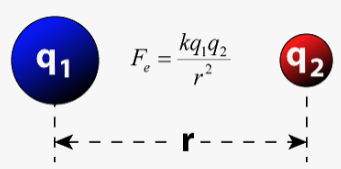
Observe the picture below:


In the equation above:
  • F = Force of attraction
  • q1, q2 = charges
  • r = distance between particles
  • k = Coulomb's constant
Does your answer to #11 match the formula above? Explain your answer using the parts of the equation.