Day 4 5# Summary Daily Grade cloned 9/15/2020
star
star
star
star
star
Last updated over 4 years ago
18 questions
4
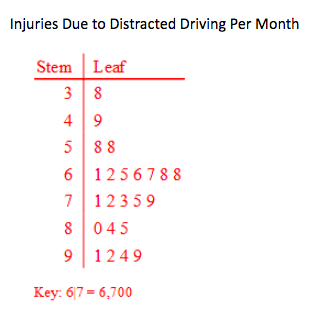
Below is a stem plot of injuries due to distracted driving per month for different cities in the U.S.
Describe the data distribution, make sure you CUSS & BS about it!Chose 4 answers.
Below is a stem plot of injuries due to distracted driving per month for different cities in the U.S.
Describe the data distribution, make sure you CUSS & BS about it!
Chose 4 answers.
4
Below is a stem plot of injuries due to distracted driving per month for different cities in the U.S.
How many cities were studied?
Below is a stem plot of injuries due to distracted driving per month for different cities in the U.S.
How many cities were studied?
4
Below is a stem plot of injuries due to distracted driving per month for different cities in the U.S.
What is the median value for # injuries due to distracted driving per month? (just give the two digit number)
Below is a stem plot of injuries due to distracted driving per month for different cities in the U.S.
What is the median value for # injuries due to distracted driving per month? (just give the two digit number)
4
Below is a stem plot of injuries due to distracted driving per month for different cities in the U.S.
1. Enter the data into List 1 of your TI-84 Calculator (or app on the Chromebook). Use 'Stat' 'Edit'
2. Calculate the 5# summary for the data using 'Stat' 'Calc' '1-VarStats', make sure the correct list is being used & frequency is blank.
3. Give the min, Q1, median, Q3 and max values.
Use the format: Min:space 23 space Q1: space 25 space Med: space 27 space Q3: space 29 space Max: space 31I will be checking and giving points if the Go-Formative counts it incorrect. Just use the two digit numbers (leave out the 'thousand injuries due to distracted driving')
Below is a stem plot of injuries due to distracted driving per month for different cities in the U.S.
1. Enter the data into List 1 of your TI-84 Calculator (or app on the Chromebook). Use 'Stat' 'Edit'
2. Calculate the 5# summary for the data using 'Stat' 'Calc' '1-VarStats', make sure the correct list is being used & frequency is blank.
3. Give the min, Q1, median, Q3 and max values.
Use the format: Min:space 23 space Q1: space 25 space Med: space 27 space Q3: space 29 space Max: space 31
I will be checking and giving points if the Go-Formative counts it incorrect.
Just use the two digit numbers (leave out the 'thousand injuries due to distracted driving')
4
Below is a stem plot of injuries due to distracted driving per month for different cities in the U.S.
Using the 5# summary from #3, 50% of the cities had less than how many injuries?
Below is a stem plot of injuries due to distracted driving per month for different cities in the U.S.
Using the 5# summary from #3, 50% of the cities had less than how many injuries?
4
Below is a stem plot of injuries due to distracted driving per month for different cities in the U.S.
Using the 5# summary from #3, 75% of the cities had less than how many injuries?
Below is a stem plot of injuries due to distracted driving per month for different cities in the U.S.
Using the 5# summary from #3, 75% of the cities had less than how many injuries?
4
Below is a stem plot of injuries due to distracted driving per month for different cities in the U.S.
Using the 5# summary from #3, 75% of the cities had more than how many injuries?
Below is a stem plot of injuries due to distracted driving per month for different cities in the U.S.
Using the 5# summary from #3, 75% of the cities had more than how many injuries?
4
Below is a stem plot of injuries due to distracted driving per month for different cities in the U.S.
Using the 5# summary from #3, what % of the cities had between 62,000 and 84,000 injuries?
Below is a stem plot of injuries due to distracted driving per month for different cities in the U.S.
Using the 5# summary from #3, what % of the cities had between 62,000 and 84,000 injuries?
4
Below is a stem plot of injuries due to distracted driving per month for different cities in the U.S.
Using the 5# summary from #3, what % of the cities had between 62,000 and 99,000 injuries?
Below is a stem plot of injuries due to distracted driving per month for different cities in the U.S.
Using the 5# summary from #3, what % of the cities had between 62,000 and 99,000 injuries?
4
Below is a stem plot of injuries due to distracted driving per month for different cities in the U.S.
Using the 5# summary from #3, what is the IQR for the distracted driving injuries?(Hint: IQR= Q3 - Q1)
Below is a stem plot of injuries due to distracted driving per month for different cities in the U.S.
Using the 5# summary from #3, what is the IQR for the distracted driving injuries?
(Hint: IQR= Q3 - Q1)
4
Use the data below on some US President’s ages at inauguration.
How many US presidents are part of this group?
Use the data below on some US President’s ages at inauguration.
How many US presidents are part of this group?
4
Use the data below on some US President’s ages at inauguration.
1. Using your TI-84 Calculator, clear list 1 (cursor over L1, clear, enter)
2. Enter the data into List 1 of your TI-84 Calculator (or app on the Chromebook). Use 'Stat' 'Edit' make sure you have 22 entries.
3. Calculate the 5# summary for the data using 'Stat' 'Calc' '1-VarStats', make sure the correct list is being used & frequency is blank.
4. Give the min, Q1, median, Q3 and max values.
Use the format: Min:space 23 space Q1: space 25 space Med: space 27 space Q3: space 29 space Max: space 31I will be checking and giving points if the Go-Formative counts it incorrect.Use decimals if needed, no units
Use the data below on some US President’s ages at inauguration.
1. Using your TI-84 Calculator, clear list 1 (cursor over L1, clear, enter)
2. Enter the data into List 1 of your TI-84 Calculator (or app on the Chromebook).
Use 'Stat' 'Edit' make sure you have 22 entries.
3. Calculate the 5# summary for the data using 'Stat' 'Calc' '1-VarStats', make sure the correct list is being used & frequency is blank.
4. Give the min, Q1, median, Q3 and max values.
Use the format: Min:space 23 space Q1: space 25 space Med: space 27 space Q3: space 29 space Max: space 31
I will be checking and giving points if the Go-Formative counts it incorrect.
Use decimals if needed, no units
4
Use the data below on some US President’s ages at inauguration.
What is the IQR for this data distribution? (Hint: IQR= Q3 - Q1)
Use the data below on some US President’s ages at inauguration.
What is the IQR for this data distribution? (Hint: IQR= Q3 - Q1)
4
Use the data below on some US President’s ages at inauguration.
What does the IQR mean for this data? Remember to BS about it! (select 2 correct answers)
Use the data below on some US President’s ages at inauguration.
What does the IQR mean for this data? Remember to BS about it! (select 2 correct answers)
4
Use the data below on some US President’s ages at inauguration.
Using the 5# summary calculated for Question #12, 25% of the presidents were younger than this age at inauguration.
Use the data below on some US President’s ages at inauguration.
Using the 5# summary calculated for Question #12, 25% of the presidents were younger than this age at inauguration.
4
Use the data below on some US President’s ages at inauguration.
Using the 5# summary calculated for Question #12, 25% of the presidents were older than this age at inauguration.
Use the data below on some US President’s ages at inauguration.
Using the 5# summary calculated for Question #12, 25% of the presidents were older than this age at inauguration.
4
Use the data below on some US President’s ages at inauguration.
Describe the data distribution, CUSS & BS about it!Select all that apply (4 correct answers)
Use the data below on some US President’s ages at inauguration.
Describe the data distribution, CUSS & BS about it!
Select all that apply (4 correct answers)
4
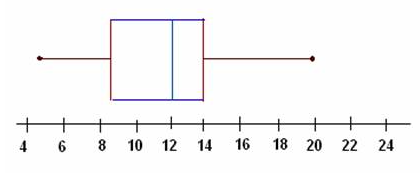
The boxplot below represents data collected on the number of pounds a group of puppies gained in their first year.
What can you tell from this boxplot?Select all that apply, there are 6 correct answers
The boxplot below represents data collected on the number of pounds a group of puppies gained in their first year.
What can you tell from this boxplot?
Select all that apply, there are 6 correct answers