Students review concepts of similarity including dilations.
1 point
1
Question 1
1.
Fill in the blank:
Similar figures have _______________ that are congruent.
1 point
1
Question 2
2.
Fill in the blank:
Similar figures have sides that are _____________________.
1 point
1
Question 3
3.
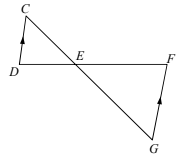
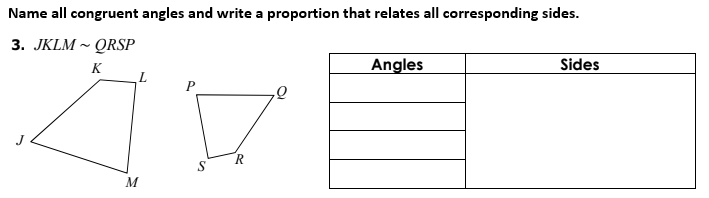
Enter a pair of congruent angles.
1 point
1
Question 4
4.
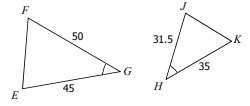
Enter a pair of congruent angles.
1 point
1
Question 5
5.
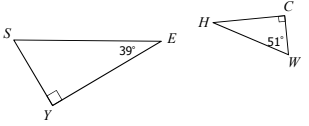
Enter a pair of congruent angles.
1 point
1
Question 6
6.
Enter a pair of congruent angles.
1 point
1
Question 7
7.
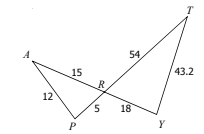
Enter your proportion of corresponding sides.
1 point
1
Question 8
8.
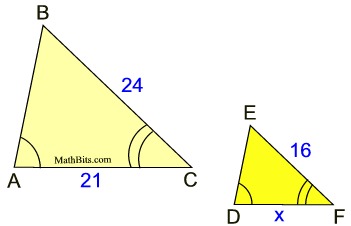
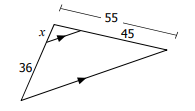
Given that the triangles are similar by AA~, solve for the missing side.
For questions 9 - 22, show all work on each problem (angle markings, fractions, etc.) used to determine if the triangles are similar. Then, select which triangle criteria (AA, SSS, or SAS) you can use to prove they are similar, if they are.
1 point
1
Question 9
9.
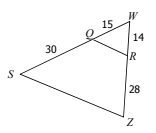
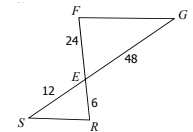
Which criteria, if any, can be used to prove these triangles are similar?
1 point
1
Question 10
10.
Explain your reasoning.
1 point
1
Question 11
11.
Which criteria, if any, can be used to prove these triangles are similar?
1 point
1
Question 12
12.
Explain your reasoning.
1 point
1
Question 13
13.
Which criteria, if any, can be used to prove these triangles are similar?
1 point
1
Question 14
14.
Explain your reasoning.
1 point
1
Question 15
15.
Which criteria, if any, can be used to prove these triangles are similar?
1 point
1
Question 16
16.
Explain your reasoning.
1 point
1
Question 17
17.
Which criteria, if any, can be used to prove these triangles are similar?
1 point
1
Question 18
18.
Explain your reasoning.
1 point
1
Question 19
19.
Which criteria, if any, can be used to prove these triangles are similar?
1 point
1
Question 20
20.
Explain your reasoning.
1 point
1
Question 21
21.
Which criteria, if any, can be used to prove these triangles are similar?
1 point
1
Question 22
22.
Explain your reasoning.
1 point
1
Question 23
23.
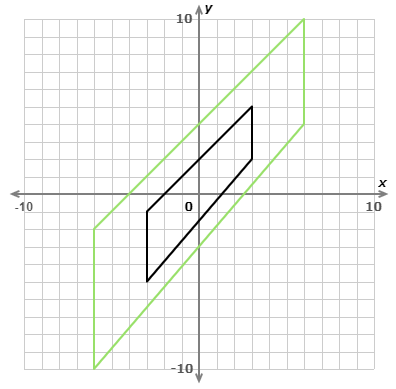
What is the scale factor from the black shape to the green shape?
1 point
1
Question 24
24.
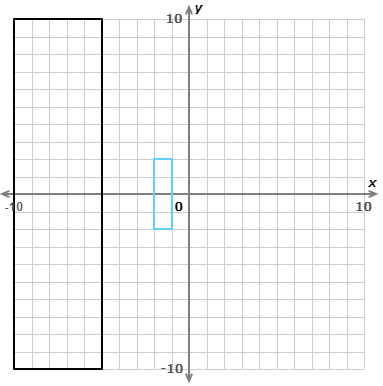
What is the scale factor from the black shape to the blue shape
1 point
1
Question 25
25.
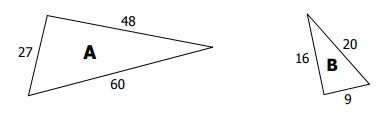
What is the scale factor from A to B?
1 point
1
Question 26
26.
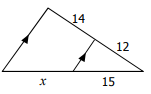
Solve for x.
1 point
1
Question 27
27.
Solve for x.
1 point
1
Question 28
28.
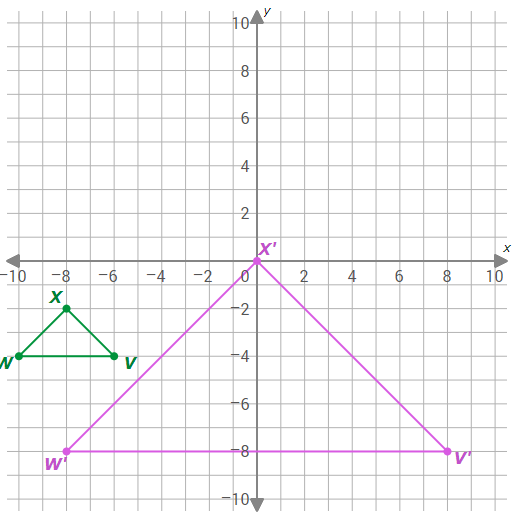
Describe a sequence of transformations that will map VWX onto V'W'X'. (Hint: use a translation to align a vertex onto it's image and then dilate from that point)
1 point
1
Question 29
29.
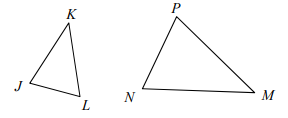
In the triangles shown below, JKL was dilated by a scale factor of 3/2 to form NMP. If <K = 52 degrees and <J = 60 degrees, find the measure of <P.
1 point
1
Question 30
30.
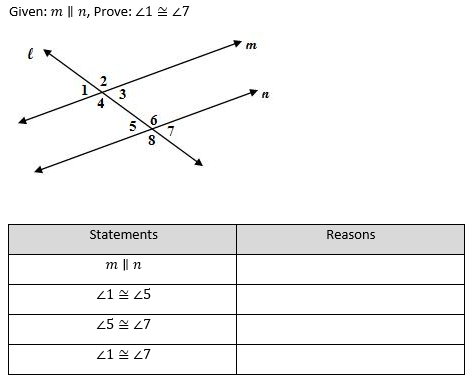
Place the Reasons in the correct order to complete the given proof.
Substitution
Corresponding Angles Postulate
Given
Vertical Angles Theorem
1 point
1
Question 31
31.
What theorem did you prove in #30?
1 point
1
Question 32
32.
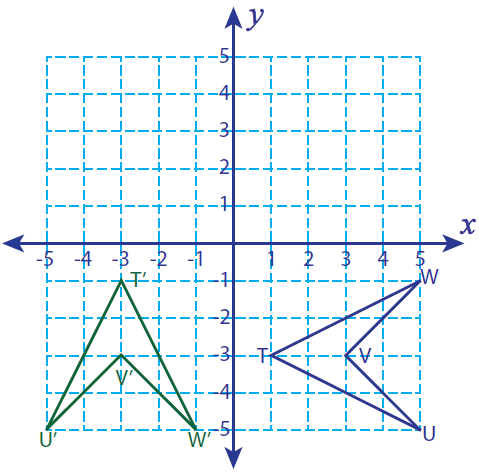
Quadrilateral TUVW was rotated 90 degrees clockwise to obtain Quadrilateral T'U'V'W'. Which statement is true about the pre-image and image?
1 point
1
Question 33
33.
The Gateway Arch in Missouri casts a 140 foot shadow while an 18 foot pole casts a 4 foot shadow. How tall is the arch?
1 point
1
Question 34
34.
Triangle ABC is dilated from point B to form A'B'C'. Describe which lines will be collinear, which lines will be parallel, and how you know.
1 point
1
Question 35
35.
Draw a dilation of rectangle ABDC with a scale factor of 1/2 and a center at point D.