Ch 3 Day 5 Boxplot Dailygrade
star
star
star
star
star
Last updated over 4 years ago
15 questions
4
An outlier is a data value that differs greatly from other values in a data set.Give the formula for calculating the lower fence?
An outlier is a data value that differs greatly from other values in a data set.
Give the formula for calculating the lower fence?
4
An outlier is a data value that differs greatly from other values in a data set.Give the formula for calculating the upper fence?
An outlier is a data value that differs greatly from other values in a data set.
Give the formula for calculating the upper fence?
4
The following are the amounts, in dollars, that 15 items sold for at a silent auction as part of a school fundraiser.
15, 24, 89, 76, 45, 32, 55, 140, 72, 21, 52, 68, 81, 33, 40
Use your Ti-84 calculator to find the 5# summary from the data above.What is the lower fence for determining if outliers are present?
The following are the amounts, in dollars, that 15 items sold for at a silent auction as part of a school fundraiser.
15, 24, 89, 76, 45, 32, 55, 140, 72, 21, 52, 68, 81, 33, 40
Use your Ti-84 calculator to find the 5# summary from the data above.
What is the lower fence for determining if outliers are present?
4
The following are the amounts, in dollars, that 15 items sold for at a silent auction as part of a school fundraiser.
15, 24, 89, 76, 45, 32, 55, 140, 72, 21, 52, 68, 81, 33, 40
Use your Ti-84 calculator to find the 5# summary from the data above. This is the same data as #3.What is the upper fence for determining if outliers are present?
The following are the amounts, in dollars, that 15 items sold for at a silent auction as part of a school fundraiser.
15, 24, 89, 76, 45, 32, 55, 140, 72, 21, 52, 68, 81, 33, 40
Use your Ti-84 calculator to find the 5# summary from the data above. This is the same data as #3.
What is the upper fence for determining if outliers are present?
4
The following are the amounts, in dollars, that 15 items sold for at a silent auction as part of a school fundraiser.
15, 24, 89, 76, 45, 32, 55, 140, 72, 21, 52, 68, 81, 33, 40
Use your Ti-84 calculator to find the 5# summary from the data above. This is the same data as #3.Are there any outliers present?
The following are the amounts, in dollars, that 15 items sold for at a silent auction as part of a school fundraiser.
15, 24, 89, 76, 45, 32, 55, 140, 72, 21, 52, 68, 81, 33, 40
Use your Ti-84 calculator to find the 5# summary from the data above. This is the same data as #3.
Are there any outliers present?
4
The following are the times, in seconds, that 15 people spent taking an online survey.
125, 91, 261, 25, 155, 105, 195, 132, 110, 143, 121, 99, 167, 165, 160
Use your Ti-84 calculator to find the 5# summary from the data above. This is a new set of data (different from #3).
Calculate the lower fence for determining if outliers are present in the data set.
The following are the times, in seconds, that 15 people spent taking an online survey.
125, 91, 261, 25, 155, 105, 195, 132, 110, 143, 121, 99, 167, 165, 160
Use your Ti-84 calculator to find the 5# summary from the data above.
This is a new set of data (different from #3).
Calculate the lower fence for determining if outliers are present in the data set.
4
The following are the times, in seconds, that 15 people spent taking an online survey.
125, 91, 261, 25, 155, 105, 195, 132, 110, 143, 121, 99, 167, 165, 160
Use your Ti-84 calculator to find the 5# summary from the data above. This is the same set of data as #6.
Calculate the upper fence for determining if outliers are present in the data set.
The following are the times, in seconds, that 15 people spent taking an online survey.
125, 91, 261, 25, 155, 105, 195, 132, 110, 143, 121, 99, 167, 165, 160
Use your Ti-84 calculator to find the 5# summary from the data above.
This is the same set of data as #6.
Calculate the upper fence for determining if outliers are present in the data set.
4
The following are the times, in seconds, that 15 people spent taking an online survey.
125, 91, 261, 25, 155, 105, 195, 132, 110, 143, 121, 99, 167, 165, 160
Using the 5# summary from the data above and your calculations for #6 & 7, are there anyoutliers present in this data set?
The following are the times, in seconds, that 15 people spent taking an online survey.
125, 91, 261, 25, 155, 105, 195, 132, 110, 143, 121, 99, 167, 165, 160
Using the 5# summary from the data above and your calculations for #6 & 7, are there anyoutliers present in this data set?
4
The following are the times, in seconds, that 15 people spent taking an online survey.
125, 91, 261, 25, 155, 105, 195, 132, 110, 143, 121, 99, 167, 165, 160
Using the 5# summary from the data above and your calculations for #6 & 7, are there anyoutliers present in this data set? If so, which one? If there is an outlier enter it below or write 'none'
The following are the times, in seconds, that 15 people spent taking an online survey.
125, 91, 261, 25, 155, 105, 195, 132, 110, 143, 121, 99, 167, 165, 160
Using the 5# summary from the data above and your calculations for #6 & 7, are there anyoutliers present in this data set? If so, which one? If there is an outlier enter it below or write 'none'
4
The following are the temperatures, in degrees Fahrenheit, of 20 US cities on April 3rd. The boxplot has been created to represent the data.
42, 47, 48, 50, 50, 50, 51, 51, 52, 52, 54, 55, 55, 55, 56, 57, 58, 59, 59, 60
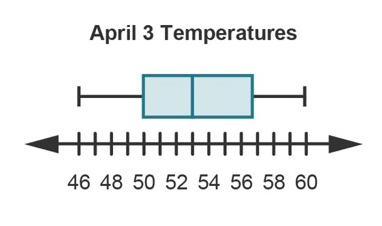
Look carefully, is this boxplot correct? First check the min and max, then the median. If needed, calculate the 5# summary in your caculator.
The following are the temperatures, in degrees Fahrenheit, of 20 US cities on April 3rd. The boxplot has been created to represent the data.
42, 47, 48, 50, 50, 50, 51, 51, 52, 52, 54, 55, 55, 55, 56, 57, 58, 59, 59, 60
Look carefully, is this boxplot correct?
First check the min and max, then the median.
If needed, calculate the 5# summary in your caculator.
4
The following are the temperatures, in degrees Fahrenheit, of 20 US cities on April 3rd. The boxplot has been created to represent the data.
46, 47, 48, 50, 50, 50, 51, 51, 52, 52, 54, 55, 55, 55, 56, 57, 58, 59, 59, 60
Based on the appearance of the boxplot, choose the best description.Look carefully.Remember: skew means that the data is more spread out on that side in relation to the center of the data.
The following are the temperatures, in degrees Fahrenheit, of 20 US cities on April 3rd. The boxplot has been created to represent the data.
46, 47, 48, 50, 50, 50, 51, 51, 52, 52, 54, 55, 55, 55, 56, 57, 58, 59, 59, 60
Based on the appearance of the boxplot, choose the best description.
Look carefully.
Remember: skew means that the data is more spread out on that side in relation to the center of the data.
4
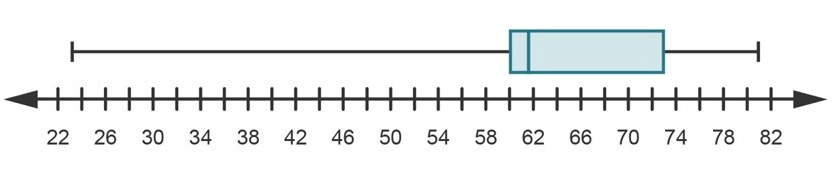
Use the boxplot below to describe the distribution:
50% of the data values are above this number, what is it called?Enter both answers separated by a comma. Enter the number first.
Use the boxplot below to describe the distribution:
50% of the data values are above this number, what is it called?
Enter both answers separated by a comma.
Enter the number first.
4
Use the boxplot below to describe the distribution:
75% of the data values are below this number, what is it called?Enter both answers separated by a comma. Enter the number first.
Use the boxplot below to describe the distribution:
75% of the data values are below this number, what is it called?
Enter both answers separated by a comma.
Enter the number first.
4
Use the boxplot below to describe the distribution:
What percent of the data values are below 60? What is this called?Enter both answers separated by a comma. Enter the number first.
Use the boxplot below to describe the distribution:
What percent of the data values are below 60? What is this called?
Enter both answers separated by a comma.
Enter the number first.
4
Use the boxplot below:
Calculate the IQR as one number, what does this value show us? (no units necessary,none given) Select 2 correct answers.
Use the boxplot below:
Calculate the IQR as one number, what does this value show us?
(no units necessary,none given)
Select 2 correct answers.