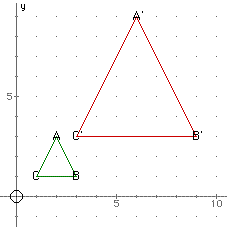
Triangles ABC and A'B'C' are shown below. Which of the following transformations takes triangle ABC onto triangle A'B'C'?

Triangles ABC and A'B'C' are shown below. Which of the following transformations takes triangle ABC onto triangle A'B'C'?
Used for geometry. Students answer review questions about different transformations.
Triangles ABC and A'B'C' are shown below. Which of the following transformations takes triangle ABC onto triangle A'B'C'?
A triangle with coordinates A (1, 1) , B (4, 2) , C (3, 5) is translated three units down and five units to the left.
What are the coordinates of the new triangle?
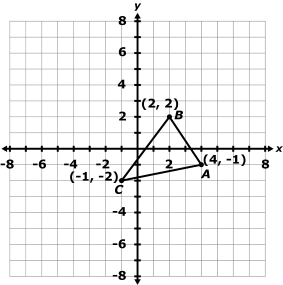
Triangle ABC is reflected over the line y = 1 to produce triangle A'B'C'. What will be the coordinates of A'?
Triangle ABC is translated to triangle A'B'C' by the following motion rule.
(x, y) → (x + 2, y − 5)
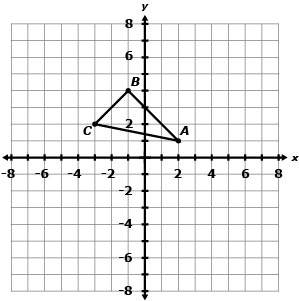
What will be the coordinates of C'?
The vertices of ∆ ABC are A (− 4, 2) , B (6, 6) , C (2, 7). A translation maps point A to the point A′ (4, 0) . If B and C are mapped by the same translation, what are the coordinates of B' and C'?
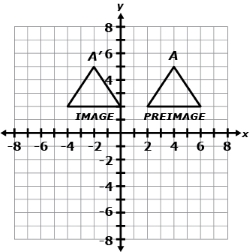
In this diagram where is the line of reflection?
A regular nonagon has 9 sides. What is the smallest angle of rotation about its center that carries a nonagon onto itself?
Patrick rotated an octagon about its center. What degree measure could he have rotated the octagon so that it mapped onto itself?
Look at AB on the coordinate plane. State the coordinates of B' after a 90 degree counterclockwise rotation about the origin.

After examining the following graph, Kate claims that WXYZ is translated according to the rule:
(x, y) → (x + 11, y − 2).

Is she correct?
A transformation that preserves length and angle measure is:
A dilation is a rigid motion.
The ______________ is the resulting figure after a transformation.
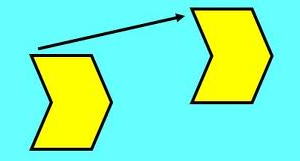
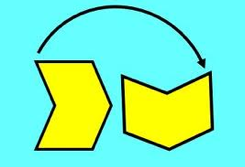
Match the transformation with its picture. (Click the word, then click the picture to match them up.)
| Draggable item | arrow_right_alt | Corresponding Item |
|---|---|---|
rotation | arrow_right_alt |
|
dilation | arrow_right_alt |
|
reflection | arrow_right_alt |
|
translation | arrow_right_alt |
|
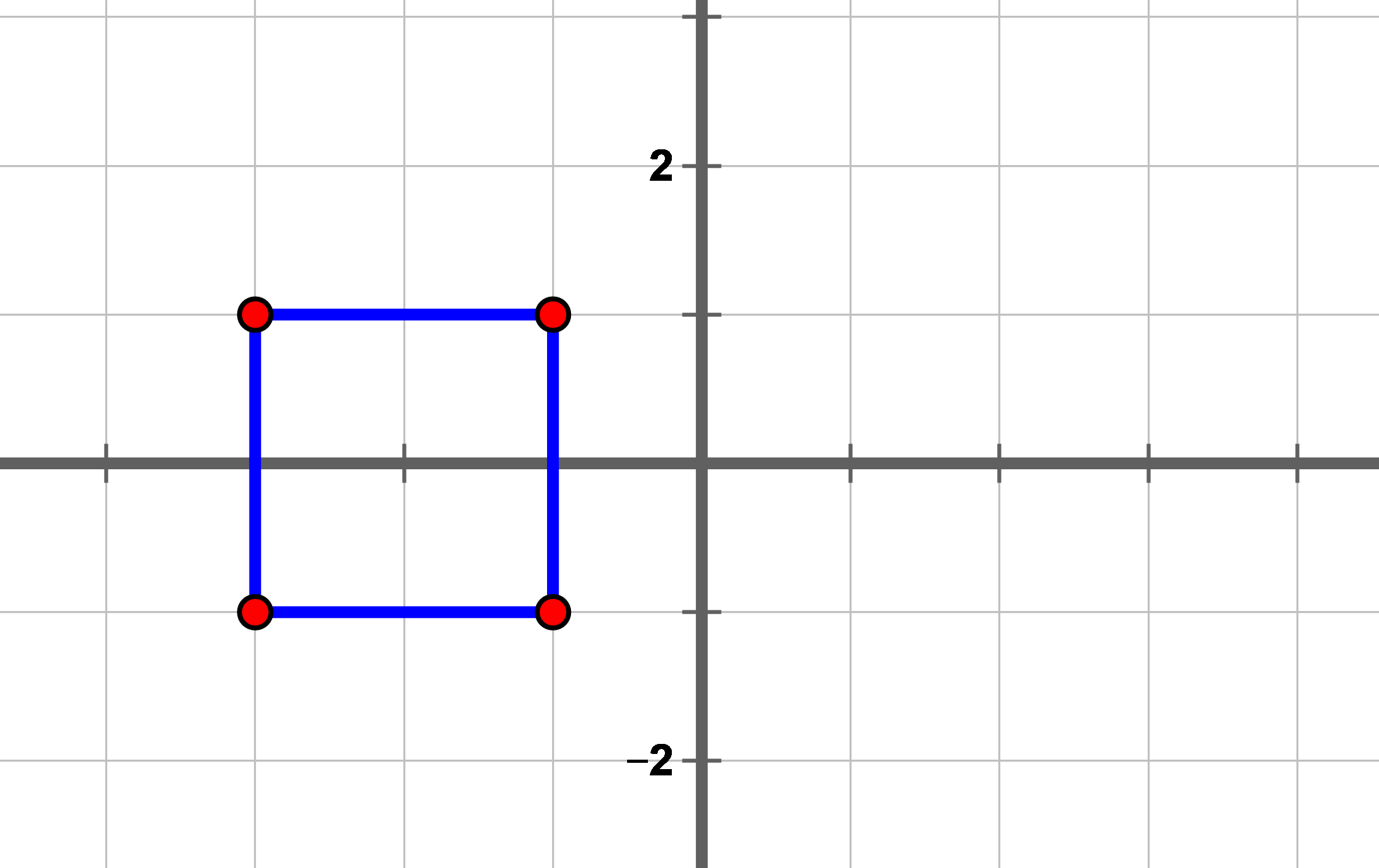
Which does NOT describe a way to map this square back onto itself?