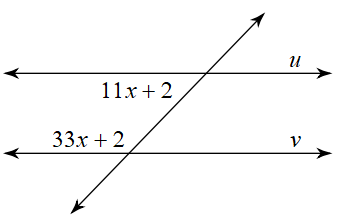
You do not need to use the show your work tool unless it says that you need to. Other wise it is available as a tool if you need it.
1 point
1
Question 1
1.
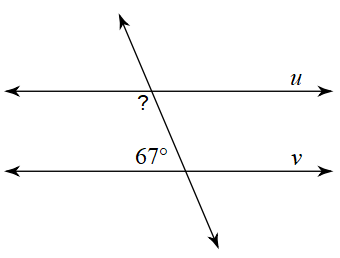
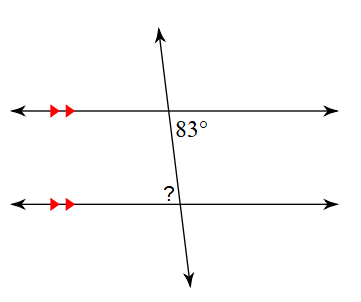
Name the angle relationship and state whether the angles are equal to each other or supplementary based on our parallel line postulates/theorems?
You can abbreviate relationships with:
Verical Angles(VA), Linear Pairs(LP), Alternate Interior Angles(AI), Alternate Exterior Angles(AE), Same Side Interior Angles (SSI), and Corresponding Angles(CA)
Then state the measure of the angle for (?) in diagram.
1 point
1
Question 2
2.
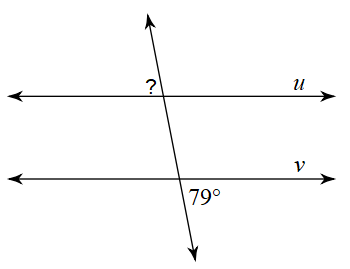
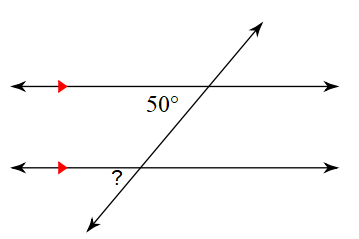
Name the angle relationship and state whether the angles are equal to each other or supplementary based on our parallel line postulates/theorems?
You can abbreviate relationships with:
Verical Angles(VA), Linear Pairs(LP), Alternate Interior Angles(AI), Alternate Exterior Angles(AE), Same Side Interior Angles (SSI), and Corresponding Angles(CA)
Then state the measure of the angle for (?) in diagram.
1 point
1
Question 3
3.
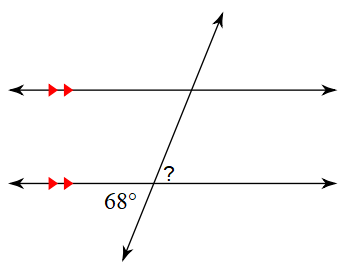
Name the angle relationship and state whether the angles are equal to each other or supplementary?
You can abbreviate relationships with:
Verical Angles(VA), Linear Pairs(LP), Alternate Interior Angles(AI), Alternate Exterior Angles(AE), Same Side Interior Angles (SSI), and Corresponding Angles(CA)
Then state the measure of the angle for (?) in diagram.
1 point
1
Question 4
4.
Name the angle relationship and state whether the angles are equal to each other or supplementary
based on our parallel line postulates/theorems?
You can abbreviate relationships with:
Verical Angles(VA), Linear Pairs(LP), Alternate Interior Angles(AI), Alternate Exterior Angles(AE), Same Side Interior Angles (SSI), and Corresponding Angles(CA)
Then state the measure of the angle for (?) in diagram.
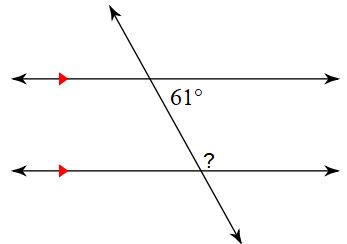
1 point
1
Question 5
5.
Name the angle relationship and state whether the angles are equal to each other or supplementary based on our parallel line postulates/theorems?
You can abbreviate relationships with:
Verical Angles(VA), Linear Pairs(LP), Alternate Interior Angles(AI), Alternate Exterior Angles(AE), Same Side Interior Angles (SSI), and Corresponding Angles(CA)
Then state the measure of the angle for (?) in diagram.
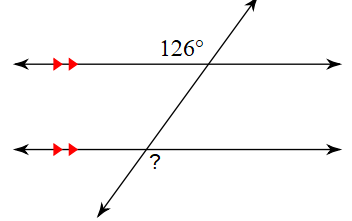
1 point
1
Question 6
6.
Name the angle relationship and state whether the angles are equal to each other or supplementary?
You can abbreviate relationships with:
Verical Angles(VA), Linear Pairs(LP), Alternate Interior Angles(AI), Alternate Exterior Angles(AE), Same Side Interior Angles (SSI), and Corresponding Angles(CA)
Then state the measure of the angle for (?) in diagram.
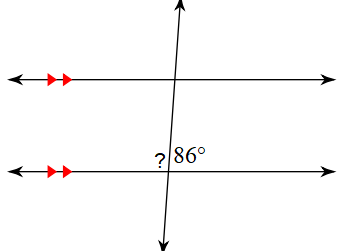
1 point
1
Question 7
7.
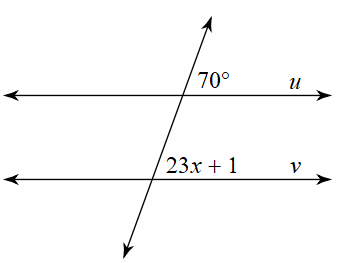
Name the angle relationship and state whether the angles are equal to each other or supplementary based on our parallel line postulates/theorems?
You can abbreviate relationships with:
Verical Angles(VA), Linear Pairs(LP), Alternate Interior Angles(AI), Alternate Exterior Angles(AE), Same Side Interior Angles (SSI), and Corresponding Angles(CA)
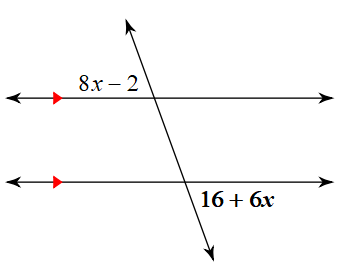
Then solve for x and state the angle measure for the angle in bold. (Show work in Show your work section)
1 point
1
Question 8
8.
Name the angle relationship and state whether the angles are equal to each other or supplementary?
You can abbreviate relationships with:
Verical Angles(VA), Linear Pairs(LP), Alternate Interior Angles(AI), Alternate Exterior Angles(AE), Same Side Interior Angles (SSI), and Corresponding Angles(CA)
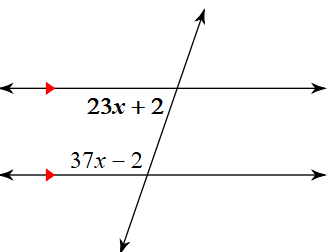
Then solve for x and state the angle measure for the angle in bold. (Show work in Show your work section)
1 point
1
Question 9
9.
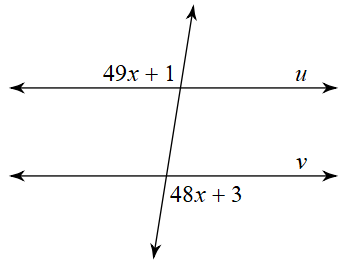
Name the angle relationship and state whether the angles are equal to each other or supplementary based on our parallel line postulates/theorems?
You can abbreviate relationships with:
Verical Angles(VA), Linear Pairs(LP), Alternate Interior Angles(AI), Alternate Exterior Angles(AE), Same Side Interior Angles (SSI), and Corresponding Angles(CA)
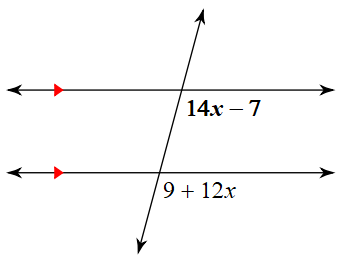
Then solve for x and state the angle measure for the angle in bold. (Show work in Show your work section)
1 point
1
Question 10
10.
Name the angle relationship and state whether the angles are equal to each other or supplementary?
You can abbreviate relationships with:
Verical Angles(VA), Linear Pairs(LP), Alternate Interior Angles(AI), Alternate Exterior Angles(AE), Same Side Interior Angles (SSI), and Corresponding Angles(CA)
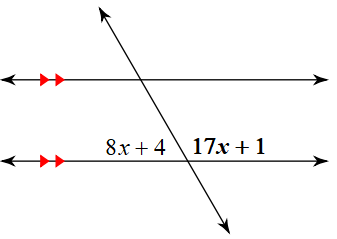
Then solve for x and state the angle measure for the angle in bold. (Show work in Show your work section)
1 point
1
Question 11
11.
For proving lines parallel we use our converse postulates/theorems.
Alternate Interior Angles Converse(AIC), Alternate Exterior Angles Converse(AEC), Same Side Interior Angles Converse (SSIC), and Corresponding Angles Converse(CAC)
State which postulate/theorem you would use to make u//v in the diagram, then find the degree of that angle.
Also, redraw the pic in the show your work section and make the proper marks to show the lines are parallel.
1 point
1
Question 12
12.
For proving lines parallel we use our converse postulates/theorems.
Alternate Interior Angles Converse(AIC), Alternate Exterior Angles Converse(AEC), Same Side Interior Angles Converse (SSIC), and Corresponding Angles Converse(CAC)
State which postulate/theorem you would use to make u//v in the diagram, then find the degree of that angle.
Also, redraw the pic in the show your work section and make the proper marks to show the lines are parallel.
1 point
1
Question 13
13.
For proving lines parallel we use our converse postulates/theorems.
Alternate Interior Angles Converse(AIC), Alternate Exterior Angles Converse(AEC), Same Side Interior Angles Converse (SSIC), and Corresponding Angles Converse(CAC)
State which postulate/theorem you would use to make u//v in the diagram, then find the degree of that angle. (If you need to find x first, do so in the show your work section)
Also, redraw the pic in the show your work section and make the proper marks to show the lines are parallel.
1 point
1
Question 14
14.
For proving lines parallel we use our converse postulates/theorems.
Alternate Interior Angles Converse(AIC), Alternate Exterior Angles Converse(AEC), Same Side Interior Angles Converse (SSIC), and Corresponding Angles Converse(CAC)
State which postulate/theorem you would use to make u//v in the diagram, then find the value for x that would make u//v.
Also, redraw the pic in the show your work section and make the proper marks to show the lines are parallel.
1 point
1
Question 15
15.
For proving lines parallel we use our converse postulates/theorems.
Alternate Interior Angles Converse(AIC), Alternate Exterior Angles Converse(AEC), Same Side Interior Angles Converse (SSIC), and Corresponding Angles Converse(CAC)
State which postulate/theorem you would use to make u//v in the diagram, then find the degree of that angle. (If you need to find x first do so in the show your work section)
Also, redraw the pic in the show your work section and make the proper marks to show the lines are parallel.