Log in
Sign up for FREE
arrow_back
Library
Weather Quiz
By Leondra Richardson
star
star
star
star
star
Share
share
Last updated over 5 years ago
20 questions
Add this activity
1
1
1
1
1
1
1
1
1
1
1
1
1
1
1
1
1
1
1
1
Question 1
1.
The order of the layers of the atmosphere from earth to outer space is
A Thermosphere, Stratosphere, Mesosphere, Troposphere, Exosphere
B Troposphere, Mesosphere, Stratosphere, Thermosphere, Exosphere
C Troposphere, Stratosphere, Thermosphere, Mesosphere, Exosphere
D Troposphere, Stratosphere, Mesosphere, Thermosphere, Exosphere
Question 2
2.
The ozone layer is found in the
Troposphere
Stratosphere
Mesosphere
Thermosphere
Question 3
3.
In the troposphere, as altitude increases
air pressure decreases
temperature decreases
air density decreases
all of the above
Question 4
4.
Which phase change in the atmosphere forms clouds?
evaporation
freezing
condensation
melting
Question 5
5.
At which location is rainfall most likely to occur?
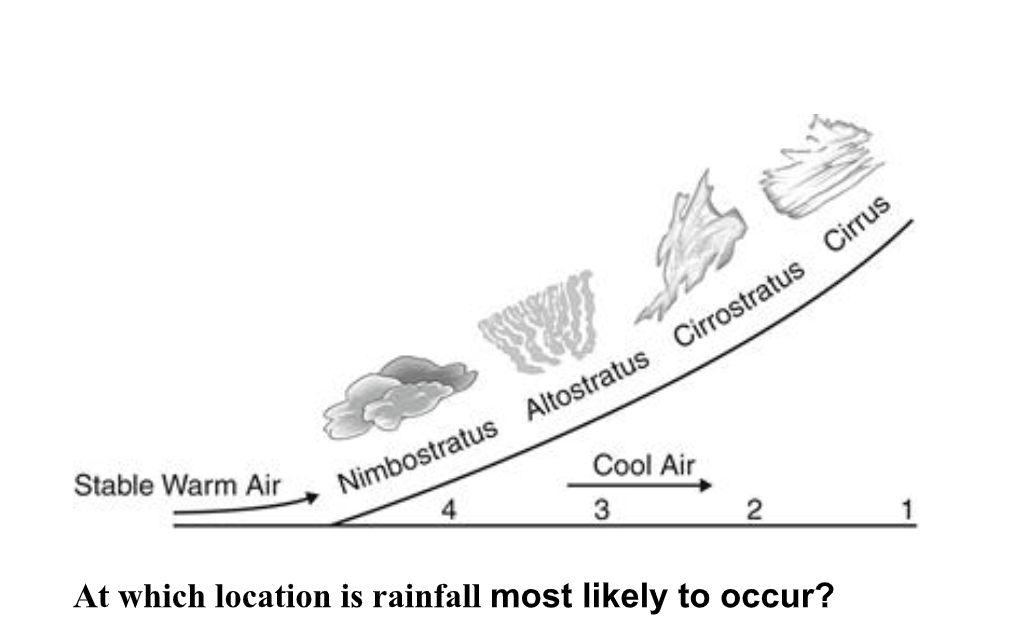
1
2
3
4
Question 6
6.
Which of the following scenerios is the best example of energy transfer by conduction?
A cold ocean water sinking near the poles
B burning your hand when you touch a hot stove
C wind blowing from the ocean to the land on a hot day
D hot magma inside a volcano rising toward the surface to erupt
Question 7
7.
Usually, as air temperature increases, air pressure
increase
remain stable
decrease
Question 8
8.
According to this map, where are they enjoying clear, sunny skies?
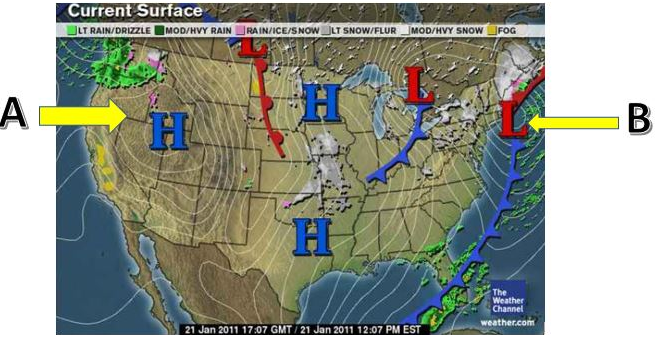
A
B
Question 9
9.
These high level clouds are very wispy.

cirrus
cumulus
cirrocumulus
nimbostratus
Question 10
10.
The movement of air from land to sea at night, created when cooler, denser air from the land forces up warmer air over the sea
tornado
sea breeze
land breeze
convection
Question 11
11.
When warm air becomes trapped between two cold fronts
cold front
warm front
stationary front
occluded front
Question 12
12.
The atmosphere is composed of mainly
Oxygen
Argon
Carbon Dioxide
Nitrogen
Question 13
13.
Which gas is released into the atmosphere by plants as they photosynthesize?
Oxygen
Argon
Carbon Dioxide
Nitrogen
Question 14
14.
An air mass that forms over an ocean is called
tropical
continential
maritime
polar
Question 15
15.
Cool, clear weather usually follows a
warm front
cold front
stationary front
occluded front
Question 16
16.
How are air masses classified?
by temperature and pressure
by pressure and humidity
by temperature and density
by temperaure and humidity
Question 17
17.
Energy from the sun travels to Earth's surface by
radiation
convection
evaporation
conduction
Question 18
18.
Bands of high-altitude, high-speed winds are called
sea breezes
land breezes
jet streams
local winds
Question 19
19.
Rain, sleet, and hail are all forms of
evaporation
precipitation
condensation
convection
Question 20
20.
A rapidly moving cold air mass meets a slowly moving warm air mass and forms a front. What will most likely occur at this front?
The two air masses will mix together
The warm air will slide under the cold air. The cold air will rise and get warmer.
Cold air will slide under the warm air. Warm air will rise and cool. Clouds will form.
The dess dense warm air will sink and cool. Clouds will form.