Log in
Sign up for FREE
arrow_back
Library

Quiz #1 Chemistry

star
star
star
star
star
Last updated over 5 years ago
22 questions
Note from the author:
1
1
1
1
1
1
1
1
1
1
1
1
1
1
intro to chemistry
Question 1
1.

Question 2
2.

Question 3
3.

Question 4
4.

Question 5
5.

Question 6
6.

Question 7
7.

Using your knowledge of matter, write two sentences that reasons out the evidence. In other words, why is this evidence important? How does it relate to the scientific concept of matter?

You can start your reasoning with, "I think this evidence relates to the idea of matter because..." if it helps.

Question 8
8.

Question 9
9.

Construct a model that shows the butter particles before and after thermal energy is transferred to the solid butter by heating.

Be sure your model includes pictures and a key to show the thermal energy and kinetic energy of the motion of the particles. Think about all of the requirements of our phase change models.

Question 10
10.

Write a description of what your model shows. In your description, explain how the state of the solid butter changes after thermal energy is transferred to butter by heating.

Question 11
11.

Question 12
12.

Question 13
13.

Explain why you chose this model.

Question 14
14.

Explain why the other model does not work.

1
1
1
1
1
1
1
1
A scientist wants to see the effect of fertilizer on plant growth. She plants two rows of corn for experimentation. She puts fertilizer on row 1 but does not put fertilizer on row 2. Both rows receive the same amount of water and light intensity. She checks the growth of the corn over the course of 5 months.
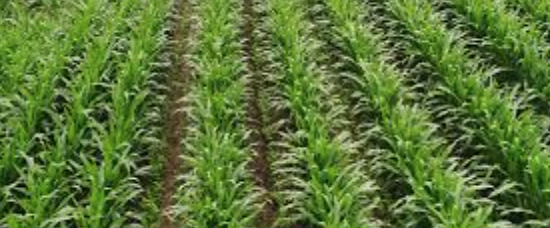

What is the independent variable?
Fertilizer
Amount of water
Light Intensity
Plant height
What is the dependent variable?
Amount of water
Plant height
Corn with fertilizer
Corn without fertilizer
Name one constant in this experiment.
Corn with fertilizer
Corn without fertilizer
Plant height
Amount of water
What is the control?
Plant height
Corn without fertilizer
Corn with fertilizer
Amount of water
Two students are arguing over whether or not air is matter. They both argue different claims.

Student 1's claim: "Air is not matter because we cannot feel it or touch it like we can solids and liquids. It is too small and invisible. We have to be able to see matter and interact with it."

Student 2's claim: "Air is matter. We know this because it is a gas and has mass and volume. Being able to see it isn't a defining feature of matter."

Which claim do you agree with?
Student 1
Student 2
What evidence is there in the video supporting the claim? Remember that evidence comes from things we can see or data from a lab.


Check all that apply. There could be more than ONE.
There is no evidence in this video.
As we pumped more air into the ball there was more mass. The mass started at 84.6 g and ended at 85.1g.
When the air was let out of the blue balloon, it took up less space (less volume).
When the air was let out of the blue balloon, it went up on the straw balance compared to the pink balloon, which means it was lighter (weighed less).
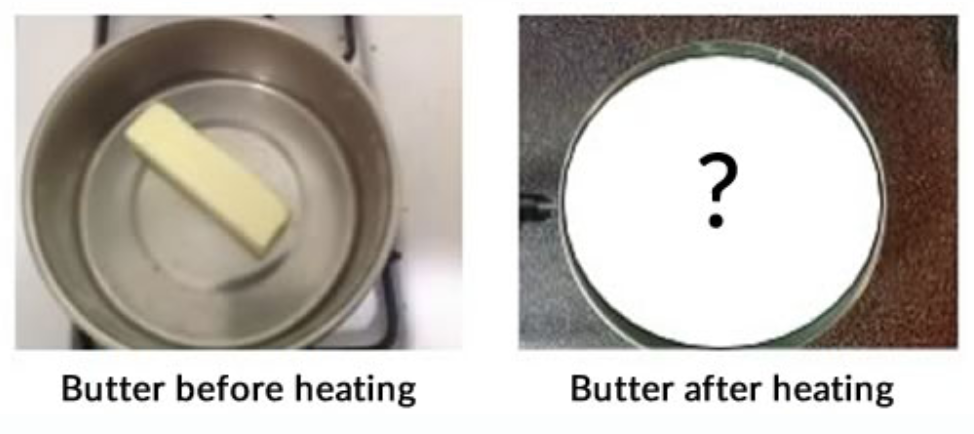
A piece of solid butter is placed in a pan on a stove and gently heated, causing thermal energy to transfer to the butter until the state of the butter changed.


Predict the change in the state of solid butter.
stays a solid
becomes a liquid
becomes a gas
There is a solid wooden table with a cup of water sitting on it. Which of the following statements is TRUE?
The atoms and molecules of the liquid water are moving, and the atoms and molecules of the table are not moving.
The atoms and molecules of both the liquid water and the table are not moving.
The atoms and molecules of both the liquid water and the table are moving.
The atoms and molecules of the liquid water are not moving, and the atoms and molecules of the table are moving.
Anna and Carla were each asked to draw a model to show why water and iodine are different substances. Anna thought that her model should show water and iodine at the particle level. Carla thought her model should show water and iodine at the molecular level.


Based on what you know about substances, whose model best shows why water and iodine are different substances?
Carla's model
Anna's model
Question 15
15.

Question 16
16.

Question 17
17.

Question 18
18.

Question 19
19.

Question 20
20.

Question 21
21.

Question 22
22.

Element
A
B
C
D
E
Compound
A
B
C
D
E
Mixture of elements
A
B
C
D
E
Mixture of compounds
A
B
C
D
E
Mixture of compounds and elements
A
B
C
D
E
Only atoms, no molecules
A and B
C only
D and E
Only molecules, no separate atoms
A and B
C only
C and E
C and D
Both atoms and molecules
A
B
C
D
E