DBQ: How the Constitution stops tyranny
star
star
star
star
star
Last updated almost 6 years ago
13 Nsɛmmisa

10

10

10

10

10

10

10
10
1
10
10
10
10
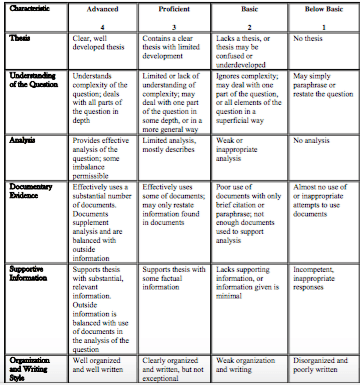
DBQ Instructions:
Remember:
1. No 1st person (I, me, my) writing style. I should not see a sentence that says "I think that the Constitution" or "What I mean is..." Just say "The Constitution" or "The American people"
2. Write for Grandma - explain what you mean. This requires more sentences and clarity
3. Listen to the voices in your head - the thoughts going through your mind that provide clarity to you should be used in the DBQ
4. Details are your friends but Mr. Parry DOESNT KNOW THEM, so be sure to include them.
5. Documents don't talk so DO NOT SAY "the document says".
6. VOCABULARY MATTERS - Write clearly using the English language. Don't abreviate words, and work on learning how to use vocabulary words so that you can use 1 word that has a meaning behind it instead of having to explain yourself in a long sentence. Ex. I want you to be cognizant of writing expectations. I use that word instead of saying I want you to be aware of or have knowledge regarding writing expectations.
7. DO NOT write about what the documents have in them. Documents have facts that you look at and then use as examples to prove your point. This is NOT a DBQ about what the documents have in each of them. Writing this way equals an automatic ZERO. Be COGNIZANT so you don't waste your time and effort.
8. CITE all of your work. You are not an expert, you don't even have an educational degree. You are getting information to support your belief FROM a document someone else has provided who is an expert. You MUST cite the document as (Doc A) or (Doc B) or (Doc C) or (Doc D) at the END of the sentence. Failure to do so is stealing that work and is plagiarism and results in a automatic ZERO. Changing a word or two is still plagiarism so be sure to use your own words. Be COGNIZANT so you don't waste your time and effort.
Example: The American government under Federalism has a complex process of powers assigned to each branch. These additional powers form what is classified as "checks and balances", enabling each branch to exercise power over the other two branches to thwart their attempts at acting in a tyrannical manner (Doc C). For example, the executive branch has the power to Veto bills passed by Congress and prevent them from becoming a law that could endanger the rights of the American public (Doc C).
DBQ Structure:
1. Intro Paragraph - Background information and Thesis
2.Support Paragragh #1
A. Topic Sentence
B. Supporting Detail for the topic sentence
C. Examples
3.Support Paragragh #2
A. Topic Sentence
B. Supporting Detail for the topic sentence
C. Examples
4.Support Paragragh #3
A. Topic Sentence
B. Supporting Detail for the topic sentence
C. Examples
Conclusion Paragraph
A. Restate your thesis / argument
B. So What? This is where you need to summarize your main points.
MAIN WRITING GOAL: You need to be able to prove that the Constitution (the present form of the American government) is capable of guarding against tyranny at multiple levels.
Definition of Tyranny is the RULE of the one, the few and the many.
THESIS: The main goal of this DBQ is to analyze and explain how the Constitution guards against tyranny. This is the main thesis. We are focusing on the Political aspects in this DBQ. You must use all 4 documents.
The Documents are:
Document A: Federalism
Document B: Separation of Powers
Document C: Checks and Balances
Document D: Big state vs Small state
REMINDERS: Don't write in 1st person: I, WE, ME, US, YOU
It might be helpful to break the DBQ BODY paragraphs into the following areas:
Federalism - how does its structure stop tyranny?
A. What is Federalism
B. How is power separated
Checks and Balances - how does this process stop tyranny?
A. What are they and why are they necessary?
B. How do they slow government
Congress and its danger - How does dividing representation stop tyranny of the big states?
A. Assigning House of Representative representation for states
B. Senate Structure
C. How this process stops tyranny (if you have paid attention to what we do daily in the lab you'll have a good analysis to make)
1. A “compound” is something made of two or more pieces. What are the two pieces that make up Madison’s compound government?
2. What word ending in “ism” is another word for this kind of compound government?
3. How does this compound government provide “double security” to the people?
Prove this using this document: How does dividing the power of government in the fashion above stop one person, a few people or many people from being able to abuse the rights of the people?
1. Using the chart above, can you see a pattern in the types of power the Constitution reserved for the State governments?
2. How do states control who gets elected at the national level?
3. How does federalism guard against tyranny?
Prove this using this document: How does spreading power out between the national and the state government (as analyzed above) stop one person, a few people or many people from being able to abuse the rights of the people using the government as its primary tool?
1. What is the main idea of the Madison quote?
2. Does Madison say it is possible to have tyranny in a democracy? Explain.
Prove this using this document: How does spreading power out between the three branches in the national government (as analyzed above) stop one person, a few people or many people from being able to abuse the rights of the people using the national government as its tool?
1. What is the primary job of each branch?
2. What would James Madison say about allowing a person elected to the House of Representatives to serve at the same time on the Supreme Court? Explain his thinking.
3. How does the separation of powers guard against tyranny?
Prove this using this document: How do term limits and division of power between branches stop one person, a few people or many people from being able to abuse the rights of the people if they "seizing control" (legally of course) of one of the branches of government?
1. What is the main idea in the Madison quote?
Prove this using this document: How do Checks and Balances make each branch of government constantly watch the other two branches ensure there will be no successful attempt for one group to become tyrannical?
1. What is one way the legislature can check the power of the chief executive?
2. What is one way the President can check the power of the Supreme Court?
3. What is one way the Supreme Court can check the Senate?
4. According to this document, how did the framers of the Constitution guard against tyranny?
Prove this using this document: How does this process above stop one person, a few people or many people from being able to abuse the rights of the people?
Prove this using this document: How does the Constitution ensure that no state will dominate a portion of Congress, making that state more powerful than the rest? Prove this using this document: How does the Constitution ensure that all states have equal representation and that no individual will be capable of dominating the Senate for a long period of time.
REMINDERS: Don't write in 1st person: I, WE, ME, US, YOU
Reminders: Cite ALL Documents; USE ALL 4 Documents
Introduction Pagagraph. Thesis is the last sentence at the end of the paragraph.
It might be helpful to break the DBQ BODY paragraphs into the following areas:
Federalism - how does its structure stop tyranny?
A. What is Federalism
B. How is power separated
Checks and Balances - how does this process stop tyranny?
A. What are they and why are they necessary?
B. How do they slow government
Congress and its danger - How does dividing representation stop tyranny of the big states?
A. Assigning House of Representative representation for states
B. Senate Structure
C. How this process stops tyranny (if you have paid attention to what we do daily in the lab you'll have a good analysis to make)
Conclusion - Restate the thesis
So What? - 3 sentences providing a summary of your 3 key points.
Create a thesis around this question: How does the Constitution guard against tyranny?
Intro Paragraph Background Info. That these facts, expand upon them, and turn it into a flowing paragraph.
1. The Articles of Confederation were a failure
2 A new system of government was required to rescue the failing American nation
3. Goal was to avoid the pitfalls of returning to a British government model
4. Other goals were to maintain some state authority but avoide the weaknesses common to Confederations
5. American government model became a form of filter system
DBQ Paragraph Organization - Part 1 - Use Document A and B
First, create your topic sentence based on this concept: Federalism - how does its structure stop tyranny?
Next,explain what Federalism is
Third, find examples in the document that support your statement on Federalism, explain it and cite it.
Fourth, explain HOW power separated AND why this is important to stopping the rise of a tyrannical leader or group.
Fifth, find evidence in your document, explain it and cite it.
DBQ Paragraph Organization - Part 2 - Use document C First, create your topic sentence based on this concept: Checks and Balances - how does this process stop tyranny?
Next,explain what Checks and Balances are and why they are necessary.
Third, find examples in the document that support your statement on Checks and Balances, explain it and cite it.
Fourth, explain HOW this creates a slow government AND why this is important to stopping the rise of a tyrannical leader or group.
Fifth, find evidence in your document, explain it and cite it.
DBQ Paragraph Organization - Part 3 - Use Document D
First, create your topic sentence based on this concept: Congress and its danger - How does dividing representation stop tyranny of the big states?
Next,explain why the House of Representative representation for states is set up in this process
Third, find examples in the document that support your statement on Federalism, explain it and cite it.
Fourth, explain HOW voting power is structured in the Senate AND why this is important to stopping the rise of a tyrannical leader or group from the more populous states.
Fifth, find evidence in your document, explain it and cite it.
Conclusion:Rewrite the thesis. Summarize your main points