
4
4
4
4
1
Test on The Hitchhiker and In The Fog
Standards RL 6.3 and RL 6.5

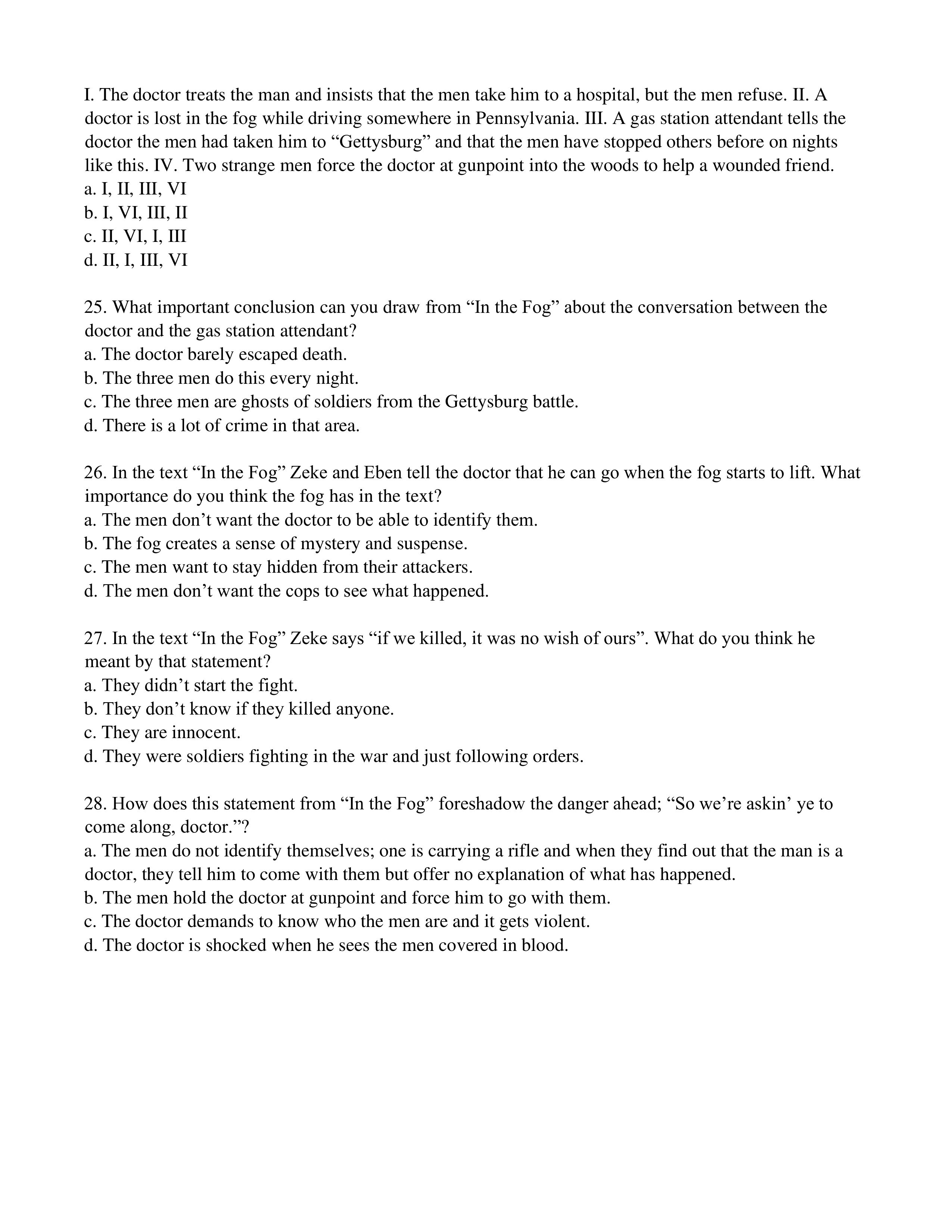
What important conclusion can you draw from “In the Fog” about the conversation between the doctor and the gas station attendant?
As used in the text, “The Hitchhiker”, What is the meaning of the word “mad” as used in the statement: “I know that I'm at this moment perfectly sane, that it's not me who's gone mad...”?
As used in the text, “The Hitchhiker”, What is the meaning of the word “drab” as used in the statement: “He [the hitchhiker] was drab as a mud fence...”?
As used in the text, “The Hitchhiker”, What is the meaning of the word “dogs” as used in the statement: “...you mind if I take off my shoes? My dogsare killin' me.”?
This drama, “The Hitchhiker”, is told in chronological order. How does this help you understand the story?
Put these events from “The Hitchhiker” in the order they occurred in the story.
I. The storekeeper threatens to call the sheriff if Ronald doesn’t leave immediately. II.Ronald hears that he died 6 days earlier in an accident on the Brooklyn Bridge.
III.Ronald sees the Hitchhiker on the Brooklyn Bridge and swerves to avoid hitting him. IV.The female hitchhiker fearfully runs away from Ronald after he almost kills them.
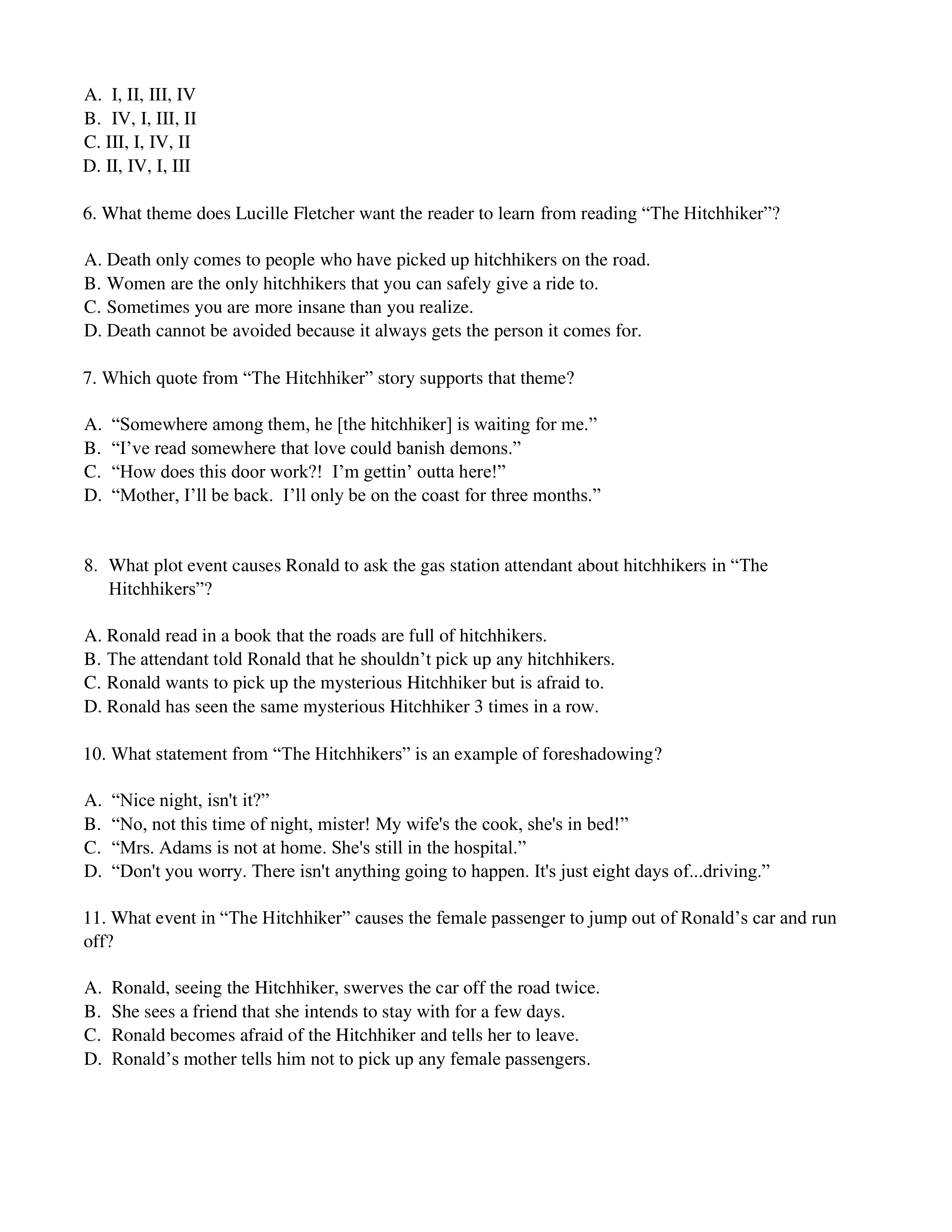
What theme does Lucille Fletcher want the reader to learn from reading “The Hitchhiker”?
Which quote from “The Hitchhiker” story supports that theme?
What plot event causes Ronald to ask the gas station attendant about hitchhikers in “The Hitchhikers”?
What statement from “The Hitchhikers” is an example of foreshadowing?
What event in “The Hitchhiker” causes the female passenger to jump out of Ronald’s car and run off?
What detail(s) from the story proves that the Hitchhiker is not a real person? I. He calls out “Hellloooo” to Ronald each time Ronald meets him on the road. II. He is everywhere that Ronald goes, even though Ronald is traveling faster.
III.The female passenger never sees the Hitchhiker, even though Ronald does.
IV. The Hitchhiker is always covered with water, even in areas where it has not rained.
What important conclusion can you draw from “The Hitchhiker” drama about Ronald’s conversation with Mrs. Whitney at the end of the play?
Who/what do you believe the Hitchhiker really is?
A struggle or problem in the story for the main character is the:
When, where, and the time a story takes place is called the:
When the climax or conflict is solved it is called the:
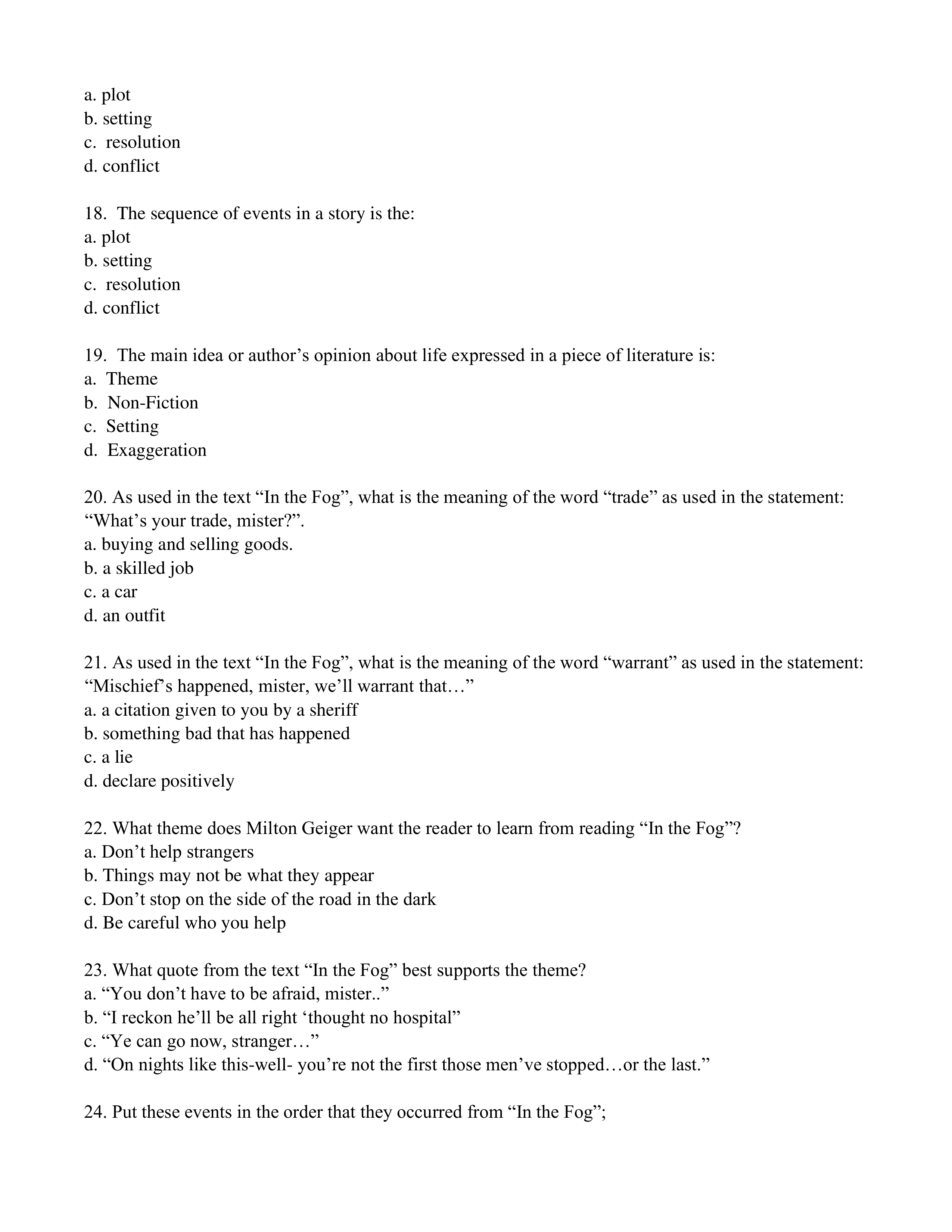
The sequence of the events in a story is the:
The main idea or author's opinion about life expressed in a piece of literature is:
As used in the text “In the Fog”, what is the meaning of the word “trade” as used in the statement: “What’s your trade, mister?”.
As used in the text “In the Fog”, what is the meaning of the word “warrant” as used in the statement: “Mischief’s happened, mister, we’ll warrant that…”
What theme does Milton Geiger want the reader to learn from reading “In the Fog”?
What quote from the text “In the Fog” best supports the theme?
. Put these events in the order that they occurred from “In the Fog”;
I. The doctor treats the man and insists that the men take him to a hospital, but the men refuse. II. A doctor is lost in the fog while driving somewhere in Pennsylvania. III. A gas station attendant tells the doctor the men had taken him to “Gettysburg” and that the men have stopped others before on nights like this. IV. Two strange men force the doctor at gunpoint into the woods to help a wounded friend.
In the text “In the Fog” Zeke and Eben tell the doctor that he can go when the fog starts to lift. What importance do you think the fog has in the text?
In the text “In the Fog” Zeke says “if we killed, it was no wish of ours”. What do you think he meant by that statement?
How does this statement from “In the Fog” foreshadow the danger ahead; “So we’re askin’ ye to come along, doctor.”?