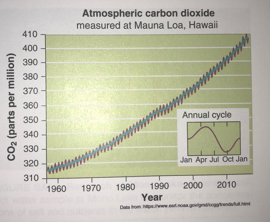
Which of the following most directly explains the periodic fluctuations of the curve?
Which of the following most directly explains the periodic fluctuations of the curve?
Which of the following most directly explains the periodic fluctuations of the curve?
Which of the following is most likely a significant cause of the general trend indicated by the graph?
Which environment is characterized by the highest diversity of tree species?
Which environment is most likely to be characterized by dry scrub with frequent fires?
Which environment is characterized by a short season of growth and reproduction?
Which of the following best helps to explain why phosphorus is often a limiting factor in many ecosystems?
Which of the following is a characteristic of tropical rain forests?
Boreal forests tend to have a thick layer of organic material but the soil is poor in nutrients. What is the BEST explanation for this?
In August of 2014, residents of several Ohio cities that use Lake Erie as a drinking water source were warned not to drink tap water because of the presence of toxins released by blue-green algae (cyanobacteria). Which of the following is the most likely cause of recent blooms of blue-green algae in Lake Erie?
A forest has a gross primary productivity (GPP) of 3.8 kg C/m2/year and the rate of cellular respiration is 2.4 kg C/m2/year. What is the net primary productivity (NPP)?
Which of the following best explains why decomposers in soils and water are important to ecosystems?
A field is abandoned, and an invasive plant that can live in nutrient-poor soil moves into the field. If the land is later cleared of this invasive species and it is discovered that the soil has an abundance of nitrogen compounds, what conclusion can best be made?
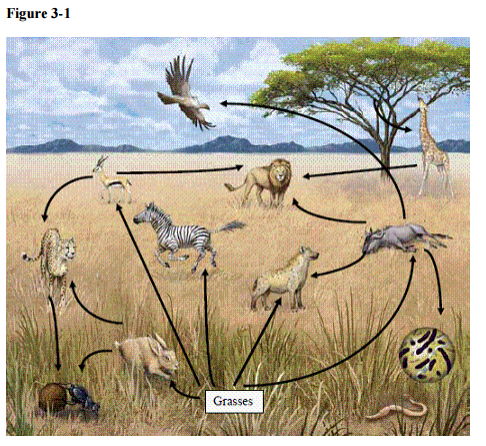
Which of the organisms illustrated above would be the TOP (apex) predator?
Which of the organisms illustrated above would be the lowest trophic level?
Which of the following is an example of a carbon sink?
Looking at Figure 3-3, what would be the MOST likely number of joules to fill in X, Y, and Z?
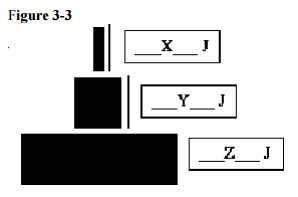
Approximately how much potential energy available from the sun’s rays hitting the Earth is used in photosynthesis?
Which group of organisms performs photosynthesis?
Which of the following is released by the process of photosynthesis?
Choose the correct sequence for energy flow within an ecosystem.
How is the MAJORITY of energy within an ecosystem lost?
Which of the following statements BEST describes the concept of NPP (Net Primary Production)?
The second law of thermodynamics states that
MOST energy on Earth comes from
For a primary producer, the main function of photosynthesis is to manufacture?