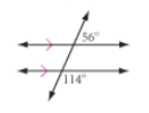
Geo. Chapter 2 Summative.
star
star
star
star
star
Last updated almost 6 years ago
16 Nsɛmmisa
1
1
1
1
1
1
1
1
1
1
1
1
1
1
1
1
Geometry. Chapter 2 Summative.
Angle Relationships.
C1P3. Students will create and solve equations for multiple geometric situations.
C2P2. Students will use models to solve real-world problems and interpret solutions in context.
C3P1. Students will communicate mathematical reasoning in multiple contexts.
C4P1. Students will know and use vocabulary and notation to describe, sketch shapes and -figures.
C1P3.
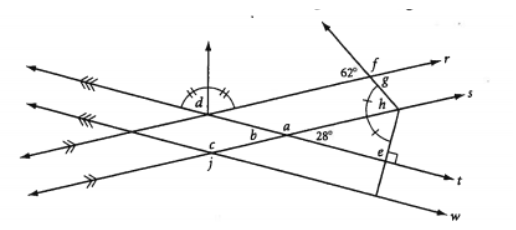
a=?
C1P3.
b=?
C1P3.
c=?
C1P3.
d=?
C1P3.
e=?
C1P3.
f=?
C1P3.
g=?
C1P3.
h=?
C1P3.
j=?
C1P3.
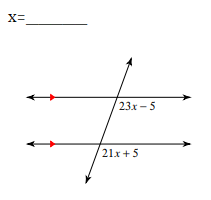
a=?
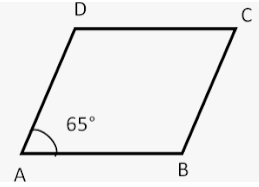
The image below is a parallelogram, therefore opposite sides are parallel. Find the measure of angle D.
C2P2.
Every summer solstice in the city of Syene, the sun was directly overhead at noon. On the same day at noon in a city called Alexandia, a city north of Syene, the angle between the perpendicular to the ground and the rays of the sun was about 7;5 degrees. The distance between Syene and Alexandria was known to be about 5,000 states, the stade was a Greek unit of measurement, and 1 stade is approximately 600 feet.
Explain ho Erasotehenes used this information to calculate the circumference of the Earth, include both a model and numerical explanation.
Competency #3. The questions below are relevant to your ability to communicate geometry. Use the most precise vocabulary as you can. Include at least some of the words below:
C1P3.
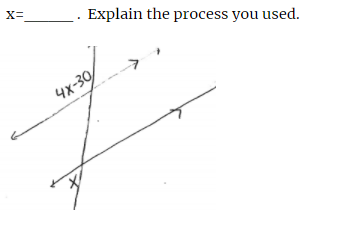
Find angle z and explain your strategy.
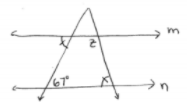
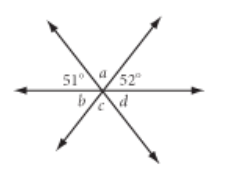
Explain what is wrong with the image below.