FM: Lesson 3.2a (9/17) Version B
star
star
star
star
star
Last updated about 3 years ago
8 Nsɛmmisa

0
0

0
0
0
0
2
2
Two identical cars with the same mass were forced to change speed. Which object experiences the strongest force to change speed?
Why do you think letter B is most correct. (use the mass and change of speed to support your answer)
Experimental Setup Part 1: Top View
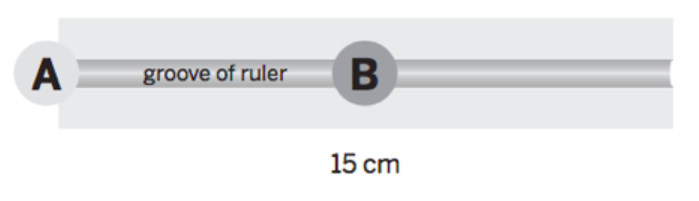
Instructions:
Roll Object A toward Object B and observe how the objects change velocity when they collide. Record your observations in the data table
For Effect: Object A and Effect: Object B. choose from the following options:
speed up, slow down, start moving, stop moving, change direction
Based on the velocity changes, infer the direction of the force (if any) acting on each object and record it in the table for Force direction: Object A and Force direction: Object B. Choose from the following options: • left, right, none
Repeat these steps for all three collisions.
Lab Reflection Questions:
In test 1-3, what evidence can you find to support why ‘Object B’ has the greatest change in velocity during one of the trials?
CFS:
accurately identifies the changes to each object in a collision
accurately describes the relationship between force, mass and velocity in a collision
accurately identifies the strongest sources of evidence from the experimental data

Use the image as an example to set up your objects.
Roll Object A toward Object B and observe how the objects change velocity when they collide.
Record your observations in the data table for Effect: Object A and Effect: Object
Choose from the following options:
speed up, slow down, stop moving, change direction
Based on the velocity changes, infer the direction of the force (if any) acting on each object and record it in the table for Force direction: Object A and Force direction: Object B. Choose from the following options: • left, right, none
Lab Reflection Questions:
In test 4-5, what evidence can you find to support why ‘Object A’ moved the most after one of the collisions?
CFS:
accurately identifies the changes to each object in a collision
accurately describes the relationship between force, mass and velocity in a collision
accurately identifies the strongest sources of evidence from the experimental data
" I think object A moved the most in collision __ because ... "
The two cars below are doing experimental crash testing. The car on the left (red) has a mass of 40kg, the one on the right (blue) has a mass of 60 kg. After the collision the red car moves at an acceleration of 2m/s2, the blue car moves with an acceleration of 1.33 m/s2.
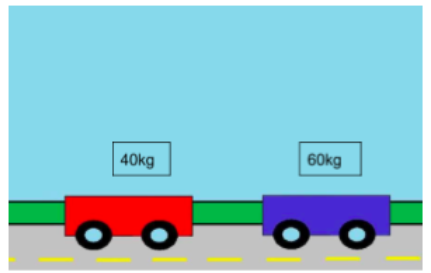
Describe the direction and strength of force each object would experience during the collision.
CFS:
accurately identifies the changes to each object in a collision
accurately describes the relationship between force, mass and velocity in a collision
How does the mass of an object impact the acceleration after a collision?
If the object has more mass it will acceleration ....
If the object has less mass it will acceleration ....
CFS:
accurately identifies the changes to each object in a collision
accurately describes the relationship between force, mass and velocity in a collision