The students in a biology class kept a record of the height (in centimeters) of plants after three weeks for a class experiment. The data is shown in the table below:
Use your Ti-84 Calculator to create a histogram:
1. Enter your data into List 1 (Stat, Edit)
2. Open a statplot (2nd, y=, statplot1 on)
3. Choose histogram, frequency=1.
4. Zoom, 9
Describe the data distribution using CUSS & BS.
Choose all answers that apply below (there are four).
Use the actual list of data when describing the spread.
4 points
4
Question 2
2.
The students in a biology class kept a record of the height (in centimeters) of plants after three weeks for a class experiment. The data is shown in the table below:
Use your Ti-84 Calculator to find the 5# summary:
1. Stat, Calc, 1-VarStats
2. Frequency: keep blank
3. Calculate.
List the 5# summary, separate each number by a comma, keep the decimals if shown.
Use the format: 3, 4, 5, 6, 7
4 points
4
Question 3
3.
The students in a biology class kept a record of the height (in centimeters) of plants after three weeks for a class experiment. The data is shown in the table below:
Use your Ti-84 Calculator to find the mean and standard deviation:
1. Stat, Calc, 1-VarStats
2. Frequency: keep blank
3. Calculate.
Enter the mean and standard deviation that your calculator gives:
Round to three places past the decimal if necessary.
Separate the values by a comma. Ex. 24, 2.145
4 points
4
Question 4
4.
The students in a biology class kept a record of the height (in centimeters) of plants after three weeks for a class experiment. The data is shown in the table below:
Using the histogram from #1, think about the shape, is it appropriate to use the mean & standard deviation to describe the center and spread of this data?
Yes or no? Why or why not?
4 points
4
Question 5
5.
The students in a biology class kept a record of the height (in centimeters) of plants after 3 weeks for a class experiment. The data is shown in the table below:
Using the 5 # summary, what is the IQR?
Interpret the IQR. (what does the IQR show?)
Select the correct answer for each question (you need to select two correct answers)
4 points
4
Question 6
6.
The students in a biology class kept a record of the height (in centimeters) of plants after 3 weeks for a class experiment. The data is shown in the table below:
Using the 5 # summary and the IQR, calculate the lower and upper fences.
Use the formulas: Q1-1.5(IQR) Q3+1.5(IQR)
List them below, separated by a comma.
Round to one place past the decimal point.
Use the format: 34.3, 75.6
4 points
4
Question 7
7.
The students in a biology class kept a record of the height (in centimeters) of plants after 3 weeks for a class experiment. The data is shown in the table below:
Using the fences calculated in #7, are there any outliers?
If so, list them.
4 points
4
Question 8
8.
The students in a biology class kept a record of the height (in centimeters) of plants after 3 weeks for a class experiment. The data is shown in the table below:
If the value of 81 cm were added to the data, would it be an outlier?
Yes or no?
Explain how you know.
4 points
4
Question 9
9.
The students in a biology class kept a record of the height (in centimeters) of plants after 3 weeks for a class experiment. The data is shown in the table below:
Using the original set of data and the 5# summary calculated in #2, interpret the Q3 in this context.
Explain what it means.
Select the best answer.
4 points
4
Question 10
10.
Students in a statistics class were asked how many pets they have.
Their responses are listed below.
1. How many students were in the class?
2. Use Stat, Edit to enter the data into a list.
Use Stat, Calc, 1-VarStats to calculate the mean (x-bar).
Round to two places past the decimal point.
Enter both answers separated by a comma below: # students, mean # pets
Ex. 8, 1.13
4 points
4
Question 11
11.
Students in a statistics class were asked how many pets they have.
Their responses are listed below.
Using the dotplot above, what percent of the students had more than 3 pets at home?
Round to one place past the decimal if needed.
7 points
7
Question 12
12.
All students in a physical education class completed a basketball free-throw shooting event and the highest number of shots made was 28.
The next day a student who had just transferred into the school completed the event, making 38 shots, that same day the student who had made 28 withdrew from the school so her data is replaced with the 38 shots, keeping the number of data values the same.
Indicate whether adding the new student’s score to the rest of the data made each of these statistics increase, decrease, or roughly stay about the same:
Select the 'rose' to drag the item to the effect the new student's score will have on it.
Minimum
Median
Mean
Maximum
Range
IQR
Standard Deviation
Roughly stay the same
Decrease
Increase
4 points
4
Question 13
13.
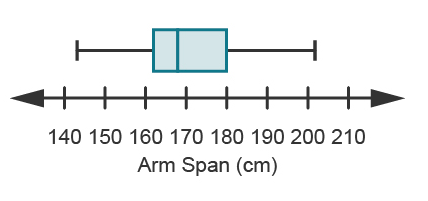
The boxplot below displays the arm spans for 44 students.
The five-number summary for the data is Min: 143, Q1: 162, Median:168, Q3: 180, and Max: 202.
Which of the following is a true statement?
4 points
4
Question 14
14.
The boxplot below displays the arm spans for 44 students.
The five-number summary for the data is Min: 143, Q1: 162, Median:168, Q3: 180, and Max: 202.
What percent of the 44 students had an armspan greater than 180 cm?
4 points
4
Question 15
15.
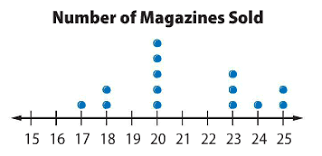
Students were hired to sell magazines to local businesses for use in their waiting rooms. The sales for each student were recorded below in a dotplot:
How many students were employed by the magazine company?
What is the range of the data?
Record the range as a single number.
Give both answers separated by a comma.
Ex. 35, 17
4 points
4
Question 16
16.
Joe is interested in the prices of homes sold in his area.
He found a list of the selling prices of 50 homes for the past month.
Most of the homes sold for $100,000–$350,000, but there were a few that sold for more than $1,000,000.
Which of the following statements is true about the mean and median selling price for the 50 homes?
Hint: picture the shape of the data distribution.
4 points
4
Question 17
17.
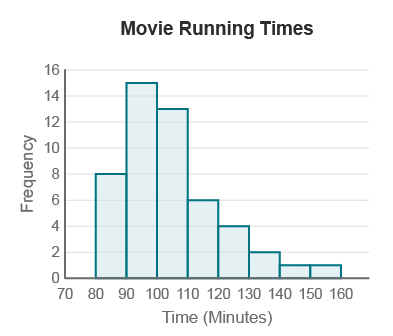
Alex records the running time—the number of minutes a movie lasts from start to finish—of 50 popular movies. The distribution of times, in minutes, is displayed in the histogram below.
Which summary statistics would be appropriate to describe the data distribution above?
Why?
Select the two correct answers below.
2 points
2
Question 18
18.
Alex records the running time—the number of minutes a movie lasts from start to finish—of 50 popular movies. The distribution of times, in minutes, is displayed in the histogram below.
Using the intervals on the x-axis and the frequency information on the y-axis, what percent of the 50 popular movies ran less than 100 minutes?
Round your percent to one place past the decimal if needed.
4 points
4
Question 19
19.
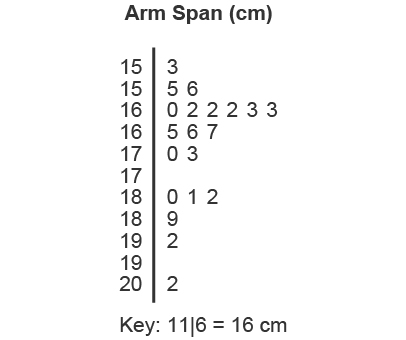
Alex records the arm span- from finger tip to finger tip- of 20 classmates.
The distribution of arm spans, in centimeters, is displayed in the histogram below.
Note the key is incorrect, it should be: 11|6 = 116 cm
Which would be greater, the mean or the median?
Why?
Select the two correct answers below.
2 points
2
Question 20
20.
Alex records the arm span- from finger tip to finger tip- of 20 classmates.
The distribution of arm spans, in centimeters, is displayed in the histogram below.
Note the key is incorrect, it should be: 11|6 = 116 cm
Give the range for the data display above, enter it as a single number.
Ex. 75
4 points
4
Question 21
21.
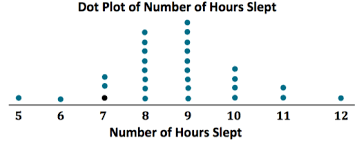
Alex records the number of hours slept of 28 classmates.
The distribution of time slept in hours, is displayed in the histogram below.