Lesson 2 - Earth's Interior and Plate Tectonics cloned 9/30/2020

Last updated almost 5 years ago
13 questions

Different Types of Crust

Please read about the different types of crust (oceanic and continental) and answer questions 1below.


4

What are the differences between Oceanic and Continental Crust? Drag the Properties on the Left into Either Continental Crust or Ocean Crust boxe.

  • Thicker
  • Thinner
  • 4-7 Miles Thick
  • Continually Recycled
  • Older
  • Less than 200 million years old
  • Over a billion years old in some places
  • Younger
  • Made of Basalt and Gabbro
  • Made of Granite
  • Forms 1/3 of Earth's Surface
  • Forms 2/3 of Earth's Surface
  • More Dense
  • Less Dense
  • 6-23 Miles Thick
  • Continental Crust
  • Oceanic Crust

The Mantle


1

How are scientists able to study what is in the mantle?

1

Describe the conditions within the asthenosphere and the impact on on plate tectonics.

2

How does rock in the mantle move? YOU MUST ALLOW FLASH ON YOUR BROSWER

(Click the quesiton to gather information) Describe the movement in words then click show your work below create a digram to show the motion of the magma in the mantle(hint for the diagram just draw the movement using arrows)

Using the maps below to help answer questions 5-8.

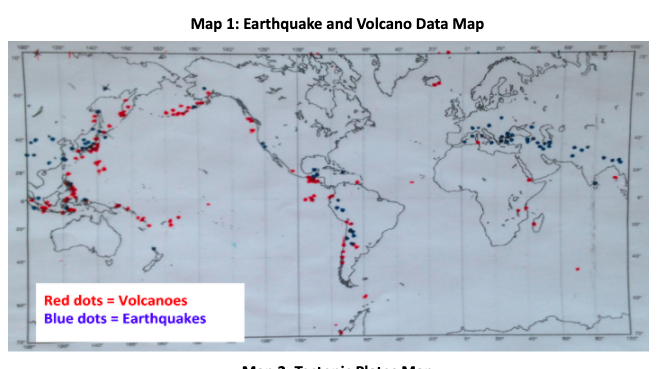
Map 1 shows earthquake and volcanic activity around the world. You can click on the fullscreen button on the bottom right to make it bigger and hover over the map for more information.

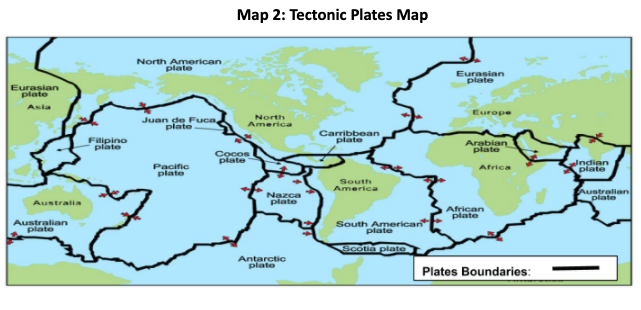
Map 2 shows the tectonic plates that interlock below both the continentS and oceanS. Tectonic plates are pieces of Earth's crust and uppermost mantle, together referred to as the lithosphere (Basically just large pieces of rocks that the continents and ocean floors sit upon) .


2

Look at the Earthquake and Volcano Data Map and Tectonic Plates Map to identify 3 observable trends in the data.

1

Where are most of the volcanoes and earthquakes on earth located?

1

Why do volcanoes and earthquakes occur close to each other?

2

What do you think is the driving force behind the formation of volcanoes and earthquakes? (Hint: think about the mantle)

You will be watching a short video to explore the different types of convergent plate boundaries and the landforms created. Use the information in the video to answer questions 9-11

2

Describe the land features that is formed with a continental crust converges with a continental crust?

2

Describe the land features that is formed with a oceanic crust converges with a oceanic crust?

2

Describe the land features that is formed with a oceanic crust converges with a continental crust?

Use the short reading below to answer questions 12 and 13.


Volcanoes on Earth form from rising magma. Magma rises in three different ways.
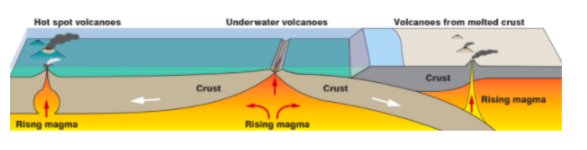


Volcanoes occur when material significantly warmer than its surroundings is erupted onto the surface from Earth's interior. The erupted material can be lava, ash, cinders, and/or gas. There are three reasons why magma might rise and cause eruptions onto Earth’s surface.

Magma can rise when pieces of Earth's crust called tectonic plates slowly move away from each other. The magma rises up to fill in the space. When this happens underwater volcanoes can form. Magma also rises when these tectonic plates move toward each other. When this happens, part of Earth's crust can be forced deep into its interior. The high heat and pressure cause the crust to melt and rise as magma.

A final way that magma rises is over hot spots. Hot spots are exactly what they sound like--hot areas inside of Earth. These areas heat up magma. The magma becomes less dense. When it is less dense it rises. Each of the reasons for rising magma are a bit different, but each can form volcanoes.
2

What are the three different types of volcanoes?

2

How are hotspots different from the other two types of volcanoes?