On the Field Trip
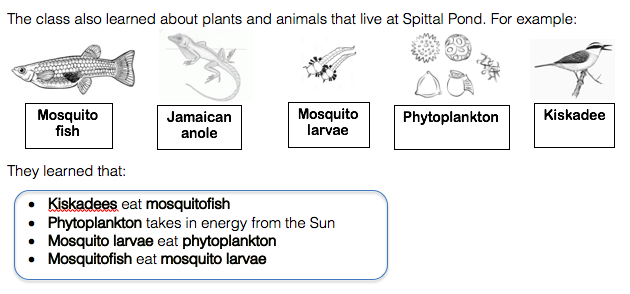
Ms. Lightbourne’s P6 class learned about plants and animals that live at Spittal Pond.
Read the statements in questions 1 -7 . Which ones are true and which ones are false?
Consumers make their own food via phtotsynthesis.
Food chains show relationships between what different organisms eat in a habitat.
Food chains begin with a consumer.
Almost all producers get their energy from the Sun.
Animals are called consumers because they eat other organisms.
Predators are eaten by prey.
A predator can be a carnivore or a herbivore.
On the Field Trip
Create a food chain based on the information above.
Click on "show your work"
Type the name of the organisms on the lines. Draw in the arrows between each organism.
Click the blue check mark in the corner when you are done.
Which organism in the food chain above is the producer?
Where do producers get their food from?
Identify organisms from this food chain that are predators.
Identify organisms from this food chain that are prey.
Identify organisms from this food chain that are consumers.
For the last question, you will create your own food chain.
Click on "show your work" and then follow the instructions to create your own food chain.
Click the blue check mark in the corner when you are done.
Yellow crowned night herons like to eat land crabs. Land crabs live on the small field at Gilbert Institute primary school. One teacher has been monitoring the numbers of crabs and herons seen on the field for many years. Here is what she found:

Look at the data above and select the correct answer to complete each statement.
On average, the number of land crabs seen over the years:
What do you notice about the number of herons seen over the years?
Do you think the number of herons had an effect on the number of land crabs in the area?
Look at your answer to question 17.
Why do you think this happened?