The annual precipitation, as measured by the National Weather Service, for Green Ridge, Wisconsin was recorded by environmental scientists interested in climatological changes.
Enter the data all into list 1, use your calculator to calculate the 5# summary.
Stat, edit, stat, calc, 1-var stats.
Make sure the list agrees with the location of your data.
List the 5# summary separating the numbers by commas.
Ex. 3.1, 5.3, 12.6, 15.4, 21.3
Question 3
3.
The annual precipitation, as measured by the National Weather Service, for Green Ridge, Wisconsin was recorded by environmental scientists interested in climatological changes.
Enter the data, use your calculator to calculate the mean (x-bar) and the standard deviation (Sx).
Stat, edit, stat, calc, 1-var stats.
Make sure the list agrees with the location of your data.
List the mean and standard deviation separated by commas. Round to three places past the decimal point.
Ex. 13.457, 11.231
Question 4
4.
Question 5
5.
Question 6
6.
The annual precipitation, as measured by the National Weather Service, for Green Ridge, Wisconsin was recorded by environmental scientists interested in climatological changes.
Refer to #2, the 5# summary.
Calculate the IQR.
Calculate the lower and upper fences.
List them separated by a comma: lower fence, upper fence.
Round to one place past the decimal.
Ex. 5.4, 45.3
Question 7
7.
The annual precipitation, as measured by the National Weather Service, for Green Ridge, Wisconsin was recorded by environmental scientists interested in climatological changes.
Refer to #2, the 5# summary.
Calculate the IQR.
Calculate the lower and upper fences.
Are there any outliers? If so, identify them.
Question 8
8.
The annual precipitation, as measured by the National Weather Service, for Green Ridge, Wisconsin was recorded by environmental scientists interested in climatological changes.
Refer to #2, the 5# summary, the IQR and the calculated lower and upper fences.
If the value of 74.1 inches of rain were added to the data, would it be an outlier?
How do you know?
Question 9
9.
The number of hours slepton the weekend was recorded for a statistics class. The data distribution is shown below:
Which summary statistics are appropriate for describing the data distribution?
Why?
Select the correct answer below.
Question 10
10.
The number of hours slepton the weekend was recorded for a statistics class. The data distribution is shown below:
If a student missed class but added his data the next day, he slept only 2 hours because he had a huge project due on Monday. What statistics would be changed and how?
IQR
Median
Standard Deviation
Mean
Question 11
11.
The number of hours slepton the weekend was recorded for a statistics class. The data distribution is shown below:
Using the graphed data above, how many students were present on the day the data was collected?
What is the range as a single number?
Enter both below separated by a comma.
Ex. # students, range
Question 12
12.
The annual precipitation, as measured by the National Weather Service, for Green Ridge, Wisconsin was recorded by environmental scientists interested in climatological changes.
Interpret the quartiles below by matching them with their correct interpretation.
25% of the precipitation is below 19.7 in.
25% of the precipitation is above 40.9 in.
4
Question 13
13.
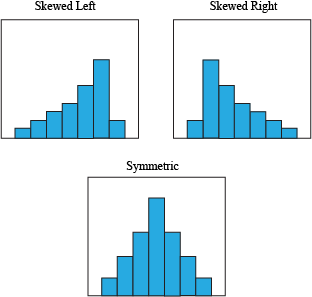
Which measure of center would be more appropriate for the data shown by the histogram (mean or median)?
4
4
4
4
4
4
4
Question 20
20.
Which summary statistics would be appropriate to record for the histogram?
4
The annual precipitation, as measured by the National Weather Service, for Green Ridge, Wisconsin was recorded by environmental scientists interested in climatological changes.
Enter the data, use your calculator to create a histogram (Stat, Edit, then 2nd, y=, select a histogram).
Use ‘window’ to clean up the distribution (Xmin=0, Xmax=60, Xscl=5, Ymin= -1, Ymax=8).
Use ‘graph’ to view the histogram.
Describe the histogram, select all that are correct.
Use the list of actual data for your spread (range).
Use the interval to show the center.
Remember to CUSS about the description, so there are four correct answers.
The center is at 25 to <30 in.
The spread is 0 to 60 in.
There is a gap from 35 to <40 in.
There is nothing unusual about the data distribution.
The shape is unimodal and skewed left.
The spread is 43.3 in.
The center is at 30 to <35 in.
The shape is bimodal and symmetric.
The shape is unimodal and skewed right.
The shape is bimodal and skewed right.
The shape is unimodal and symmetric.
The center is at 20 to <25 in.
The shape is bimodal and skewed left.
The annual precipitation, as measured by the National Weather Service, for Green Ridge, Wisconsin was recorded by environmental scientists interested in climatological changes.
Think back to #1, the description of the histogram.
Which summary statistics (mean and Std Dev OR Median and IQR) would be appropriate for describing the data distribution?
Why?
Select the two correct answers.
The data distribution is skewed to the right.
The mean and standard deviation
The median and IQR
Cannot be determined.
The data distribution is skewed to the left.
The data distribution is symmetric.
The annual precipitation, as measured by the National Weather Service, for Green Ridge, Wisconsin was recorded by environmental scientists interested in climatological changes.
Refer to #2, the 5# summary.
Calculate the IQR.
Describe (interpret) what it shows.
Select the two correct answers.
The lower 50% of the data.
21.2
18.5
The middle 50% of the data.
The upper 50% of the data.
24.9
No, it is above the upper fence.
No, it is not above the upper fence.
Yes, it is above the upper fence.
Yes, it is not above the upper fence.
It cannot be determined.
Median and IQR because the data is skewed.
Range
Remain roughly the same
Increase
Decrease
75% of the precipitation is above 19.7 in.
50% of the precipitation is below 27.3 in.
50% of the precipitation is above 27.3 in.
75% of the precipitation is below 40.9 in.
Q1
Median
Q3
Question 14
14.
Which measure of center would be greater or would they be the same (mean or median or the same)?
Question 15
15.
Which measure of center would be more appropriate for the data shown by the histogram (mean or median)?
Question 16
16.
Which measure of center would be greater or would they be the same (mean or median or the same)?
Question 17
17.
Which measure of center would be more appropriate for the data shown by the histogram (mean or median)?
Question 18
18.
Which measure of center would be greater or would they be the same (mean or median or the same)?
Question 19
19.
Describe the shape of the histogram to the left:
Select all that apply.
There are two correct answers.
Question 21
21.
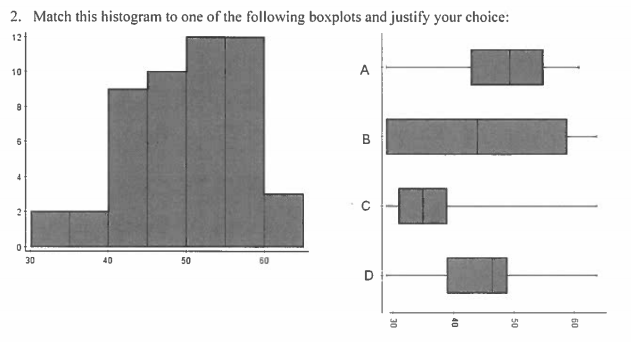
Which boxplot corresponds the most closely with the histogram?