FM: Lesson 3.2b (10/13)
star
star
star
star
star
Last updated about 3 years ago
10 Nsɛmmisa


0
0
0
0
0
2
0
2
0
0
All three chairs have the same mass, but were pushed in different directions. Identify which chair (Blue, Black, or Pink) chair experienced the greatest force. Show your work/thought process.
Unit 2: Force and Motion
Chapter 3: Collisions
Lesson 3.2: Investigating Collision Forces
Activity: Simulation
PART I:
For Each Trial, Drag a second 1kg object into the screen and place it on the same plane as object A, 8 grid unit apart.

Change the initial velocity of each object as described in your data table.
Press RUN and observe how the velocity of each object changes due to the collision.
Record your observations in the data table. For the effect, choose from the following options:
speed up, slow down, start moving, stop moving, change direction
Press ANALYZE to determine the strength and direction of the force exerted on each object. Record in the data table.
Press ANALYZE to determine the strength and direction of the force exerted on each object. Record in the data table.
What relationship do find between mass and acceleration in a collision?
CFS:
accurately identifies the changes to each object in a collision
accurately describes the relationship between force, mass and velocity in a collision
accurately identifies the strongest sources of evidence from the experimental data
How is the force on Object A related to the force on Object B?
CFS:
accurately identifies the changes to each object in a collision
accurately describes the relationship between force, mass and velocity in a collision
accurately identifies the strongest sources of evidence from the experimental data
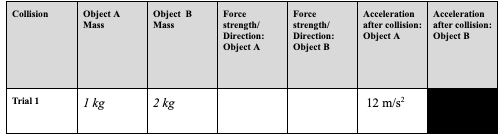
Calculate the force of Object A on Object B AND the acceleration of Object B after the collision.

Calculate the force of Object A on Object B AND the acceleration of Object B after the collision.
Part II:
For Each Trial, drag a second object of a different mass into the screen and place it on the same plane as object A, 8 grid unit apart.

Record the mass of each object in the data table.
Change the initial velocity of each object as described in your data table.
Press RUN and observe how the velocity of each object changes due to the collision.
Record your observations in the data table. For the effect, choose from the following options:
speed up, slow down, start moving, stop moving, change direction
Press ANALYZE to determine the strength and direction of the force exerted on each object. Record in the data table.
Press ANALYZE to determine the strength and direction of the force exerted on each object. Record in the data table.
What relationship do find between mass and the total force in a collision?
CFS:
accurately identifies the changes to each object in a collision
accurately describes the relationship between force, mass and velocity in a collision
accurately identifies the strongest sources of evidence from the experimental data
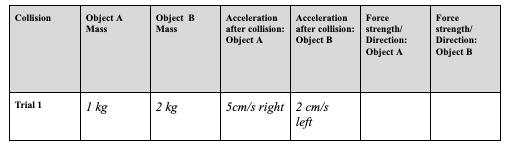
What relationship do find between mass and acceleration in a collision?
CFS:
accurately identifies the changes to each object in a collision
accurately describes the relationship between force, mass and velocity in a collision
accurately identifies the strongest sources of evidence from the experimental data
How is the force on Object A related to the force on Object B?
CFS:
accurately identifies the changes to each object in a collision
accurately describes the relationship between force, mass and velocity in a collision
accurately identifies the strongest sources of evidence from the experimental data