Week 9 Reading Summative
star
star
star
star
star
Last updated almost 6 years ago
12 Nsɛmmisa
1
1
1
1
1
1
3
1
1
1
1
1
Science Experiment
Bean seeds are very easy to grow. You can experiment to discover what type of liquid will grow the best bean plants.
Materials you will need:
a packet of bean seeds
some potting soil
6 plastic cups
apple juice
soda water
tap water
a 1-cup measuring cup
a measuring cup that measures 1/8 cup
a ruler
a pen for labeling
paper for taking notes
Procedure:
Label the plastic cups: Water A, Water B, Soda Water A, Soda Water B, Apple Juice A, and Apple Juice B.
Fill each cup with 2 cups of potting soil.
Press one bean seed 4 cm deep into the soil of each cup.
Pour 1/8 cup tap water into the cups labeled Water A and Water B.
Pour 1/8 cup soda water into the cups labeled Soda Water A and Soda Water B.
Pour 1/8 cup apple juice into the cups labeled Apple Juice A and Apple Juice B.
Set the plastic cups in a well-lit area in a safe spot.
Pour 1/8 cup of the correct liquid into the correct cup every other day.
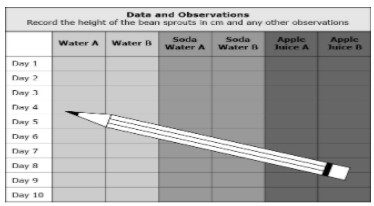
Every day, observe the cups for growth, and write down what you see. When the beans begin to sprout, use the ruler to measure the height of the shoots. Make a table like the one below to record your data and observations.
After ten days, you will be able to answer the question: Which liquid will grow the best bean plants?
Use the above text to answer the questions.
Which step would make sense to add after step “3) Press one bean seed 4 cm deep into the soil of each cup.” ? 4LA.B.12
In step 9 the word “shoots” is used. What does it mean here? 4LA.B.13
What is the main idea of this informational text? 4LA.B.11
Hurricanes and Tornadoes
by Gustavo Cardoso
1 Hurricanes and tornadoes are two of the strongest storms in nature. Their destructive power can cause millions of dollars in damage. But what causes these intense storms?
2 A hurricane is a rotating, or spinning, storm with heavy winds. It begins near the equator when wind, a thunderstorm, and warm ocean water meet. The wind sweeps up warm, moist air from the ocean�s surface. This air feeds the thunderstorm, making it grow larger and stronger. As more air is added, the storm begins to rotate, which creates a calm area in the center of the storm called the eye. Once the winds reach 39 miles per hour, the storm is called a tropical storm. If the winds reach 74 miles per hour, it becomes a hurricane.
3 A tornado is a spinning column of air that stretches from a thunderstorm to the ground. It can form anywhere if the weather conditions are right. Scientists don't fully understand how a thunderstorm becomes a tornado. They do know a tornado can form when warm, wet winds meet cold, dry air. The cold air traps the warm air underneath it, causing the warm air to spin. This spinning air rises through the cold air, which is then pushed below the warm air, creating a long spinning column of air. This column is called a funnel cloud. When it touches the ground, it is called a tornado.
4 Even though hurricanes and tornadoes are different types of storms, they are formed by some of the same weather conditions. Scientists study these weather conditions to learn how to better predict these powerful and dangerous storms. Knowing when a storm will strike can give people living in the area time to get to safety.
Which sentence from the passage best explains why strong storms are so harmful?
When does a funnel cloud become a tornado?
When is a storm considered a hurricane?
In which three ways are hurricanes and tornadoes similar?
Which statement best explains how hurricanes form?
How are hurricanes and tornadoes similar?
Which is a main idea of the passage?
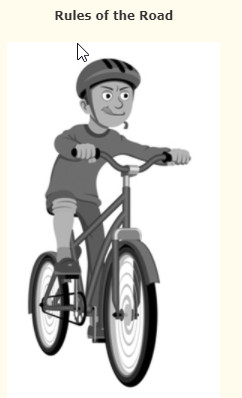
1 Riding a bicycle is one of the great thrills in life. Once you get going, the wind rushes against your face. Objects move quickly out of view. It feels like flying. Plus, there's a big bonus. You now have the ability to go places on your own. Some kids ride their bicycles to school. Others ride to the park or their friend's house. As long as you are safe, riding a bike is an exciting skill to have.
Knowing the Rules of the Road
2 To get around on a bike, you'll have to learn to ride on the street. To ride on the street, you have to learn the rules of the road. The best way to learn the rules of the road is when you're in a car. Watch how drivers react to traffic signs. Observe the flow of cars. Ask the driver questions about the things you see. In this way, you'll come to understand how driving on the road works.
3 Riding a bicycle is just like driving a car. When you're riding on a street, you share the road with cars that are much bigger than you are! You don't want to get hurt. You also don't want to hurt anyone. By knowing and following the rules of the road, you will be sure to arrive safely. Here's a list of safety tips for bicyclists.
Traffic Safety Rules for Bikers
1. Know what traffic signs mean.
2. Ride with traffic on the right side of the street.
3. Learn to use hand signals so other drivers know what you are about to do.
4. Keep both hands on the handlebars, except when giving hand signals.
5. When traveling with others, ride in a single line, not side-by-side.
6. Slow down and look both ways when coming to cross streets.
7. Walk your bike across busy streets.
8. Most bikes are meant for one rider, so keep it that way.
9. Watch out for hazards in the road, like holes, sticks, or animals.
10. People on foot always have the right of way.
11. Watch for cars pulling into traffic as they may not see you.
12. When riding near parked cars, be on the lookout for opening doors.
13. Always wear a helmet to protect your head in case of a crash.
Making Your Bike Safe to Ride
4 Before drivers of cars start to move, they do certain safety checks. They check their mirrors. They fasten their seat belts. Before you get on a bike, there are some safety checks that you should do, too.
5 Adjust your bicycle to fit you. Stand over your bicycle. There should be one to two inches between you and the top bar. The seat should be level. The seat height should allow your feet to touch the ground easily. The handlebars should be near the same level as the seat.
6 Check your equipment. Before riding, inflate the tires properly. Check that your brakes work. Also, make sure your clothing cannot get caught in the chain or wheels.
7 See and be seen. Always wear bright colors when riding your bike. Make sure your bike has reflectors and reflective tape every place it will stick. Flashing lights are also good. Just because you can see a car doesn't mean the driver can see you. The flashier you are, the better your chances are of being seen. Once you have checked your equipment, you are ready for a safe ride.
8 Practice before you go. It's best to practice riding on the street with the help of someone older before you go too far. You and your parents must feel confident in your skills before you set out on your own. Be certain that you are truly ready. It's not enough to know how to operate your bicycle. You must also know the rules of the road and be a safe driver.
The Benefits of Bicycling
9 Once you've learned to be a safe driver, you can enjoy the benefits of biking. Bikes don't cost a lot of money to operate. They also create zero emissions, so they're environmentally friendly. Biking is good exercise and makes you healthier. You can also travel five times faster than walking. And when performed safely, bicycling is a thrill and a skill that will last a lifetime.
Which is the main idea of the passage?
Which evidence from the passage best supports the response in question 11?