In our final quarter of preparations for the SAT, we will be working on timing by using paired passages to train.
Please read the Paired Passage and answer the Short Answer questions in complete sentences. While these extra steps may seem "extra" or "time-consuming," they are designed to improve your reading skills and accuracy on the comprehension questions.
Question 1
1.
Access Prior Knowledge: What do you know about the author of either Passage 1 or 2?
Question 2
2.
What is the author's claim in Passage 1?
Question 3
3.
What is the author's claim in Passage 2?
Before you approach the questions, consider: How do the two passages relate to one another?
Question 4
4.
Do you think the authors would agree or disagree? Explain why.
SAT Paired Passages are intimidating, but deceivingly easy to use Process of Elimination. If an answer does not fit one Passage, it's out!
Half-right, but half-wrong is allwrong!
Regular Credit: 6, 7, 8, 11, 12
Extra Credit: 5, 9, 10, 13
Question 5
5.
Question 6
6.
Question 7
7.
Question 8
8.
Question 9
9.
Question 10
10.
Question 11
11.
Question 12
12.
Question 13
13.
Question 14
14.
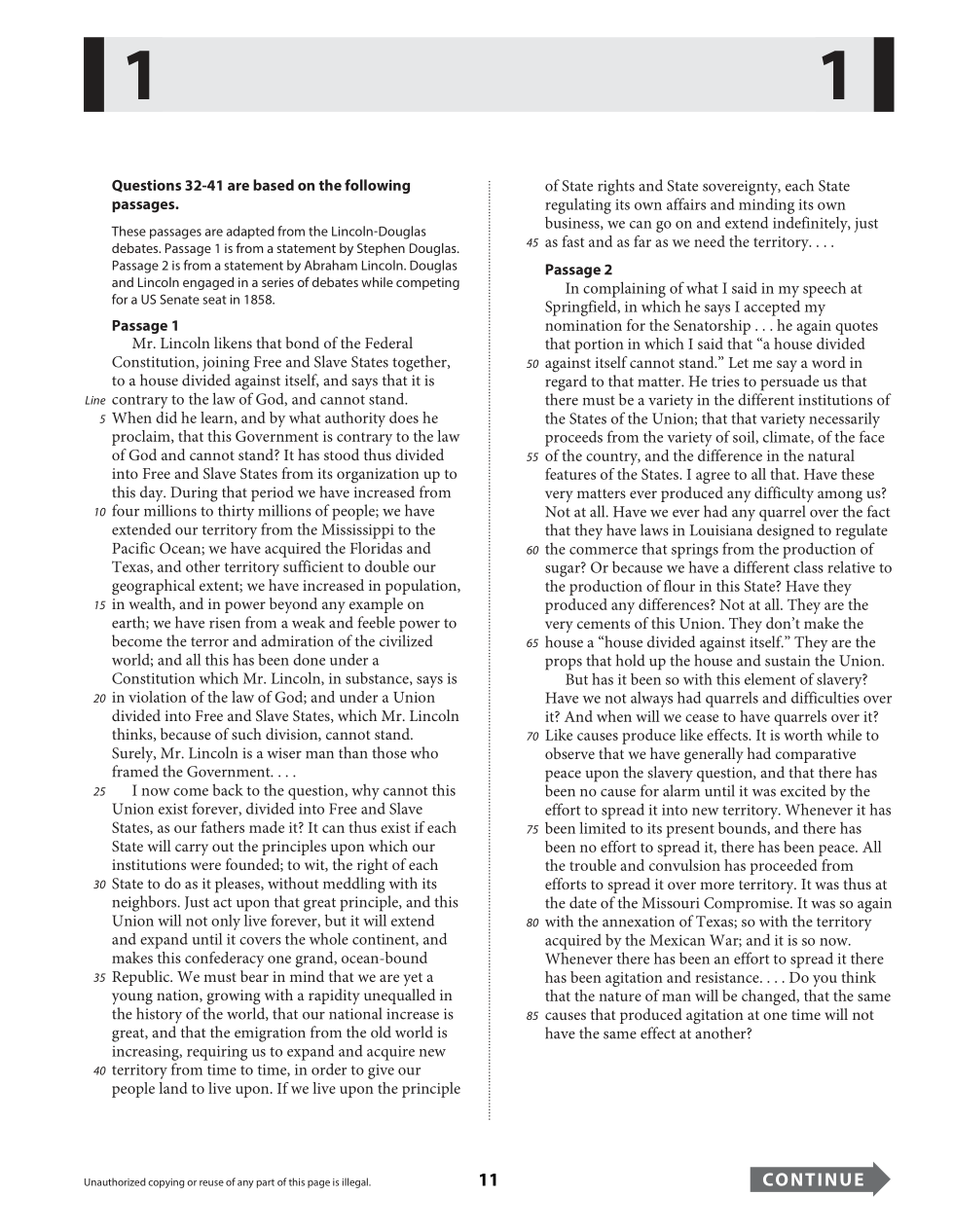
In the first paragraph of Passage 1, the main purpose of Douglas’s discussion of the growth of the territory and population of the United States is to
provide context for Douglas’s defense of continued expansion.
suggest that the division into free and slave states does not endanger the Union.
imply that Lincoln is unaware of basic facts concerning the country.
account for the image of the United States as powerful and admirable.
What does Passage 1 suggest about the US government’s provisions for the institution of slavery, as framed in the Constitution?
They provided a good basic structure that does not need to be changed.
They were founded on an assumption that slavery was necessary for economic growth.
They included no means for reconciling differences between free states and slave states.
They anticipated the Union’s expansion into western territories.
Which choice provides the best evidence for the answer to the previous question?
Lines 10-16 (“we have . . . earth”)
Lines 25-27 (“I now . . . made it”)
Lines 35-39 (“We must . . . increasing”)
Lines 41-45 (“If we . . . territory”)
As used in line 67, “element” most nearly means
environment.
factor.
quality.
ingredient.
Based on Passage 2, Lincoln would be most likely to agree with which claim about the controversy over slavery?
It would abate if attempts to introduce slavery to regions where it is not practiced were abandoned.
It has been exacerbated by the ambiguity of laws regulating the holding of slaves.
It is fueled in part by differences in religion and social values from state to state.
It can be ended only if Northern states act unilaterally to abolish slavery throughout the United States.
Which choice provides the best evidence for the answer to the previous question?
Lines 56-61 (“I agree . . . sugar”)
Lines 64-66 (“They don’t . . . Union”)
Lines 74-76 (“Whenever . . . peace”)
Lines 83-86 (“Do you . . . another”)
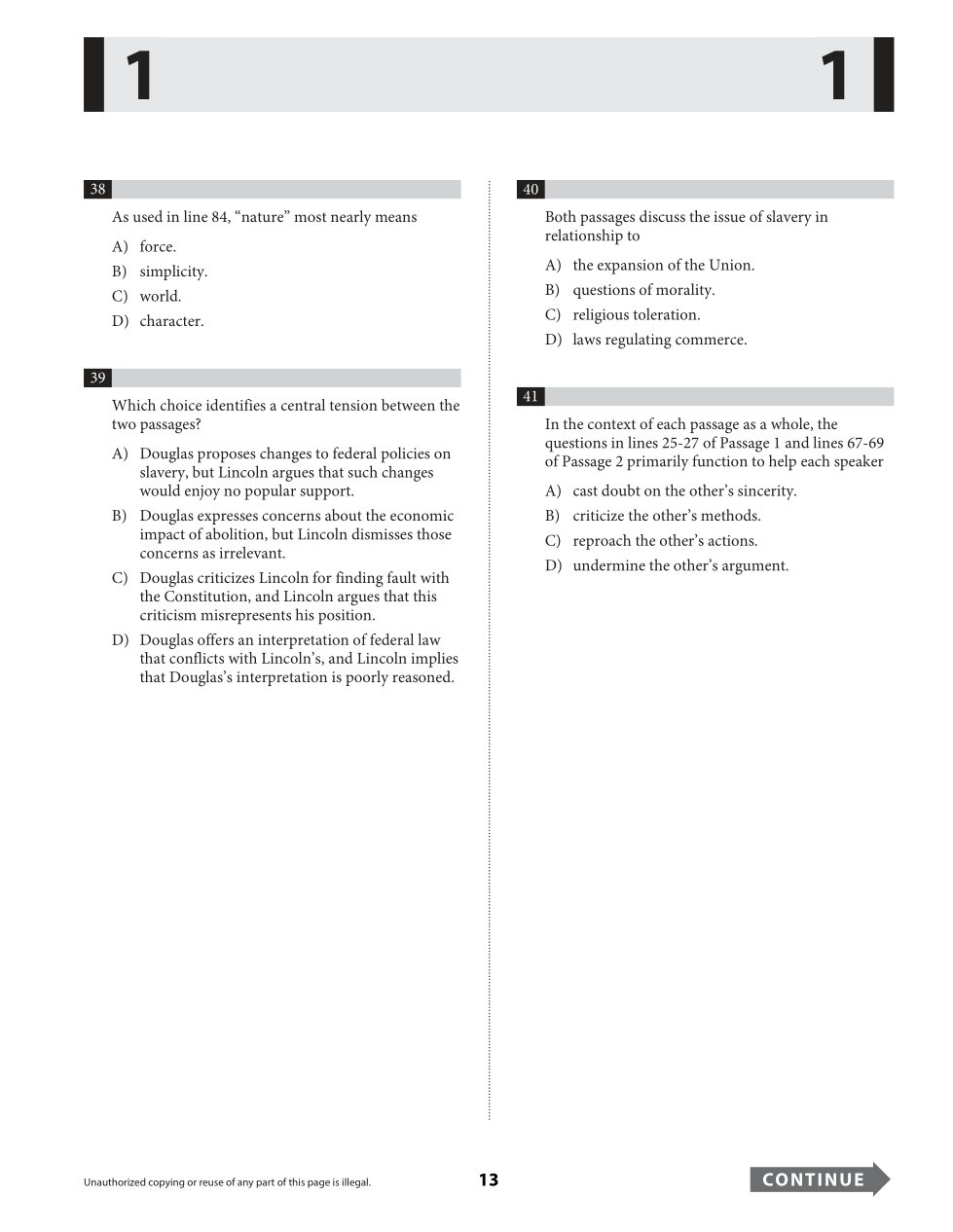
As used in line 84, “nature” most nearly means
world.
character.
simplicity.
force.
Which choice identifies a central tension between the two passages?
Douglas proposes changes to federal policies on slavery, but Lincoln argues that such changes would enjoy no popular support.
Douglas criticizes Lincoln for finding fault with the Constitution, and Lincoln argues that this criticism misrepresents his position.
Douglas expresses concerns about the economic impact of abolition, but Lincoln dismisses those concerns as irrelevant.
Douglas offers an interpretation of federal law that conflicts with Lincoln’s, and Lincoln implies that Douglas’s interpretation is poorly reasoned.
Both passages discuss the issue of slavery in relationship to
religious toleration.
laws regulating commerce.
questions of morality.
the expansion of the Union.
In the context of each passage as a whole, the questions in lines 25-27 of Passage 1 and lines 67-69 of Passage 2 primarily function to help each speaker