Log in
Sign up for FREE
arrow_back
Library

APUSH SAT Practice Passage 5

star
star
star
star
star
Last updated almost 2 years ago
15 questions
1
1
IIWD.01
1
1
SMT.01
1
SMT.01
1
SMT.01
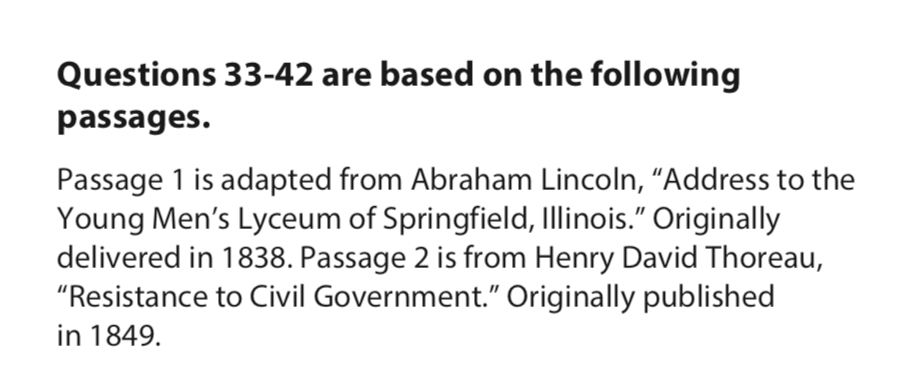
STOP! If you have the hard copy of SAT Practice Passage 5: Lincoln v. Douglas, please grab it now.

Hint: A U.S. History packet was mailed to you if you didn't pick it up from Q3 Materials Pick Up. Look for a yellow manila envelope from "Ms. Truong."
1
Question 1
1.

What do you already know about either the author of Passage 1 (Lincoln) or Passage 2 (Thoreau)?

Question 2
2.

Have you ever been asked to follow a rule that you don't believe in? Explain the rule and what you chose to do.

Welcome to SAT Practice Passage 5!

As your last practice passage before you take the SAT for real (😱), the formatting of this has changed to remind you to focus on process over perfection. This means you shouldn't try to get every question right, but rather focus on developing the reading strategies we've been working on all year!

Consequently, you are being graded on the open-ended questions (#1-2, 8-9, 12) in adding to the following question types we've been working on all year:

  • SAT Full Credit: #3, 5, 7, 10, 13
  • SAT Extra Credit: #4, 11, 14, 15
1
IIRC.01
1
IITE.01
1
IIWD.01
0
RTS.02
Question 7
7.

1
Question 8
8.

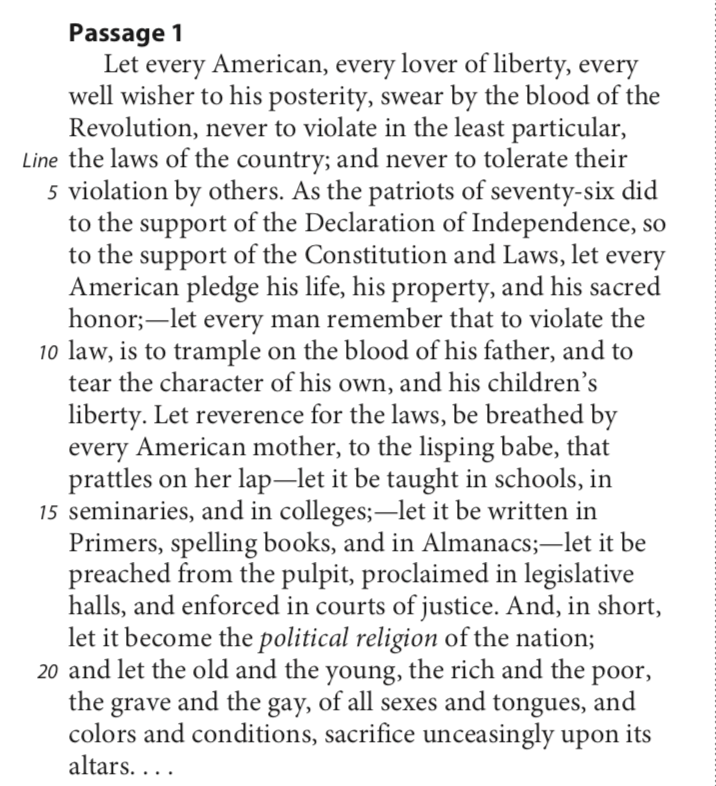
What is the author's claim in Passage 1 (Lincoln)?

1
Question 9
9.

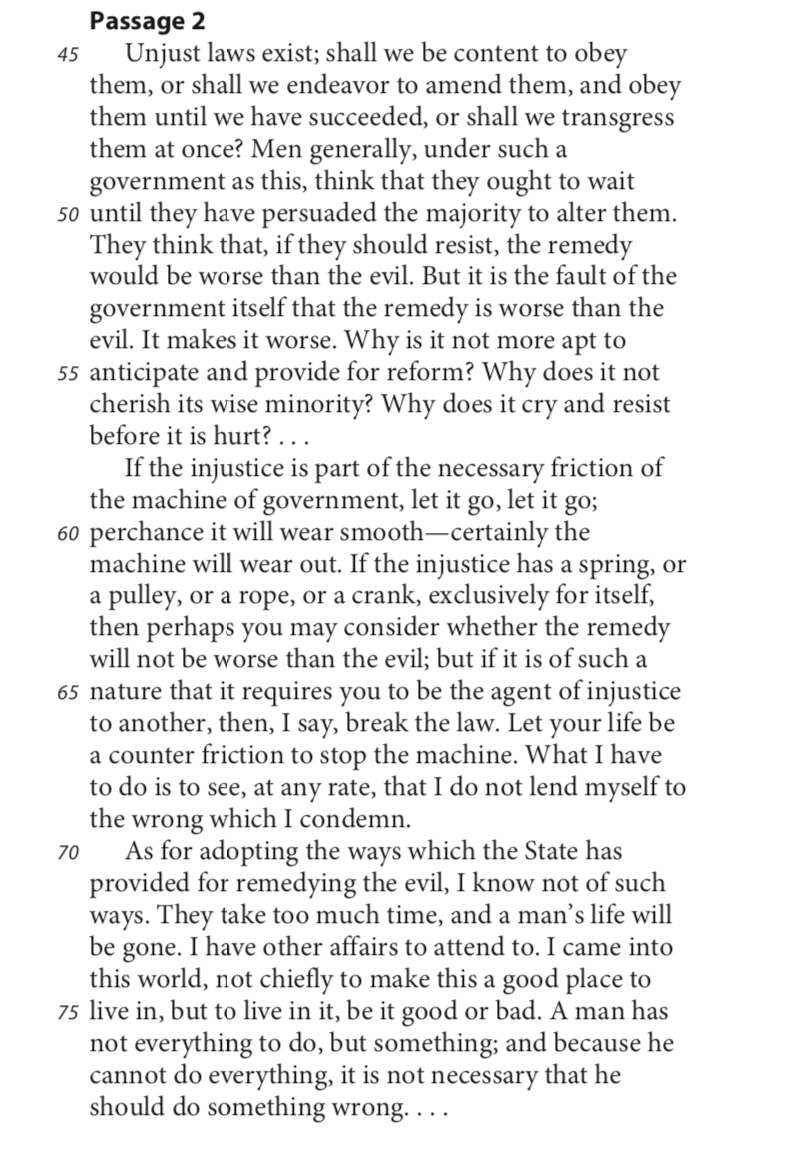
What is the author's claim in Passage 2 (Thoreau)?

1
IIRC.01
1
IITE.01
Question 12
12.

Do you think the authors would agree or disagree? Explain.

Question 13
13.

Question 14
14.

Question 15
15.

Question 3
3.

Question 4
4.

Question 5
5.

Question 6
6.

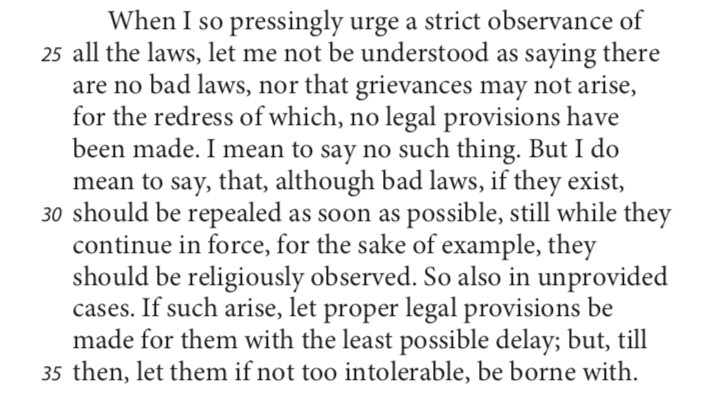
As used in line 32, “observed” most nearly means
contemplated
followed
noticed
scrutinized
Question 10
10.

Question 11
11.

The primary purpose of each passage is to
advance a view regarding whether individuals should follow all of the country’s laws.
articulate standards by which laws can be evaluated as just or unjust.
make an argument about the difference between legal duties and moral imperatives.
discuss how laws ought to be enacted and changed in a democracy.
Based on the passages, Lincoln would most likely describe the behavior that Thoreau recommends in lines 64-66 (“if it . . . law”) as
a rejection of the country’s proper forms of remedy.
an honorable response to an unjust law.
a misapplication of a core principle of the Constitution.
an excusable reaction to an intolerable situation.
Based on the passages, one commonality in the stances Lincoln and Thoreau take toward abolitionism is that
neither author expects the cause to win widespread acceptance.
both authors see the cause as warranting drastic action.
both authors view the cause as central to their argument.
neither author embraces the cause as his own.
In Passage 1, Lincoln contends that breaking the law has which consequence?
It leads slowly but inexorably to rule by the mob.
It slows the repeal of bad laws.
It undermines and repudiates the nation’s values.
It creates divisions between social groups.
Which choice provides the best evidence for the answer to the previous question?
A) Lines 9-12 (“let every man . . . liberty”)
B) Lines 20-23 (“and let . . . altars”)
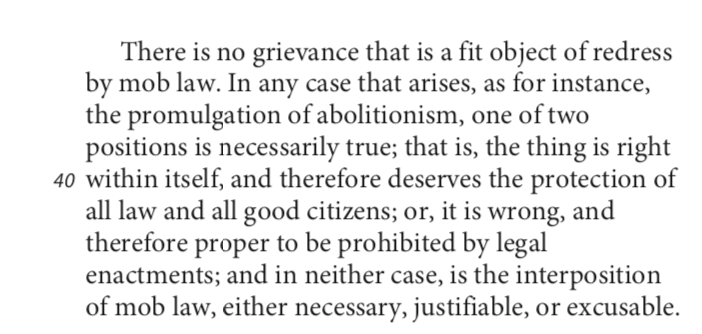
C) Lines 33-35 (“If such . . . borne with”)
D) Lines 36-37 (“There . . . law”)
As used in line 24, “urge” most nearly means
require
stimulate
advocate
hasten
The sentence in lines 24-28 (“When . . . made”) primarily serves which function in Passage 1?
It identifies and concedes a crucial shortcoming of Lincoln’s argument.
It acknowledges and substantiates a central assumption of Lincoln’s argument.
It raises and refutes a potential counterargument to Lincoln’s argument.
It anticipates and corrects a possible misinterpretation of Lincoln’s argument.
In Passage 2, Thoreau indicates that some unjust aspects of government are
subtle and must be studied carefully.
inevitable and should be endured.
superficial and can be fixed easily.
self-correcting and may be beneficial.
Which choice provides the best evidence for the answer to the previous question?
A) Lines 45-48 (“Unjust . . . once”)
B) Lines 51-52 (“They . . . evil”)
C) Lines 58-59 (“If the injustice . . . go”)
D) Lines 75-78 (“A man . . . wrong”)