Use words, numbers, and your model to explain why each of the digits from question 2 has a different value. Be sure to use “ten times as large” and “one tenth as large” in your explanation.
1 point
1
Question 4
4.
Multiply 77.7 × 10³ . Explain the shift of the digits and the change in the value of each digit.
1 point
1
Question 5
5.
Divide the product from the previous problem by 104 . Explain the shift of the digits and the change in the value of each digit.
1 point
1
Question 6
6.
Rainfall collected in a rain gauge was found to be 3.2 cm when rounded to the nearest tenth of a centimeter. Circle all of the measurements that could be the actual measurement of the rainfall.
1 point
1
Question 7
7.
Convert the rounded measurement from the previous problem to meters. Write an equation to show your work. Put the rainfall measurements in order from least to greatest. Write the smallest total rainfall in word form and expanded form.
1 point
1
Question 8
8.
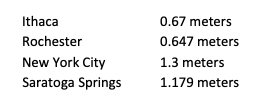
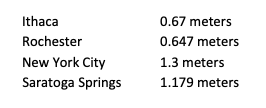
Average annual rainfall totals for cities in New York are listed below.
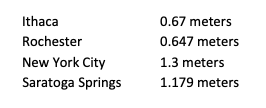
Put the rainfall measurements in order from least to greatest.
1 point
1
Question 9
9.
Write the smallest total rainfall from the previous problem in word form AND expanded form.
1 point
1
Question 10
10.
Round each of the rainfall totals to the nearest tenth.
1 point
1
Question 11
11.
Imagine New York City's rainfall is the same every year. How much rain would fall in 100 years?
1 point
1
Question 12
12.
Write an equation using an EXPONENT that would express the 100-year total rainfall. Explain how the digits have shifted position and why.