FM: Lesson 3.2c (9/21) Version B
star
star
star
star
star
Last updated about 3 years ago
8 Nsɛmmisa

0
0

0
0
0
0
2
2
Bryan loves to cruise around downtown. Sometimes, he even takes his bikes over lots of stairs. Which jump does he experience the greatest force?
Which ride does he experience the greatest force?
Modeling forces that are exerted when two objects collide (strength and direction)
Draw force arrows in the EACH panel so it shows the strength and direction of forces exerted on each object in each phase of the collision.

Confirm the force and predict the acceleration of Object 2 after the collision?
What is the relationship between the amount of force Object 1 and Object 2 experience in a collision?
CFS:
accurately identifies the changes to each object in a collision
accurately describes the relationship between force, mass and velocity in a collision
accurately identifies the strongest sources of evidence from the experimental data
Modeling forces that are exerted when two objects collide (strength and direction)
Draw force arrows in the EACH panel so it shows the strength and direction of forces exerted on each object in each phase of the collision.
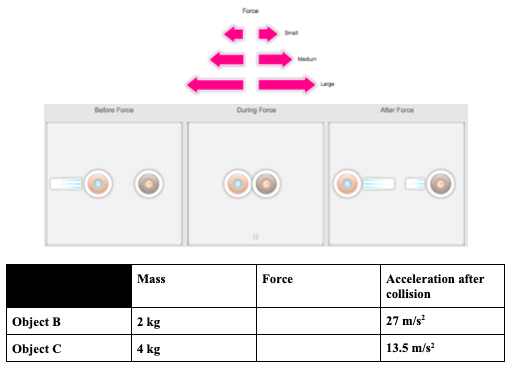
How much force was applied to Object B and C during the collision?
What evidence can you find to support why Object 1 or Object 2 experience a different acceleration after the collision?
CFS:
accurately identifies the changes to each object in a collision
accurately describes the relationship between force, mass and velocity in a collision
accurately identifies the strongest sources of evidence from the experimental data
Modeling forces that are exerted when two objects collide (strength and direction)
Draw force arrows in the EACH panel so it shows the strength and direction of forces exerted on each object in each phase of the collision.

How much force was applied to Object A and B during the collision?
What evidence can you find to support why Object 1 or Object 2 experience a different acceleration after the collision?
CFS:
accurately identifies the changes to each object in a collision
accurately describes the relationship between force, mass and velocity in a collision
accurately identifies the strongest sources of evidence from the experimental data