Mixture Separation Lab

Last updated about 5 years ago
10 questions
Background Information:
Have you ever thought of your eyes as powerful tools for studying chemistry? Many of the properties of matter and the changes it undergoes can easily be determined through careful observation. Recall, physical properties include color, odor, solubility, and the state of the matter.

In this lab you will investigate the physical properties of salt, sand, and iron filings. You will examine physical properties such as magnetism and solubility. Finally, you will separate a mixture of these three substances using filtration, magnetism, and evaporation.

Purpose: To identify mixtures as heterogeneous or homogeneous and to successfully separate a mixture.

Materials:
  • sand (SiO2)
  • iron filings (Fe)
  • sodium chloride (NaCl)
  • ring stand
  • ring clamp
  • funnel
  • triple beam balance
  • hot plate
  • stirring rod
  • (2) beakers
  • graduated cylinder
  • metal tongs
  • water

Safety:
  • Avoid touching these chemicals with your hands.
  • Wear goggles and aprons during the experiment.
  • To test if a piece of glassware is hot, bring your hand close to the object BEFORE touching it.
Pre-lab Questions: Answer in complete sentences.
1

Give three physical properties of sugar.

2

Mixing sugar and water is an example of what kind of mixture? Why?

2

Solubility is the ability for a substance to dissolve. Is this a physical or chemical property? Why?

Procedure: Part A - Physical Properties
CAUTION: Do not taste any of the substances or touch them with your hands.
1. Examine each substance on the piece of paper. Record your observations in Data Table 1. Remember to smell a chemical, waft the vapors toward you.
2. Test the effect of a magnet on each substance by passing the magnet under the sheet of paper. Record your observations in data table 1.
3. Mass an empty weigh boat to the correct number of significant figures.
4. Carefully add the sample to the weigh boat and noting the mass.
5. Record the mass of the sample to the correct number of significant figures in data table 1. Place the sample back on the piece of paper.
6. Repeat steps 4-5 for the remaining two samples.
2

Data Table 1: Physical Properties of Substances

Procedure: Part B - Making Your Mixture
1. Pour the iron filings, salt, and sand on the same paper. Examine the mixture and record your observations in Data Table 2.
2. Test the effect of a magnet by passing the magnet under the paper.
3. Pour the mixture into a clean 100-mL beaker.
4. Taking your magnet, insert it into the beaker to remove the iron filings. Record your observations.
5. Add 20mL of tap water and stir the mixture with your stirring rod. Record your observations.
6. Prepare a filtration setup as shown below. See below for filter paper folding technique. Filter the mixture by pouring it into the funnel.
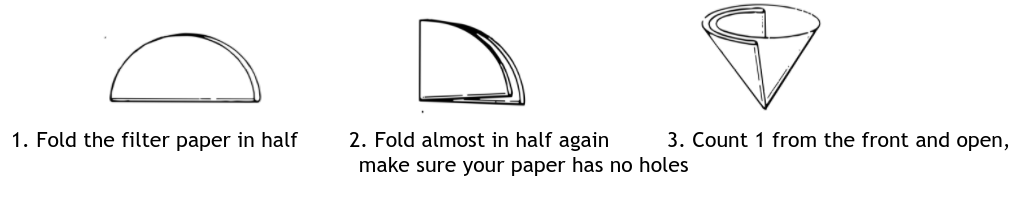


6. Using a hot plate, heat the filtrate in the beaker. Heat the beaker until the water has completely evaporated. Examine both the dry residue in the beaker and the wet residue on the filter paper and record your observations.
1

Data Table 2: Mixture Observations

Clean up: Remove the iron filings from the magnet by using a paper towel to wipe them off into the garbage can. Throw away the filter paper into the garbage can. Rinse the filtrate from the beaker into the sink. Rinse the stirring rod and beakers with plenty of water. Return all materials to the proper location as directed by your teacher. Don't forget to wash your hands!

Post-Lab Questions: Write all answers in complete sentences.
2

When you mixed the salt, sand, and iron filings, did the entire mixture become magnetic? Explain why or why not.

1

What is the criteria used to distinguish between a physical or chemical property?

1

What criteria is used to distinguish between a homogeneous and heterogeneous mixture?

2

From the substances used in this lab, give two examples of heterogeneous mixtures.

1

From the substances used in this lab, give one example of a homogeneous mixture.