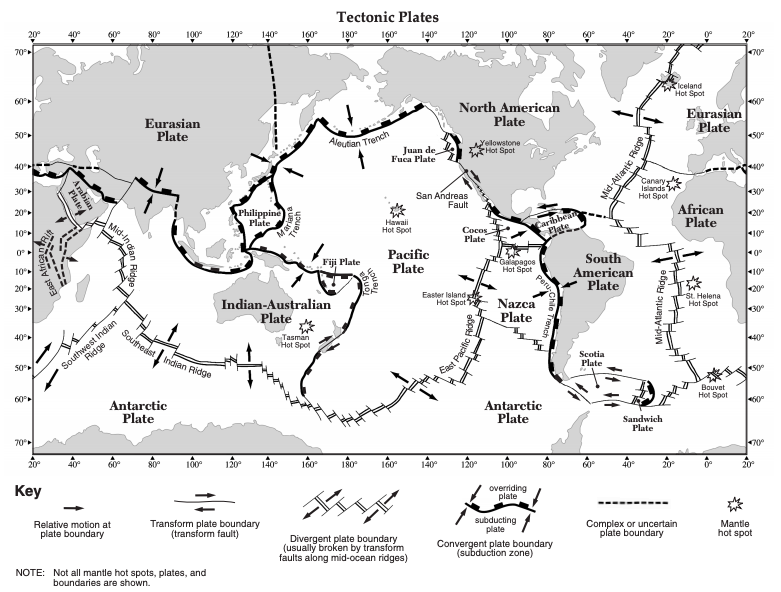
Activity 1: Answer questions 1-5 using the Tectonic Plates map below (ESRT 5).
ESRT 5
Aim: Today we will learn more about plate tectonics, and then we will look at the different types of volcanoes and we will uncover what makes them so deadly.
Activity 1: Answer questions 1-5 using the Tectonic Plates map below (ESRT 5).
According to the key, how do divergent and transform boundaries move?
According to the key, how do you know what plate will subduct?
Name two plates that have all three types of plate boundaries.
Name two plate boundaries where volcanic mountain ranges are being formed.
Where the Juan de Fuca and North American plate converge which will have the volcanic mountain range and which plate will have the trench. Explain your reasoning using the diagram and your background knowledge.
Why is a shield volcano shaped differently than a stratovolcano?
What are some interesting facts about the Krakatoa Eruption of 1883?
Explain in detail why Yellowstone is such a great threat to human civilization?
Could life on Earth recover if every single volcano erupted at once?
Activity 3: Please go to this website and add the emoji extensions for Google Chrome. You will read about volcanoes and analyze the text using emojis. Basically you are rewriting the text only using emojis. Also, depending on your computer, some of the emojis might not be recognized as it will show up as 👨 when you paste it. That happened to me and you just have to find another one. Also, please notice that 🚦is used as a period to demonstrate another sentence or idea is beginning. You do not have to find an emoji for every word, just the ideas behind the words. HAVE FUN!
Example: Example: Mr. Wachter drove with his family to pick apples and choose a pumpkin to carve. His daughter, Isabel, took a picture with Casper the friendly ghost.
Paragraph 1: Volcanoes are very deadly, but there’s no more frightening way to meet your doom than by a pyroclastic flow. These fast-moving ferocious fires look more like summoned demons from a videogame than anything natural – but what exactly happens when one hits you?
Paragraph 2: Pyroclastic flows are the fireworks of the most explosive kinds of volcanic eruptions. These mixtures of ash, lava blebs and super hot gas are normally at temperatures between 200°C and 700°C (390-1300°F), but they can exceed temperatures of 1,000°C (1,832°F). They move at speeds of around 80 kilometers (50 miles) per hour, but have been observed travelling at 700 kilometers per hour (about 450 miles per hour).
Paragraph 3: They tend to rush down the slopes of stratovolcanoes, the steep, mountainous types of volcanoes with the most explosive eruptions. Sometimes, when the ratio of gas to ash is higher, they are referred to as “pyroclastic surges.” These currents are so sparse that have been known to actually go up hills and across water, not just downslope. Basically, if you see one coming towards you, there’s no escape unless you have an extremely agile helicopter.
Paragraph 4: Assuming you’re on the ground, you’ll first encounter the intense heat riding at the front of the flow. If it’s a surge, despite it being cooler than a flow, you will still combust; your skin will rupture and become blackened by the severe heat of the gas before most of the ash even touches you microseconds later.
Paragraph 5: Even hiding inside a building won’t save you. When a surge passes by, the temperature of the air in the environment around it can sometimes be about 300°C (570°F), enough to destroy anything living within mere moments, and certainly high enough to severely damage the linings of your lungs if you breathe any of this heated gas in. If it does hit you, any fabric you have on will quickly burn away, and if you’re wearing any metal, it’ll sear itself into your skin for as long as it is still intact.
Paragraph 1:
Paragraph 2:
Paragraph 3:
Paragraph 4:
Paragraph 5:
What volcano did you decide to choose?
What tectonic plates are involved and what type of crustal movement is occurring (convergence/divergence/transform)
What type of volcano is this and is it dangerous?
Describe the 1st known eruption, most famous eruption, OR most recent eruption. (You are choosing one to describe)