Wolves in Yellowstone Activity
star
star
star
star
star
Last updated over 5 years ago
10 Nsɛmmisa

1
1
1
1
1
1
1
1
1
1
AST 1.5: Evaluate the claims, evidence, and reasoning that the complex interactions in ecosystems maintain relatively consistent numbers and types of organisms in stable conditions, but changing conditions may result in a new ecosystem.
Phenomenon: The presence of wolves dramatically changed the ecosystem of Yellowstone National Park.
Essential Question: How do populations in a community affect each other?
Part 1: Defining the Trophic Cascade
As a class, we'll watch the first 2:37 of this video:
NOTE: If you are having trouble seeing this video, copy this web address into your web browser and watch video directly from the PBS site: https://opb.pbslearningmedia.org/resource/a58e3ca2-52ab-45f5-87ac-26ee0d681146/wolves-of-yellowstone-earth-a-new-wild/
Categorize the below factors as either biotic or abiotic by dragging them and putting them under the Biotic or Abiotic category.
beaver
soil
riverbank
fish
bacteria
air
water
temperature
rock
grass
beaver dam
aspen tree
wolf
elk
Biotic
Abiotic
When wolves were eliminated from the ecosystem, how was the population of plants (producers) indirectly affected?
Sentence frame: When wolves were eliminated, ...
Predict what would happen to the wolf and elk populations if there were a drought that caused many of the plant species to dry up and/or die.
Sentence frame: If _________________, then _________________, because..
Part 2: Analyzing Population Growth Data
Background:
The graphs in this section were taken from a 2012 study by William Ripple and Robert Beschta on trophic cascades in Yellowstone National Park. Aspen, willow, and cottonwoods are common foods for browsers like elk. Willows are also commonly eaten by beavers.
If scientists want to measure trees and shrubs to look for the impact that browsers are having on their growth, they might measure the following things:
Height: A measure of height can tell scientists how tall the trees are allowed to grow. If the mean tree height in one area is low compared to another area that could be an indication of heavy browsing by elk.
Recruitment: Recruitment is the growth of seedlings or sprouts above the level of browsers. In other words, the trees are able to grow taller than the level at which elk and other browsers can eat them.
# of Rings: Tree rings indicate the age of a tree – the more rings a tree has, the older it is. Increases in these three measurements can indicate an increase in the level of health of the woody plants. Decreases in these measurements could indicate a higher level of browsing pressure on the plants.
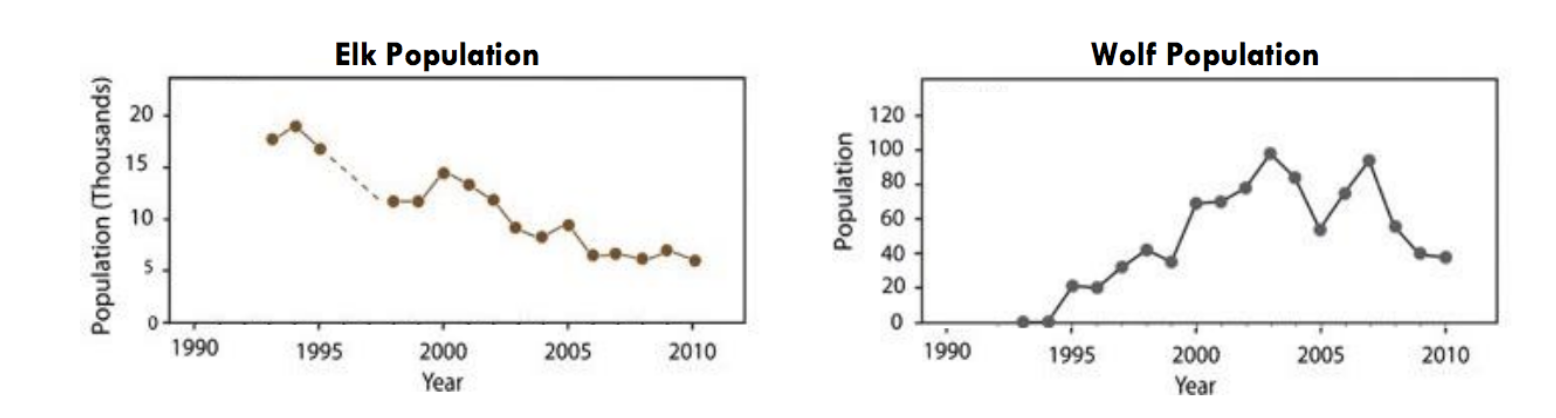
You have already identified that wolves are a predator of elk. Using the graph above, describe the general trend of the elk and wolf populations between 1993 and 2003.
Sentence frame: From ______ to ______, the population of …, while the population of …

Using information from the graphs, describe what happens to the wolf and elk populations in 2005. Indicate what you think might have happened during this year to cause this change.
In 2005,…
This is supported by the graphs because…
Read this to help you with the graphs below: Note that the willow tree rings were measured in two different species of willow (Geyer and Booth). The aspen heights were measured in two different habitats – the uplands and riparian (stream side). During the aspen measurements, it was also noted if there were logs in the area, since logs could impede browsers from getting to the trees, which would possibly decrease herbivory on those trees. In the cottonwood recruitment graph, the measurement “>5cm DBH” means that the scientists measured the number of trees that had reached a “diameter at breast height” greater than 5 cm.
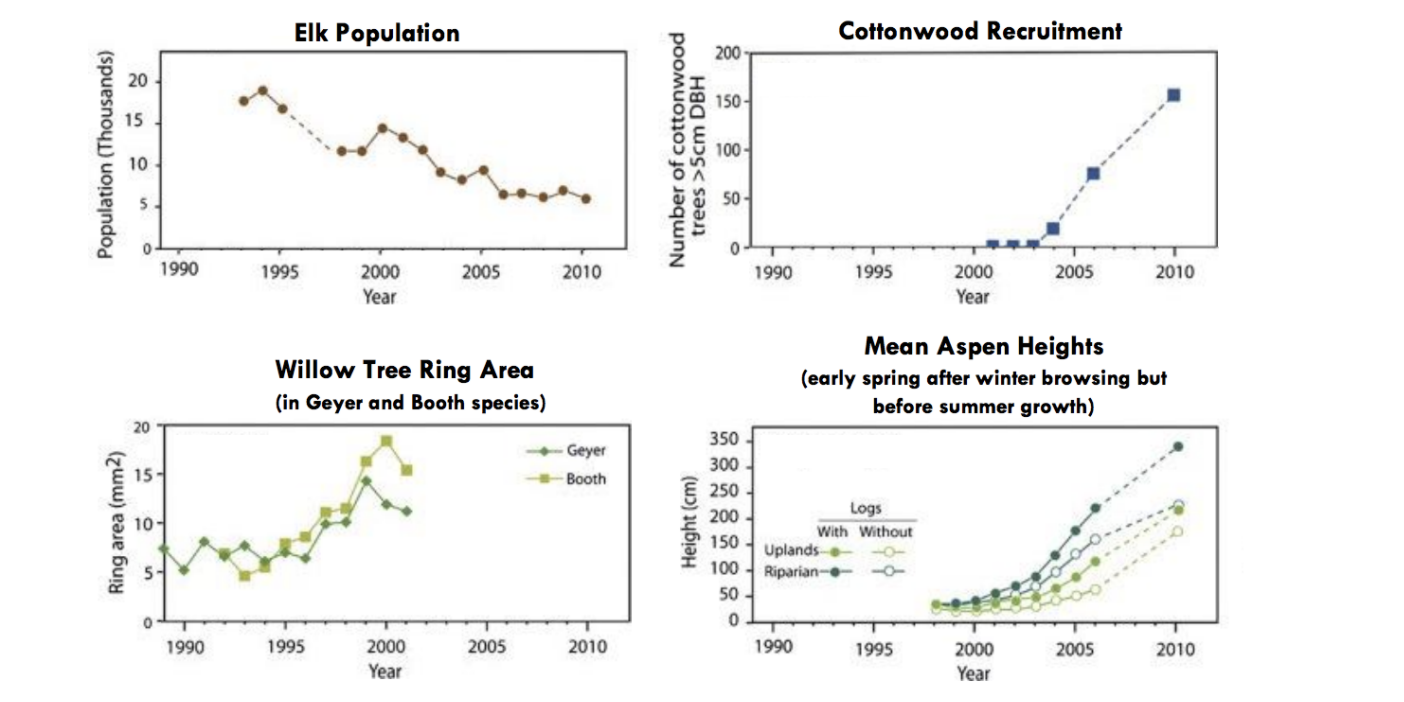
Use information from the graphs to describe the change in the size and growth of the trees and the population of elk during the data collection periods depicted in the graphs.
Sentence frames:
_______________ (increases/decreases) while ____________ (increases/decreases).
During _________ it can be observed that _____________ at the same time that ____________.
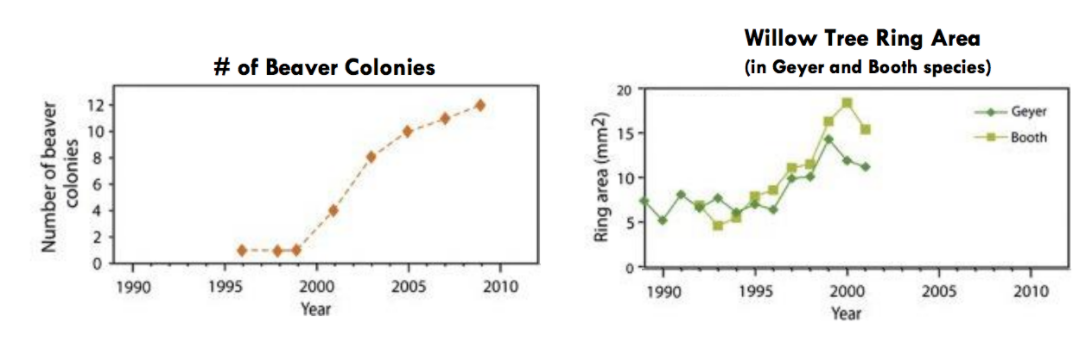
Describe what happened to beaver colonies after 1995 (when wolves were reintroduced). Then describe the relationship between the number of beaver colonies and the willow tree ring area. Use specific evidence from the graphs to support your answer.
Sentence frames:
After __________, ___________. This is shown in _________ when...
The relationship between _________ and _________ is __________. This is supported by the data because...
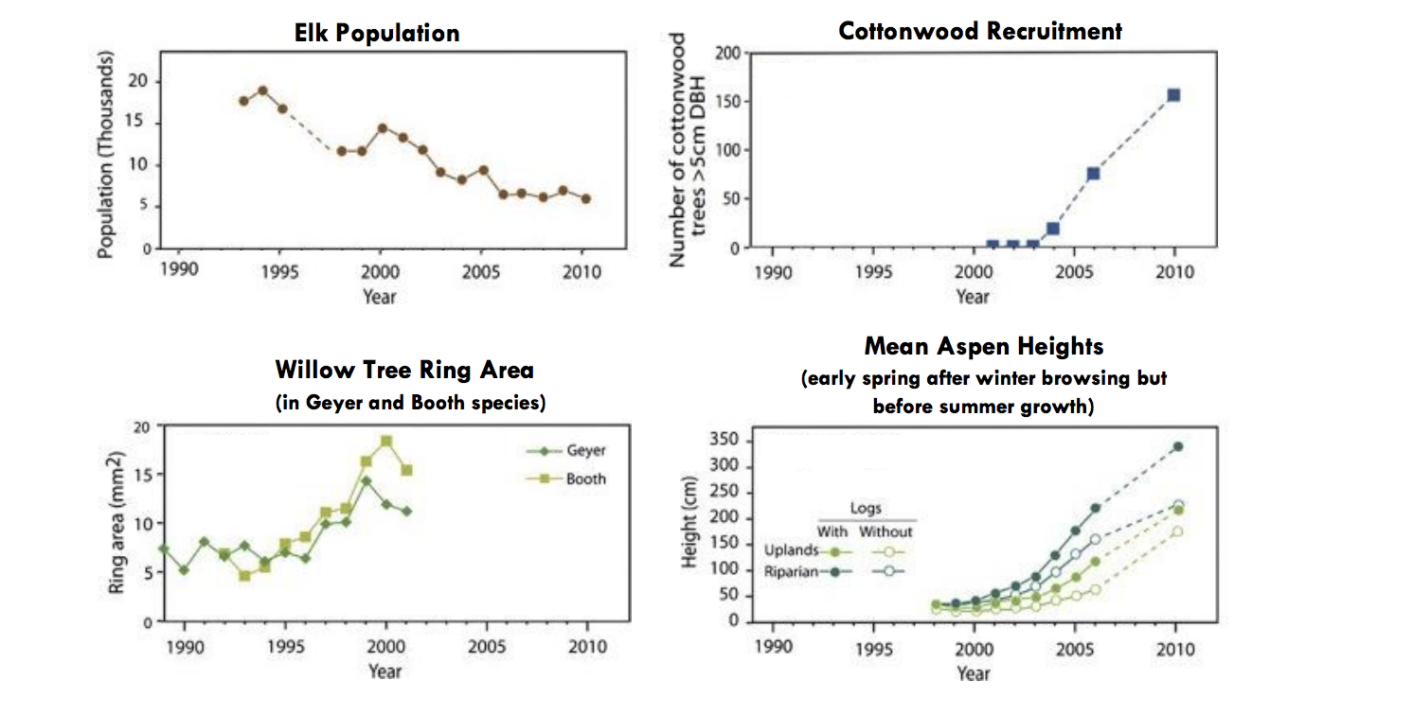
Based on what you know about tree growth and elk population, use data from the graphs to make a statement about how the elk population impacts the beaver population. In your answer, address why there was a lag between the change in elk population and the change in beaver population.
Sentence frames:
Because I know that _______________, I can conclude that ____________. The __________ changes differently than _________ because ______________.
Due to ______________, the impact of ________ on _________ is ___________. The rate of ___________ is different than _________ because ______________.
Once you have completed the data analysis, watch the entire Wolves of Yellowstone video clip:
REMEMBER: If you are having trouble seeing this video, copy this web address into your web browser and watch video directly from the PBS site: https://opb.pbslearningmedia.org/resource/a58e3ca2-52ab-45f5-87ac-26ee0d681146/wolves-of-yellowstone-earth-a-new-wild/
What was the most surprising set of events that you observed in the recovery of Yellowstone National Park? Identify one or more specific events from the video and use them to support your answer.
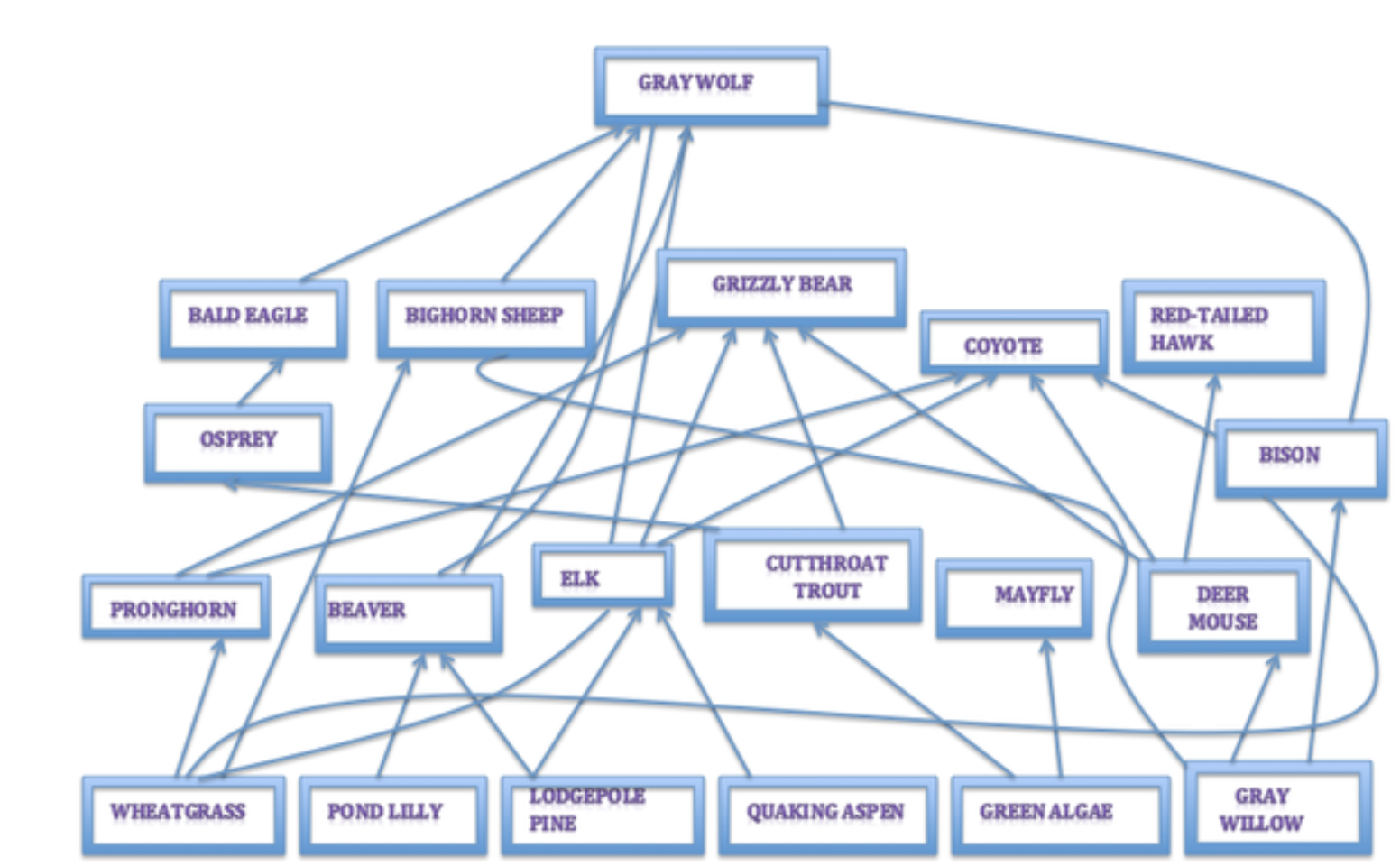
Eat or Be Eaten!. [Image]. Retrieved from https://visityellowstonenationalparkyall.weebly.com/uploads/1/9/1/2/19128651/3776355.png?602
The wolf is considered to be a keystone species in the Yellowstone ecosystem. The food web above describes the ecosystem when wolves are present (after 1995). Imagine what the ecosystem looked like before the wolf was re-introduced. Using this knowledge and the word bank below, compare and contrast the Yellowstone ecosystem with and without wolves present.
Word Bank:
biodiversity
removal
ecosystem health
stability
When ______, _______. In contrast, when _______, _______.
When comparing _______ and ______, it can be seen that _______.
In Yellowstone…
This is supported by…