2.2 Phase Change Diagrams
star
star
star
star
star
Last updated almost 4 years ago
18 Nsɛmmisa
1
1
1

1
1
1
1
1
1

1
1
1
1
1
1
1
1
1
DIRECTIONS: Carefully review the diagrams below in order to answer the questions.
FACILITATOR SCRIPT:
Read each question aloud or ask a group member to read for the group.
Allow 1-2 minutes for each group member to answer the question. Ask if the group is ready and have group members share responses.
Ask if any group members have questions before moving on to the next quest.
(Harmonizer shares screen to make it easier for the group to stay at the same pace while working)
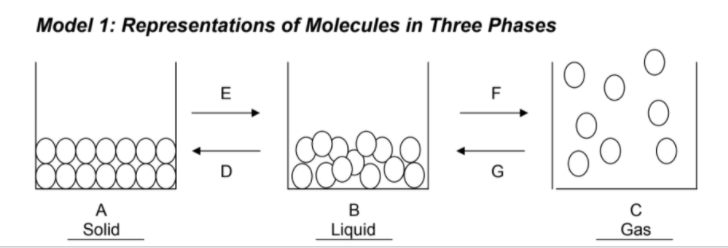
Label each arrow (D, E, F, G) in Model 1 with the appropriate phase change (fusion/melting, freezing, vaporization/boiling, condensation).
fusion/melting (solid-->liquid)
freezing (liquid-->solid)
boiling (liquid-->gas)
condensation (gas-->liquid)
Arrow D
Arrow E
Arrow F
Arrow G
Which processes in Model 1 are endothermic? (Endothermic- Energy is added or absorbed by the system, particles)
Which processes in Model 1 are exothermic? (Exothermic- Energy is released or removed from the system, particles)
Overview: What do you notice about what the graph in model 2 is showing? I notice...
Parts: What does the x and y axis represent? X axis represents- Y axis represents-
Title: What new information or understanding can you get from the title of the graph? The title let's me know that this is about...
Interrelationships: What patterns do you notice? Try to record at least 2. One pattern I notice is... Another pattern is...
Conclusions: Are there any conclusions you can make from analyzing the graph? One conclusion I can make is...
Questions: What is a question or wondering you have about this graph? One question I have is...
Does the kinetic energy of molecules increase, decrease, or remain the same when the substance melts or boils?
Does the kinetic energy of molecules increase, decrease, or remain the same when the substance freezes or condenses?
Does the kinetic energy of molecules increase, decrease, or remain the same AFTER the substance completely freezes and turns from a liquid to a solid?
How do you know that energy is added (endothermic) in order for the substance to change from a solid into a liquid? Use at least 2 pieces of evidence from the model and graph to explain your reasoning.
How do you know that energy is released or removed (exothermic) in order for the substance to change from a gas into a liquid? Use at least 2 pieces of evidence from the model and graph to explain your reasoning.
THINK ABOUT IT! Why do you think the temperature remains the same during a phase change (melting, freezing, boiling, condensing)? Hint: How is the energy changing in the system during this time if it's not causing the temperature to increase or decrease?
THINK ABOUT IT! Line segment DE is longer than segment BC. What do you think this might mean? Hint: Think about differences in the amount of energy added to the system.
Select all the responses that are true when this substance vaporizes or boils.
This is your space to record any additional notes you have about this assignment to have when studying.