Biology UNIT 4 OUTCOME 2 SAC

Last updated about 5 years ago
18 questions
Area of Study 2/Outcome 2

On completion of this unit the student should be able to describe how tools and techniques can be used to manipulate DNA, explain how biological knowledge is applied to biotechnical applications, and analyse the interrelationship between scientific knowledge and its applications in society.
Outcome 2 Describe how tools and techniques can be used to manipulate DNA, explain how biological knowledge is applied to biotechnical applications, and analyse the interrelationship between scientific knowledge and its applications in society. A response to an issue OR A report of a laboratory investigation. The assessment task may be written or multimodal. (approximately 50 minutes or not exceeding 1000 words) 30 marks

Outcome Summary

This outcome will focus on genetic modification by humans in the agricultural industry. The assessment will incorporate the biomolecular techniques that are involved in producing the genetically modified organisms as well as the ethical issues that arise from the use of such techniques. Questions both specific to the provided scenario, and general to the topic, will form the basis of this assessment. This exam styled assessment will be a 50 min task with 10 mins reading time and be worth 30 marks.

Roundup Ready crops are crops genetically modified to be resistant to the herbicide Roundup. Roundup is the brand-name of a herbicide produced by Monsanto. Its active ingredient glyphosate was patented in the 1970s. Roundup is widely used by both people in their backyards and farmers in their fields. Roundup Ready plants are resistant to Roundup, so farmers that plant these seeds must use Roundup to keep other weeds from growing in their fields.

The first Roundup Ready crops were developed in 1996, with the introduction of genetically modified soybeans that are resistant to Roundup. These crops were developed to help farmers control weeds. Because the new crops are resistant to Roundup, the herbicide can be used in the fields to eliminate unwanted foliage. Current Roundup Ready crops include soy, corn, canola, alfalfa, cotton, and sorghum, with wheat under development.


Roundup Ready crop seeds have notoriously been referred to as "terminator seeds." This is because the crops produced from Roundup Ready seeds are sterile. Each year, farmers must purchase the most recent strain of seed from Monsanto. This means that farmers cannot reuse their best seed.

Information taken from website: http://web.mit.edu/demoscience/Monsanto/about.html
1

QUESTION 1:
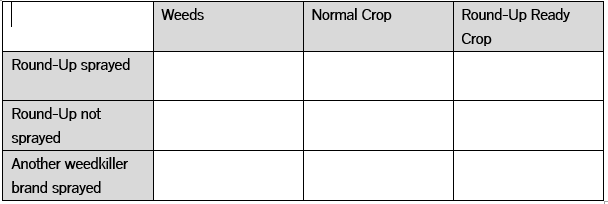
Complete the following table by putting a tick (a) to indicate growth and a cross ( x ) to indicate no growth to summarise the effects on Round-Up on crops: #Note: The other weedkiller brand uses an active ingredient different to glyphosate. (1 mark)

2

QUESTION 2:
What might be the benefits of farmers using Round-Up ready seeds? Explain (2 marks)

2

QUESTION 3:
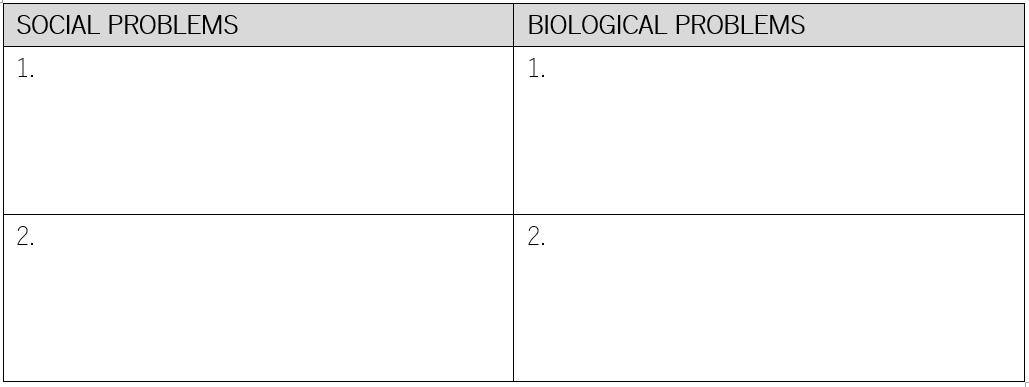
Use the table below to summarise the potential social and biological problems for using Round-Up ready seeds. Give two examples for each (2 marks)


2

QUESTION 4:
Roundup Ready plants carry the gene coding for a glyphosate-insensitive form of this enzyme, obtained from the bacteria Agrobacterium sp. strain CP4. The gene is called the EPSPS gene and can be found in plants. The plant gene does confer resistance to glyphosate but the bacterial version does. Once incorporated into the plant genome, the gene product, CP4 EPSPS synthase, confers crop resistance to glyphosate.
Taken from website: https://www.pnas.org/content/103/35/13010

4a) Are Round-up ready plants considered as Genetically Modified Organisms (GMOs), Transgenic Organisms or both? Explain (2 marks)

1

4b) What is term used to describe when extra genetic material is inserted into cells? (1 mark)

1

QUESTION 5:


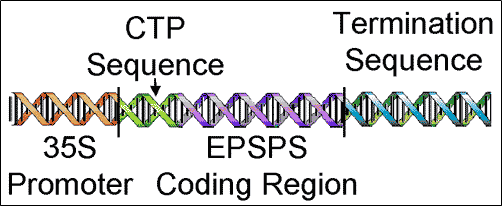
The above diagram shows the key regions of the Round-Up resistance gene. They 4 main regions are:
- 35S Promoter
- CTP Sequence
- EPSPS Coding Region
- Termination Sequence

5a) What is the role of the 35S Promoter? (1 mark)

1

5b) What is the role of the Terminator Sequence? (1 mark)

2

5c) The CTP (Chloroplast Transit Peptide) sequence are specific amino acid sequences added to proteins which direct them to go to the chloroplast of the plant cell. In plants the EPSPS Protein needs chloroplasts for it to be produced. Why is the CTP sequence required on the gene being inserted into the plants? (2 marks)

4

5d) Quite often large quantities of this DNA needs to be reproduced so that it can be inserted into the relevant plants. What is the name of the process used to amplify small amounts of DNA and list the 3 key steps involved in this process? (4 marks)

1

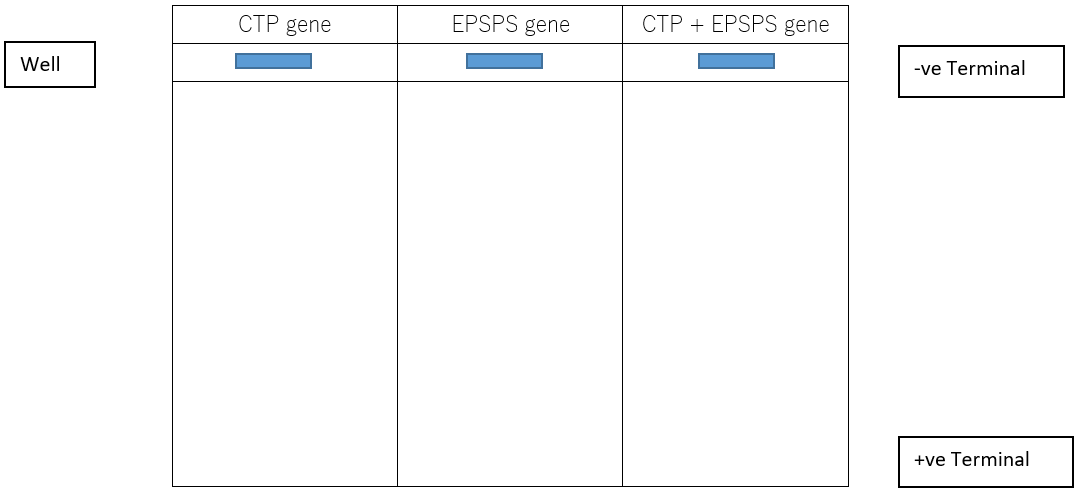
5e) The CTP coding region contains 18 base pairs, whilst the EPSPS coding region contains 1584 base pairs. On the Gel Electrophoresis diagram below draw the bands that would form for the CTP region, the EPSPS region as well as both regions joined together. (1 mark)


2

5d) Explain why you have drawn the bands on the diagram in 5e where you have (2 marks)

1

QUESTION 6:
Once all of the necessary components have been combined, the resulting package of DNA is cloned. Now the genetic material is ready for insertion into the desired crop. For this purpose, a device called a gene gun is used to bombard a plant tissue culture. The gun fires microscopic pellets made of a heavy metal, such as gold. The pellets are coated in DNA.

After the plant culture has been bombarded, it is usually in a state of disarray, with some of the cells being damaged beyond use. All intact cells are carefully gathered up, treated with hormones, and kept in a culture to allow entire plants to develop from them. These plants are then tested to ensure that they are truly glyphosate-resistant. The genetically modified plants serve as sources of glyphosate-resistant seeds.

Information taken from website:

https://homesteadontherange.com/2015/06/01/how-glyphosate-resistant-crops-work/

6a) What does ‘the resulting package of DNA is cloned’ mean? (1 mark)

1

6b) What enzymes are used to cut the desired gene out of the original DNA? (1 mark)

4

6c) Design an experiment that scientists could use to determine if the cells bombarded by the desired DNA have taken up the new glyphosate-resistant gene. Include the Independent Variable (IV) and Dependent Variable (DV) in your design (4 marks)

1

QUESTION 7:
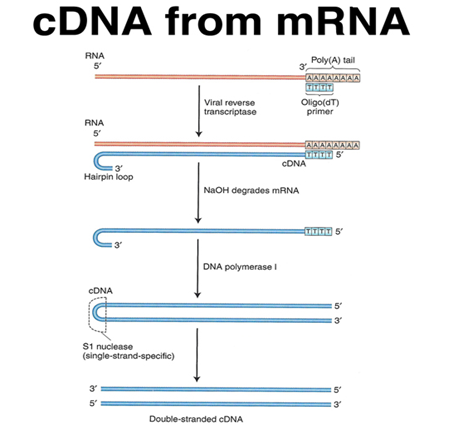
When inserting or using genes, scientists often prefer to use complimentary DNA (cDNA). cDNA is DNA that is made from a mRNA transcript. The mRNA that is used is mature and has had its introns removed. The following diagram shows how cDNA is made using mRNA as a template.


7a) What is the name of enzyme 1? (1 mark)

1

7b) Is enzyme 2 likely to be RNA Polymerase or DNA Polymerase? Explain (1 mark)

2

7c) Why would scientists prefer to use cDNA over regular DNA when using it as a functional gene? (2 marks)

1

7d) What is the purpose of the methyl cap and poly-A tail on mature mRNA? (1 mark)

REFERENCES:
Round-Up Picture:
https://www.amazon.co.uk/Roundup-Action-Weedkiller-Ready-Spray/dp/B000TAXYTU
cDNA from mRNA Picture: http://www.discoveryandinnovation.com/BIOL202/notes/lecture26.html
Structure of Round-Up Resistant Gene:
http://passel.unl.edu/pages/informationmodule.php?idinformationmodule=959031259&topicorder=6&maxto=9&minto=1
https://www.pnas.org/content/103/35/13010