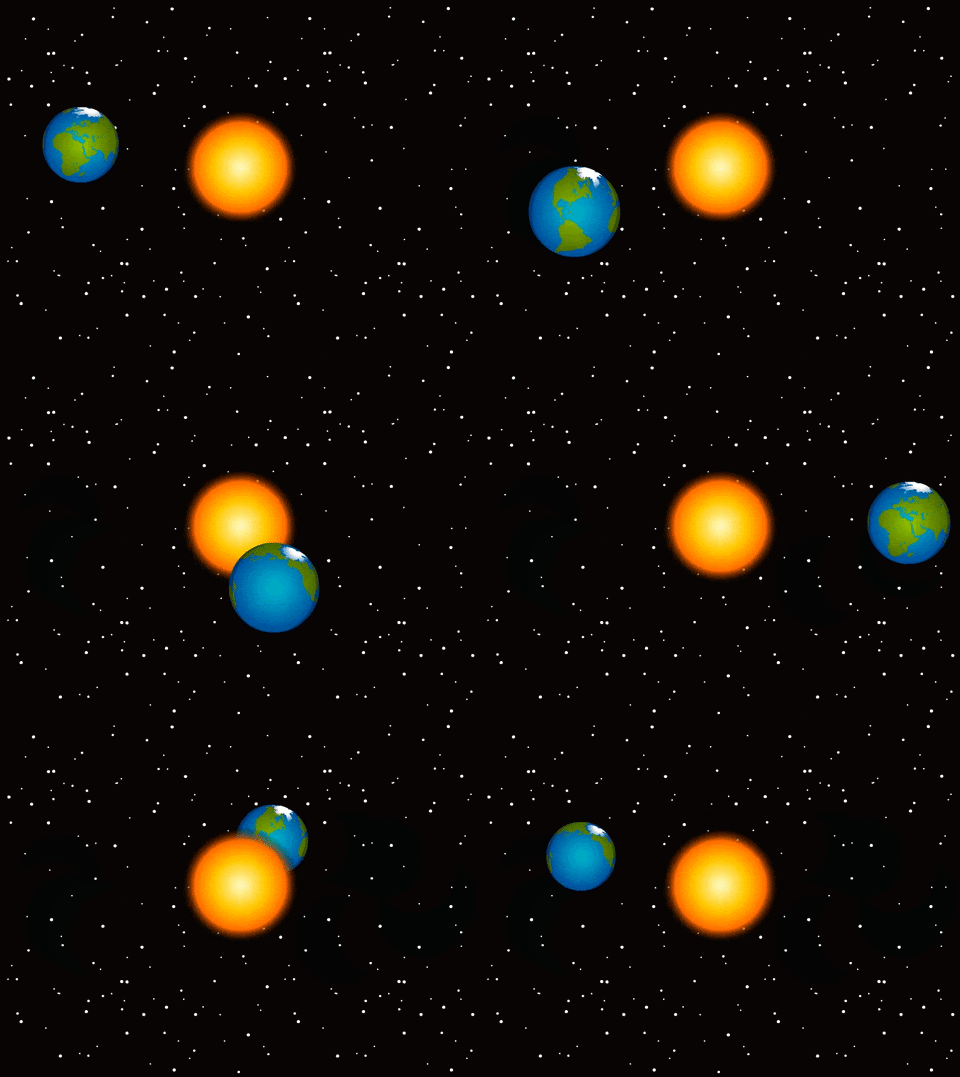
Watching the clip above, describe the movement of the earth.
Watching the clip above, describe the movement of the earth.
Spin is turn around its axis (the center of object). Which image is show the movement of spin?
Orbit is to move in a regular path around something. Which image is show the movement of ORBIT?
Watching the clip above, describe the movement of the earth.
Which of the following correctly explains the way the Earth moves?
Many of you have the idea that the yearly pattern of stars we see has something to do with the orbit of Earth around the sun. We’ll use the Sim to study one constellation, Leo, to investigate what causes that yearly pattern.
Open Sim 1: Patterns of Earth and Sky:
https://learning.amplify.com/patternsofearthandsky/
Change the date to your starting date - January 1, 2017
Click MIDNIGHT.
Click on your constellation name in System View to highlight our constellation, LEO
Can you see your ENTIRE constellation? Write “Yes” or “No.”
Remember to use the red arrows to allow the observer to look sideways.
If you can only see part of your constellation, write NO.
Change to the next month and repeat!
What months is the constellation LEO visible in the year 2017? Choose the months you can see LEO.
What month was the observer’s head directly pointing towards the constellation Leo?
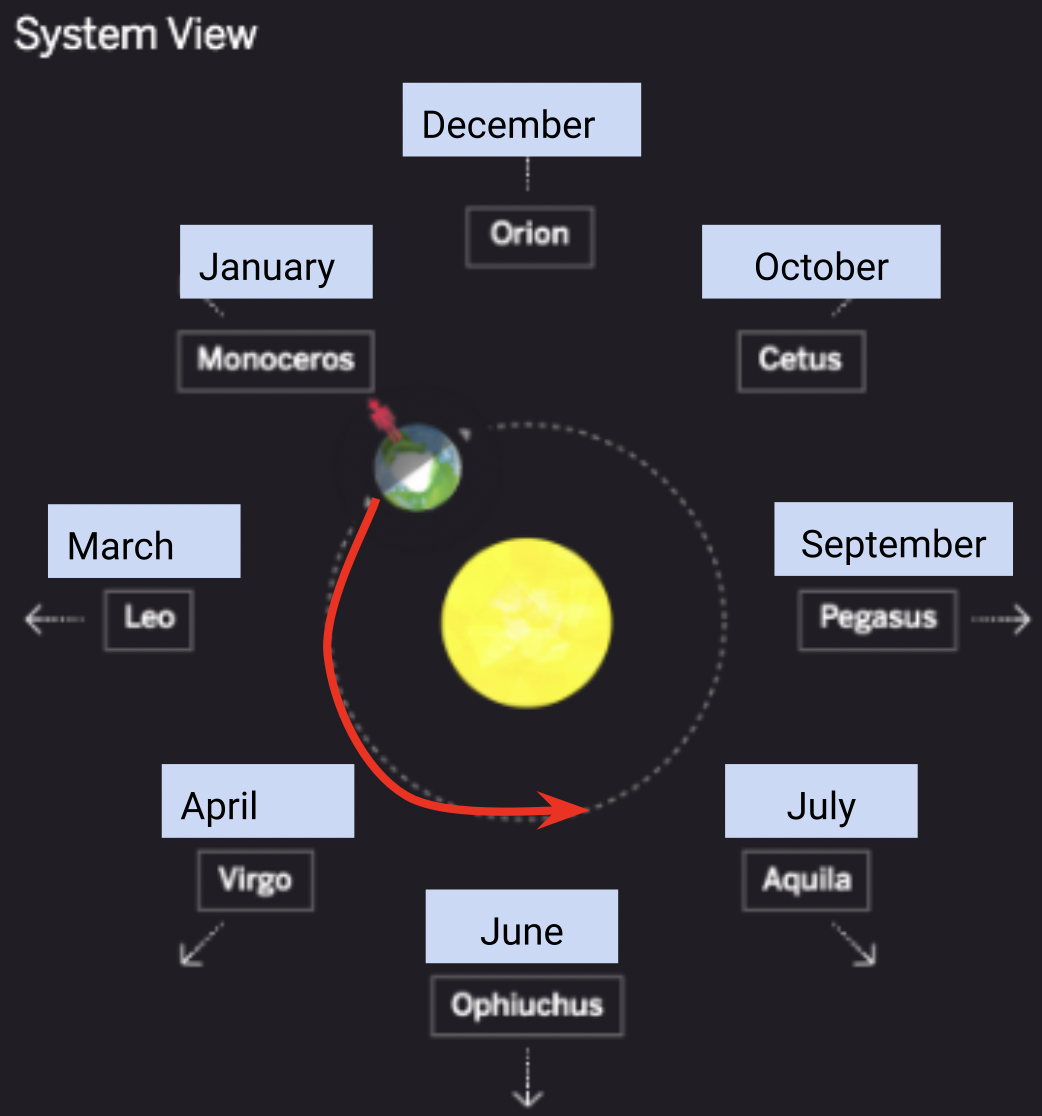
This image shows the months of the year when in North America, an observer's head points directly towards each constellation as Earth travels around the sun. According to the diagram, which of the following is true?
If a person were to look into the sky at midnight on January 1 and again at midnight on July 1, would they see the same constellations in the sky? Why or why not?
Explain your answer. Use the words in the word bank.
Word Bank: revolve/orbit earth sun position location stars
Choose ONE Sentence Starter:
The person would see the same constellations in the sky because ________________
OR
The person would see different constellations in the sky because ________________
Based on this diagram, how long does it take for the Earth to travel (ORBIT/REVOLVE) around the sun?
If a person were to look into the sky at midnight on January 1 and again at midnight on July 1, would they see the same constellations in the sky?