The following is a force diagram of a body falling towards a black hole. Explain why Ffeet is so much bigger than Fhead
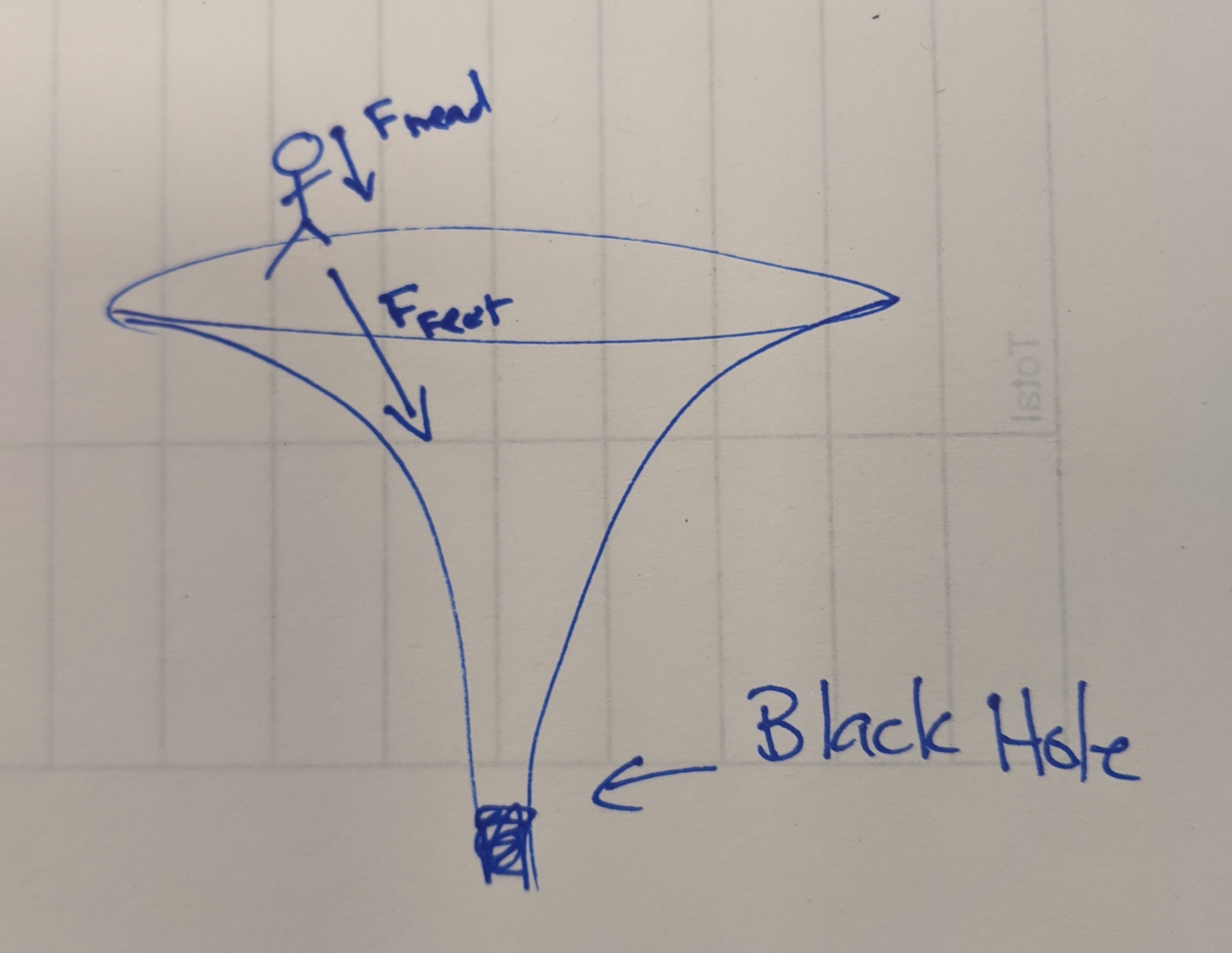
The following is a force diagram of a body falling towards a black hole. Explain why Ffeet is so much bigger than Fhead
Eventually the earth will have the northern hemisphere tilted towards the sun at perihelion instead of at aphelion. The process by which the direction of the earth’s tilt changes is called
Explain what effect the scenario in question 1 will have on the polar ice caps.
Explain why the loss of ice is so important to the feedback loop that drives climate change, and why gaining ice creates a feedback loop that can lead to an ice age.
Currently the earth is situated with the angle of tilt at 23 and is decreasing. Does this mean
Which of the following is the best description of the Milankovitch cycles?
The following is a force diagram of a body falling towards a black hole. Explain why Ffeet is so much bigger than Fhead
What happens to that body is called
Which of the following is another term to describe the above phenomenon?
A clown riding a unicycle on a railway car throws a ball in the air as he passes a railroad station. Match the ball’s motion to the frame of reference of the person watching the performance
Scientists of his day rejected Copernicus’ theory of heliocentrism for 4 specific reasons. Which of the reasons was resolved by Kepler?
How much faster a planet or comet moves at perihelion vs at aphelion will depend on the
If the impact theory involves another planet smashing into the Earth and creating the moon, why would the moon be so similar to the Earth in composition? Wouldn’t it be closer in composition to the planet that crashed into the earth?
Describe the process that creates the earth’s magnetosphere.
Why would giving Mars a magnetosphere be a first step in terraforming Mars?
Extra credit - Why can I not solve
for k using the orbital period for earth and the average distance from the sun for earth, and use that k to determine how quickly the sun moves around the center of the galaxy?