Characteristics of Living Things and Classification Test
star
star
star
star
star
Last updated almost 6 years ago
30 Nsɛmmisa
3
3
3
3
3
3
3
3
3
3
3
3
3
3
3
3
3
3
3
3
3
3
3
3
3
3
5
6
6
5
Which of the following is NOT a characteristic that all living things share?
A change in an organism’s surroundings that causes it to react is called
Homeostasis refers to an organism’s ability to
What is taxonomy?
Why do scientists organize living things into groups?
An organism’s scientific name consists of
The more classification levels that two organisms share,
Which group of organisms includes only multicellular heterotrophs?
A plant grows toward the light. The plant’s action is an example of
Which domain(s) include(s) only prokaryotes?
The process of change that occurs during an organism’s life to produce a more complex organism is called
A group of organisms that can mate with each other and produce offspring that can also mate and reproduce is called a(n) ________________.
A tool used by a taxonomist to identify an unknown organism is known as a __________.
In the name Acer rubrum, the word rubrum designates the species.
Each genus of organisms is divided into classes.
Mushrooms, molds, and mildew are members of the fungi kingdom.
Archaea and Bacteria are two domains of eukaryotes.
An organism that is made up of many cells is unicellular.
Organisms that make their own food are called ____________________.
The process of grouping things based on similarities is called ____________________.
The first word in an organism’s scientific name is its ____________________.
A(an) ____________________ organism is a living thing that is composed of many cells.
____________________ developed a naming system that grouped organisms on the basis of their observable features.
In the modern classification system used by biologists, the broadest level of organization is called a(an) ____________________.
An owl and a bat share the same kingdom and phylum.
An owl and a robin share the same kingdom, phylum, and class.
The owl and ____________________ have more characteristics in common.
An organism whose cells contain a nucleus is called a _____________________.
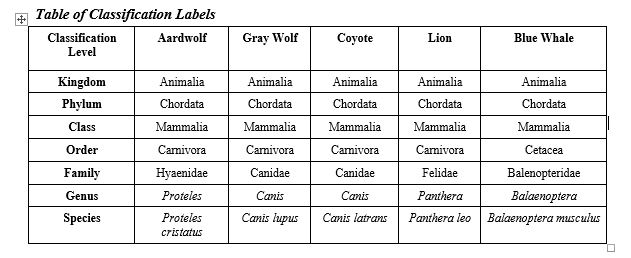
Use the diagram above to answer the question.
What classification groups do all of the organisms in the table have in common?
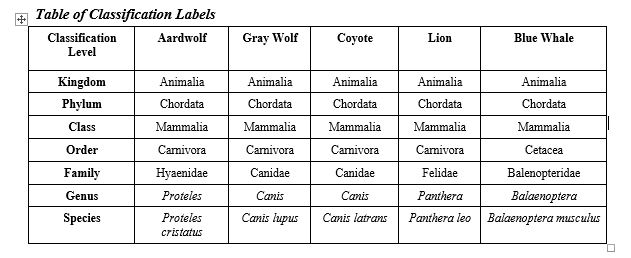
Use the diagram above to answer the question.
Which of the organisms in the table is least similar to the others? Explain.
Use the diagram above to answer the question.
Which of the organisms in the table is (are) most similar to a tiger (Panthera tigris)? Explain.
Use the diagram above to answer the question.
Which two species in this table are most similar to each other? Explain.