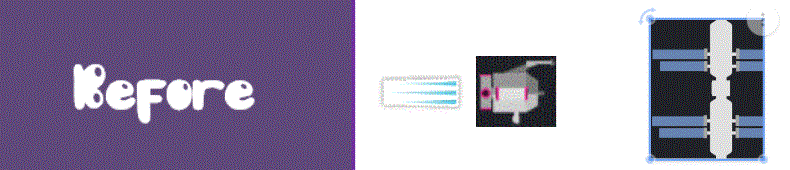
We have proven Claim 1 False but we need to review it before the final written report.
Question 2
2.
Question 3
3.
If Claim 1 is correct...
Firing the thrusters would have caused the pod to move in the opposite direction __________ compared to normal mission
Question 4
4.
A stronger thruster force would cause.....__________when compared to a weaker force
(velocity change?)
Do not copy and paste
Part 2 Claim 2
Claim 2 is the correct motion of the pod.
Question 5
5.
Question 6
6.
Claim 2 is correct...
Firing the thrusters only slowed the pod, it didn’t stop; the pod hit the space station, which made it bounce and move in the opposite direction. This would happen
__________compared to normal mission
Question 7
7.
Because the thruster force was weak, the pod change in motion is __________
Part 3 New Data
Question 8
8.
Question 9
9.
Question 10
10.
Question 11
11.
Question 12
12.
Question 13
13.
According to Newton's 2nd, the acceleration of an object is caused by how much you push it and the object's __________

Question 14
14.
If you push a lighter object with the same force as a heaver object, the lighter object will have __________ acceleration.
Question 15
15.
If you push a heavier object with the same force as a lighter object, the heavier object will have __________ acceleration.
Question 16
16.
New Data Mass of the Pods
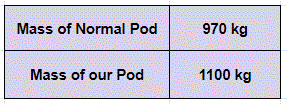
Our pod has __________ than the normal pod. This causes what type of change in motion for the pod: __________
Question 17
17.
Question 18
18.
Before anything happened to the pod, the pod was
leaving the space station and needed to speed up
not moving at all
approching the space station and needed to slow dow and dock (stop) at the station
What is the best example of a student writing claim 1 in their own words?
Claim one said the thrusters fired and caused the pod to move away
Claim one said the thrusters firing with a larger force causing the pod to change directions and fly away
When the thrusters fired, the thrusters caused the pod to move away.
When the thrusters fired, the larger force caused the pod to change directions and fly away
What is the best example of a student writing claim 2 in their own words?
Claim 2 says the thrusters fired but the pod still hit the station. Then the pod bouced off the station
Claim 2 says the thrusters firing with less strength causing the pod to slow down but not enough. The pod hit the station causing it to bounce off and move away.
The thrusters fired but the pod still hit the station. Then the pod bounced off the station
The thrusters with less strength causing the pod to slow down but not enough. The pod hit the station causing it to bounce off and move away.
Acceleration is defined as speed up
True
False
Acceleration is defined as slowing sown
True
False
Acceleration is defined as changing direction
True
False
Acceleration is defined as starting to move
True
False
Acceleration is defined as stopping
True
False
What is the best example of a student writing the evidence in their own words?
The evidence says the mass was different for the normal pod and our pod. Our pod was heaver.
The data provided by Dr. Jones shows the mass of the normal pod is 970 kg and our pod was 1,100 kgs. Our pod was 130 kgs heavier.
The evidence says the mass of the normal pod is 970 kg and our pod was 1,100 kgs. Our pod was 130 kgs heavier.
The data provided by Dr. Jones shows the mass was different for the normal pod and our pod. Our pod was heaver.
What is the best example of a student writing the Reasong (conclusion) in a paragraph
In conclusion, since our pod was heaver, when the thursters fired it only showed down.
Since our pod was 130 kg heavier, it only slowed down. Using Newton's 2nd law, when the mass increases but the force stays the same, the acceleration is less.
Since our pod was heavier, it only slowed down, bounced off the station and moved away.
Since our pod was 130 kg heavier, it only slowed down. Using Newton's 2nd law, when the mass increases but the force stays the same, the acceleration is less. Since the pod only slowed down, it hit the station and bounced off it.