AGHS - CP Bio - Protein Pratice
star
star
star
star
star
Last updated almost 6 years ago
15 Nsɛmmisa
Hyɛ no nsow a efi ɔkyerɛwfo no hɔ:
practice with proteins
1
1
1
1
1
1
1
1
1
1
1
1
1
1
1
practice with proteins
Amino acids are the monomers of proteins. What elements are always found in amino acids and thus proteins
Circle the two structures/parts of this amino acid that are common to ALL amino acids.
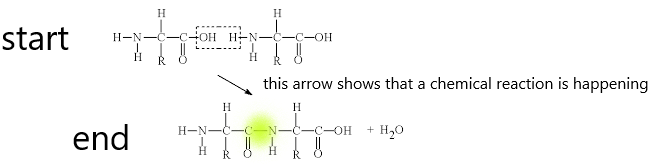
Next to the word "start" in the image above, you'll see two amino acids that are about to be bonded together. The molecules apper to be identical BUT which part of the amino acids should appear different if these are two amino acids are chemically different with properties (for example one could be polar and the other could be nonpolar)?
The type of reaction that is occurring in the image above, where two monomers are chemically bonded together, is called
What is the specific name given to the covalent bond that connects two amino acids together. This bond has been highlighted in the diagram above.
What protein-related term would be used to descibe the chemical molecule that is shown at the "end" of this reaction? Hint: two monomers are joined together!
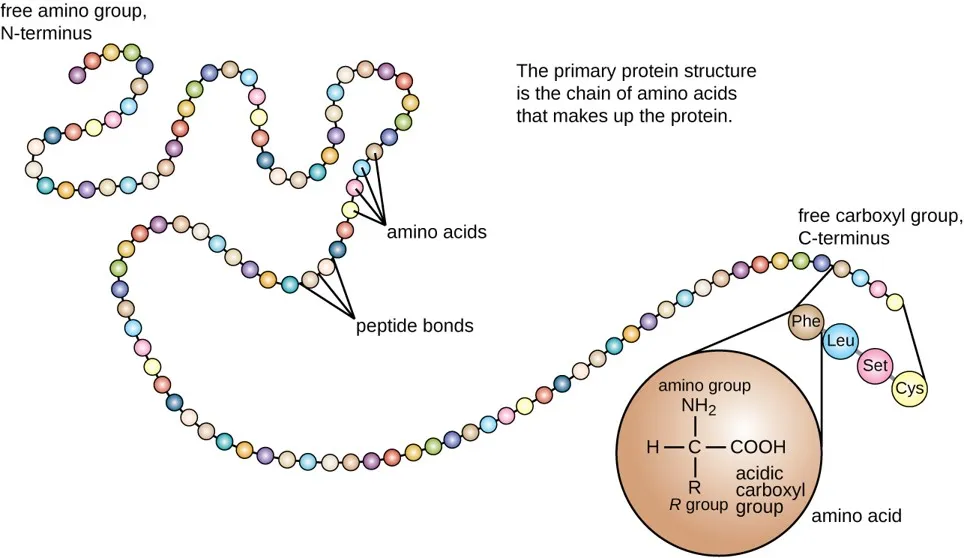
A long chain of amino acids chemically bonded together, like the one shown above, is called a
What MUST happen to chain of amino acids in order for it to become a funcitonal protein in the body?
The events you watched in this video are not random. The part of the amino acids that plays an incredibly important role in getting the proper final protein structure is the ______ . The interactions between these strongly influences the final shape of all proteins. Referring back to this simulation from class may help you remember.
You just saw 6 proteins in actions performing differnet tasks in a human body. All of these are happening in your body RIGHT NOW! Did any proteins have the same struture?
Which protein from the video provides structure and support in your skin and tendons?
Which protein from the video is a hormone (a chemical messenger) that tells cells to open a glucose transported in their cell membranes and absorb glucose into cells?
Which protein from the video had the specific job of breaking down starches? This protein is found in your saliva and was degrading starches (chains of simple sugars) via hydrolysis!
Do you suspect the proteins you saw in the videos would function the same way if some of their amino acids were changed to different amino acids? Explain your thinking.
Explain the rationale for your answer to #14.