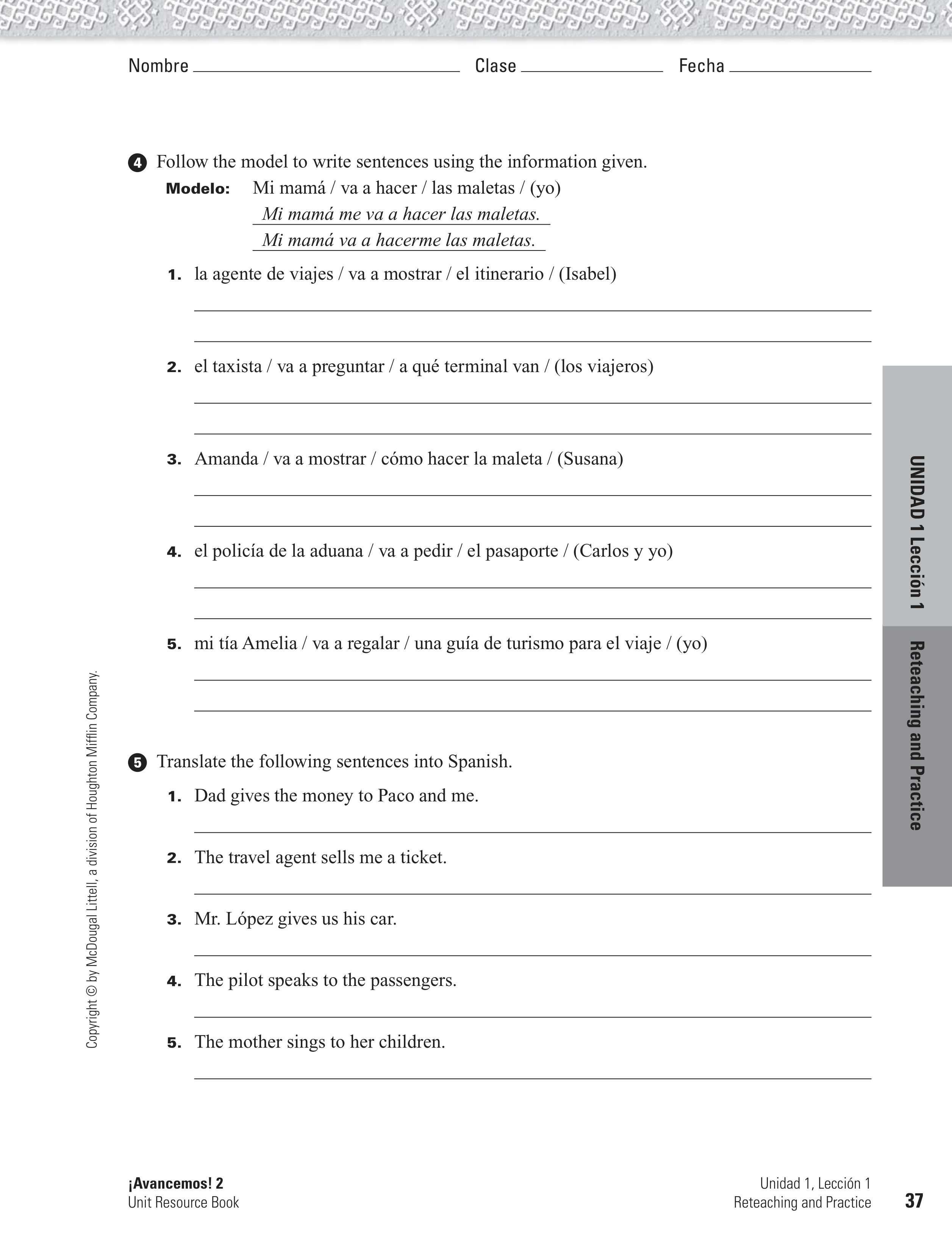
Remember: indirect object pronouns can go either 1) before a conjugated verb, or 2) after and attached to an infinitive. The following questions have you doing it both ways.
1
1
1
1
1
1
1
1
1
1
1
1
1
1
1
Question 1
1.
Question 2
2.
Question 3
3.
Question 4
4.
Question 5
5.
Question 6
6.
Question 7
7.
Question 8
8.
Question 9
9.
Question 10
10.
Question 11
11.
Question 12
12.
Question 13
13.
Question 14
14.
Question 15
15.
Question 16
16.
Question 17
17.
Question 18
18.
Question 19
19.
Question 20
20.
Question 21
21.
Question 22
22.
Question 23
23.
Question 24
24.
Question 25
25.
Question 26
26.
Question 27
27.
Question 28
28.
Question 29
29.
Question 30
30.
Question 31
31.
Question 32
32.
Question 33
33.
Question 34
34.
Question 35
35.
Choose the answer that matches.
A
B
C
D
E
Choose the answer that matches.
A
B
C
D
E
Choose the answer that matches.
A
B
C
D
E
Choose the answer that matches.
A
B
C
D
E
Choose the answer that matches.
A
B
C
D
E
Choose the correct translation.
A
B
C
Choose the correct translation.
A
B
C
Choose the correct translation.
A
B
C
Choose the correct translation.
A
B
C
Choose the correct translation.
A
B
C
Choose the correct translation.
A
B
C
Choose the correct indirect object pronoun to say who gets something.
nos
le
les
me
te
Choose the correct indirect object pronoun to say who gets something.
nos
le
les
me
te
Choose the correct indirect object pronoun to say who gets something.
nos
le
les
me
te
Choose the correct indirect object pronoun to say who gets something.
nos
le
les
me
te
Choose the correct indirect object pronoun to say who gets something.
nos
le
les
me
te
Choose the correct indirect object pronoun to say who gets something.
nos
le
les
me
te
Choose the correct indirect object pronoun to say who gets something.
nos
le
les
me
te
Choose the correct indirect object pronoun to say who gets something.
nos
le
les
me
te
Choose the correct indirect object pronoun to say who gets something.
nos
le
les
me
te
Choose the sentence that uses the correct indirect object pronoun.
La agente de viajes le va a mostrar el itinerario a Isabel.
La agente de viajes me va a mostrar el itinerario a Isabel.
La agente de viajes te va a mostrar el itinerario a Isabel.
Choose the sentence that uses the correct indirect object pronoun.
La agente de viajes va a mostrarle el itinerario a Isabel.
La agente de viajes va a mostrarla el itinerario a Isabel.
La agente de viajes va a mostrarlo el itinerario a Isabel.
Choose the sentence that uses the correct indirect object pronoun.
El taxista me va a preguntar a qué terminal van a los viajeros.
El taxista les va a preguntar a qué terminal van a los viajeros.
El taxista le va a preguntar a qué terminal van a los viajeros.
Choose the sentence that uses the correct indirect object pronoun.
El taxista va a preguntarle a qué terminal van.
El taxista va a preguntarme a qué terminal van.
El taxista va a preguntarles a qué terminal van.
Choose the sentence that uses the correct indirect object pronoun.
Amanda te va a mostrar cómo hacer la maleta a Susana.
Amanda me va a mostrar cómo hacer la maleta a Susana.
Amanda le va a mostrar cómo hacer la maleta a Susana.
Choose the sentence that uses the correct indirect object pronoun.
Amanda va a mostrarnos cómo hacer la maleta a Susana.
Amanda va a mostrarle cómo hacer la maleta a Susana.
Amanda va a mostrarte cómo hacer la maleta a Susana.
Choose the sentence that uses the correct indirect object pronoun.
El policía de la aduana me va a pedir el pasaporte a Carlos y yo.
El policía de la aduana nos va a pedir el pasaporte a Carlos y yo.
El policía de la aduana les va a pedir el pasaporte a Carlos y yo.
Choose the sentence that uses the correct indirect object pronoun.
El policía de la aduana va a pedirme el pasaporte a nosotros.
El policía de la aduana va a pedirle el pasaporte a nosotros.
El policía de la aduana va a pedirnos el pasaporte a nosotros.
Choose the sentence that uses the correct indirect object pronoun.
Mi tía Amelia me va a regalar una guía de turismo para el viaje a mí.
Mi tía Amelia te va a regalar una guía de turismo para el viaje a mí.
Mi tía Amelia le va a regalar una guía de turismo para el viaje a mí.
Choose the sentence that uses the correct indirect object pronoun.
Mi tía Amelia va a regalarle una guía de turismo para el viaje a mí.
Mi tía Amelia va a regalarte una guía de turismo para el viaje a mí.
Mi tía Amelia va a regalarme una guía de turismo para el viaje a mí.
Choose the translation that uses the correct indirect object pronoun.
Papá les da el dinero a Paco y a mí.
Papá nos da el dinero a Paco y a mí.
Papá le da el dinero a Paco y a mí.
Papá me da el dinero a Paco y a mí.
Choose the translation that uses the correct indirect object pronoun.
La agente de viajes les vende un boleto.
La agente de viajes me vende un boleto.
La agente de viajes le vende un boleto.
La agente de viajes te vende un boleto.
Choose the translation that uses the correct indirect object pronoun.
El señor López me da su carro.
El señor López le da su carro.
El señor López les da su carro.
El señor López nos da su carro.
Choose the translation that uses the correct indirect object pronoun.
El piloto les habla a los pasajeros.
El piloto me habla a los pasajeros.
El piloto nos habla a los pasajeros.
El piloto le habla a los pasajeros.
Choose the translation that uses the correct indirect object pronoun.