Which is the state of matter shown in this figure?
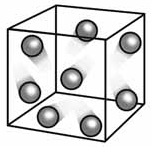
Which is the state of matter shown in this figure?
Matter that has a uniform and unchanging composition is called a pure substance.
A solid can not be compressed because its particles are tightly packed.
An intensive physical property is one that depends on the amount of matter present.
A change in state of matter is a physical change.
Fresh squeezed orange juice is a heterogeneous mixture.
Pizza is a substance.
Which is the state of matter that has a definite shape and definite volume?
Which is the state of matter shown in this figure?
Which term is the state change in which a solid becomes a liquid?
Which is the state change in which a gas becomes a liquid?
Which is NOT a chemical change?
Which is an example of a homogeneous mixture?
Which is the separation technique that relies on the different boiling points of the parts of the mixture?
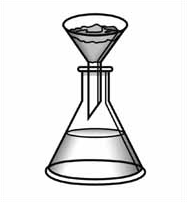
Which is the type of separation technique being demonstrated in the figure?
Which is a compound?
A 25.0-gram sample of magnesium oxide contains 10.8 grams of magnesium. What is the percent of magnesium by mass in this compound?
According to the Law of Conservation of Mass, in any chemical change
What is the atomic symbol for the element Tungsten?
Which of the following substances is an element?
Which of the following samples of matter is a mixture?
Use the following word bank to complete each of the following statements:
homogeneous heterogeneous substance
solution chemical physical
matter element compound
solid liquid gas
A process that involves one or more substances changing into new substances is known as a ____________________ change.
Use the following word bank to complete each of the following statements(some may be used more than once):
homogeneous heterogeneous substance
solution chemical physical
matter element compound
solid liquid gas
Cutting a sheet of paper is an example of a ____________________ change.
Use the following word bank to complete each of the following statements(some may be used more than once):
homogeneous heterogeneous substance
solution chemical physical
matter element compound
solid liquid gas
A ____________________ property enables a substance to combine with or change into one or more substances.
Use the following word bank to complete each of the following statements(some may be used more than once):
homogeneous heterogeneous substance
solution chemical physical
matter element compound
solid liquid gas
_______________________ is the the state of matter most abundant on Earth.
Use the following word bank to complete each of the following statements(some may be used more than once):
homogeneous heterogeneous substance
solution chemical physical
matter element compound
solid liquid gas
In a(an) ____________________ mixture, the parts of the mixture are noticeably different from one another.
EXTRA CREDIT: __________________ is the most abundant state of matter found in the universe.
What is the density of an object having a mass of 5.6 g and a volume of 37.25 mL?
What is the volume of an object with a density of 8.24 g/mL and a mass of 460. g?
EXTRA CREDIT: The density of osmium, which is the densest metal, is 22.57 g/cm3. What is the mass of a block of osmium that measures 1.04 cm x 4.19 cm x 2.58 cm?
A 50.51 g sample of a compound made from phosphorus and chlorine is decomposed. Analysis of the products showed that 11.39 g of phosphorus atoms were produced. What percent by mass is phosphorus of the sample?
6.22 grams of hydrogen is combined with 97.22 grams of sulfur to make hydrosulfuric acid(H2S). What percent of the hydrosulfuric acid is hydrogen?
Essay--Write the answer to one essay question in the space provided below.
FCA’s 1. Write in complete sentences and paragraph form.
2. Use Chapter 3 terminology to answer questions(example: substance, element, compound, solution, etc...).
3. Provide inferences, other thoughts, or personal experiences in your answer whenever possible.
Essay Questions to choose from....
#1 Distinguish among solids, liquids, and gases on the basis of their shape, their volume, and how their particles are packed together.
#2 Compare and contrast homogeneous and heterogeneous mixtures. Provide examples and explain both mixtures.