Z-Atomic review for test
star
star
star
star
star
Last updated almost 6 years ago
40 Nsɛmmisa
Hyɛ no nsow a efi ɔkyerɛwfo no hɔ:
atomic structure cross section of chapter
1
1
1
1
1
1
1
3
1
1
1
1
1
1
1
1
1
1
1
1
1
1
1
1
atomic structure cross section of chapter
This picture is of an atom with 2 protons, 2 neutrons and 2 electrons. Which subatomic particles is missing?
Draw an atom with 3 protons, 4 neutrons and 3 electrons.
Using your Periodic Table, What is nuclear charge of an Ag atom?
Using the Chart above, What is number of nucleons in the element Al?
Using the Periodic Table, What is atomic mass of the element with an atomic number of 78?
This element has 10 electrons when it forms a -2 charged ion.
The Atomic Number of an element determines the number of which subatomic particle?
Draw a Bohr Diagram of Carbon
Protons have a ________ charge and are located _________ the nucleus
C-14 would be classified as a(n):
Rb has this many valence electrons.
The nucleus of an atom is...
The electron cloud of an atom is...
Match the subatomic particle to its charge.
| Draggable item | arrow_right_alt | Corresponding Item |
|---|---|---|
Proton | arrow_right_alt | Negative |
Electron | arrow_right_alt | Netural |
Neutron | arrow_right_alt | Positive |
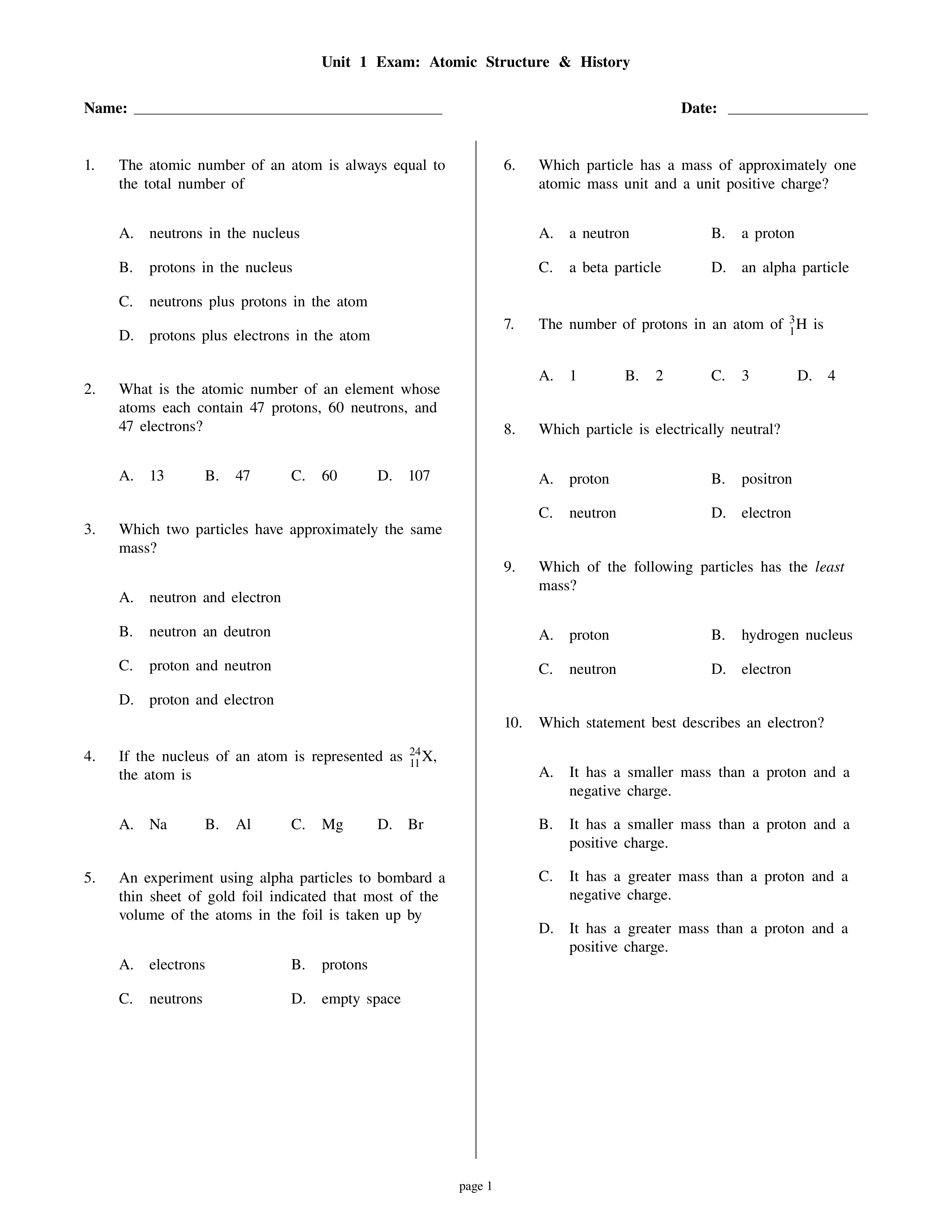

The atomic mass is derrived from:
2 isotopes exist: 72% is 84.9 amu and 28% is 87 amu. What is the correct numerical setup for calculating the atomic mass?
How many principal energy levels are full in an atom of copper in the ground state?
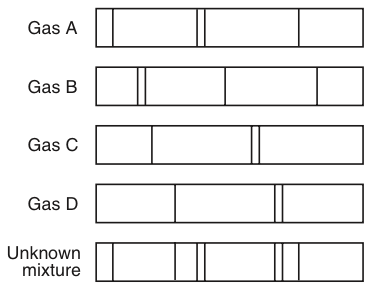
The unknown mixture is a composite of :
Spectral lines are formed when:
How many Lewis dots would be around S -2 ion
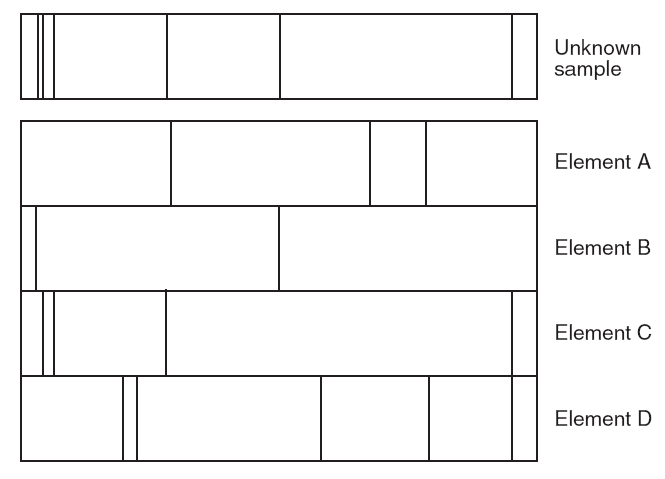
The above picture has an unknown with a combination of which elements?
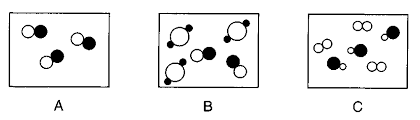
Describe each picture above in order with words: element, compound, mixture of (alphabetical ordered)
Which element has a valence electron with the most energy?
Which of the following electron configurations could be the excited state of potassium?
Question 1.
Question 2.
Question 3.
Question 4.
Question 5.
Question 6.
Question 7.
Question 8.
Question 9.
Question 10.
Question 11.
Question 12.
Question 13.
Question 14.
Question 15.
Question 16.