Unit 1 Assessment 2020 3steps
star
star
star
star
star
Last updated almost 6 years ago
6 Nsɛmmisa
5
4
3
2
3

3
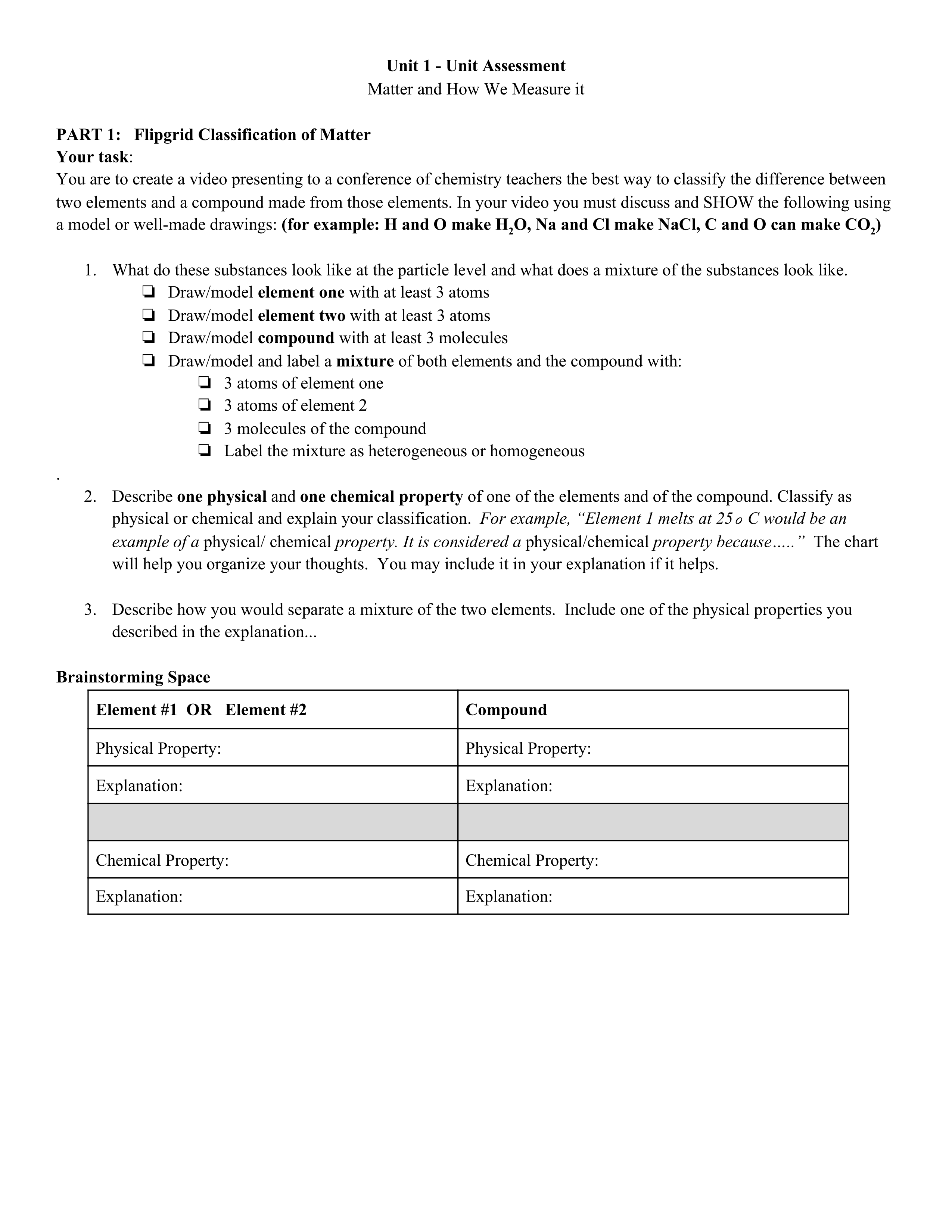
READ THIS:
If any question calls for you to do calculations, you must show your work in order to receive credit. If your teacher cannot read your work because it is too messy, you may not get credit!
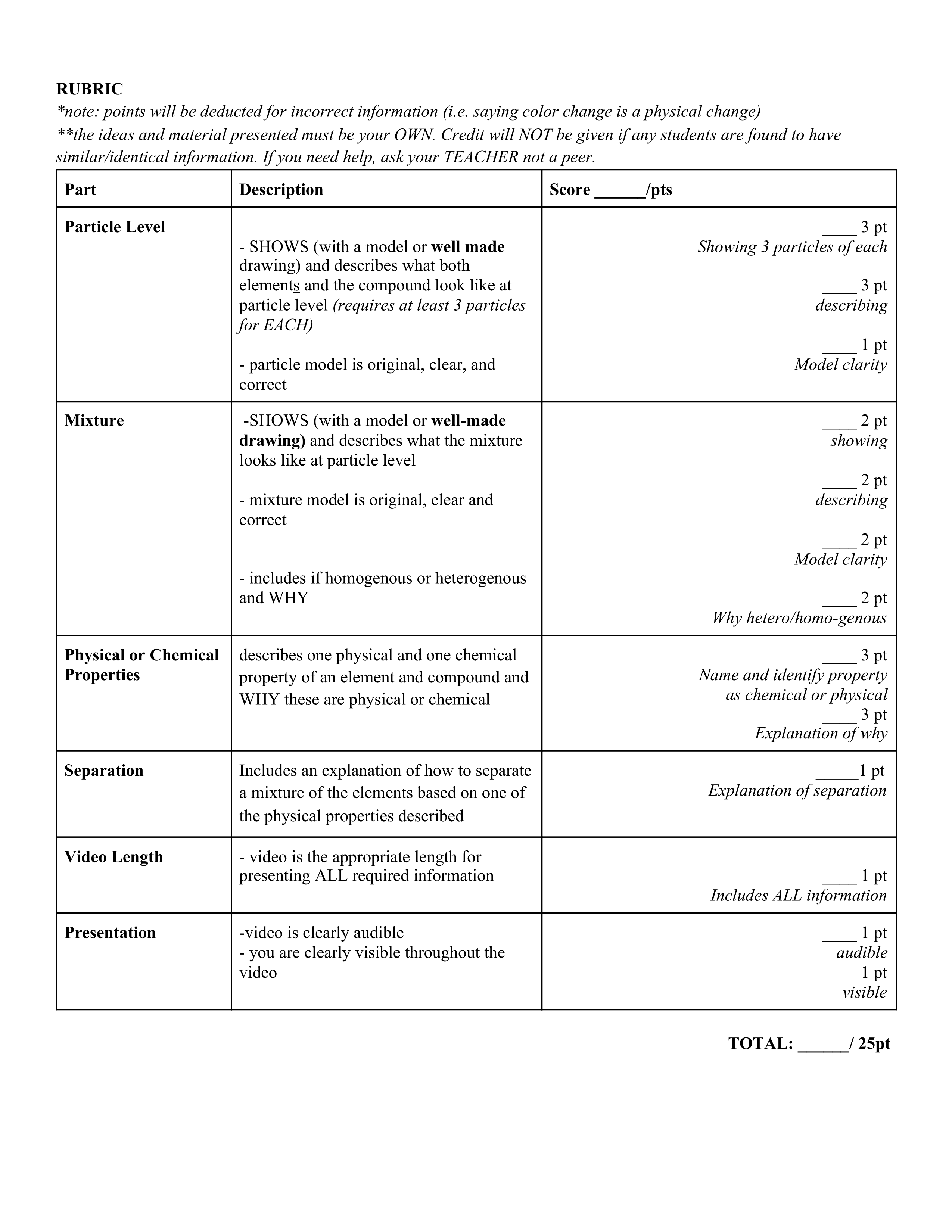
This assessment should demonstrate your OWN understanding. Collaborating with ANY PEER in ANY CLASS will result in a zero. This assessment is individualized per student so cheating will give you the incorrect answer.
However, please feel free to ask your teacher for help understanding any question!
The assessment is in TWO PARTS:
PART 1 - Flipgrid Classification of Matter Video
PART 2 - Measurement of Matter lab analysis using your own balance.
For the second part of the project, you will use your balance scale to find the common household substance density and answer questions related to your lab results. For this part, you will need:
your homemade scale balance
a 1 Tablespoon measuring spoon
your counterweights from Part 1
one of the following: salt, sand, cooking oil, Gatorade, soda OR fruit juice
Possible Counterweights:

Follow the procedure below. Record your data in the space provided.
Add TWO tablespoons(T) of your substance to one cup of your balance (or one side of your balance).
Use the counterweights to balance the 2 Tablesp of the substance. Record the measurement in the data table below. (hint: you can type into the table!)
Repeat three times and take the average.
Calculate the mass of the substance.
SHOW WORK USING DIMENSIONAL ANALYSIS.

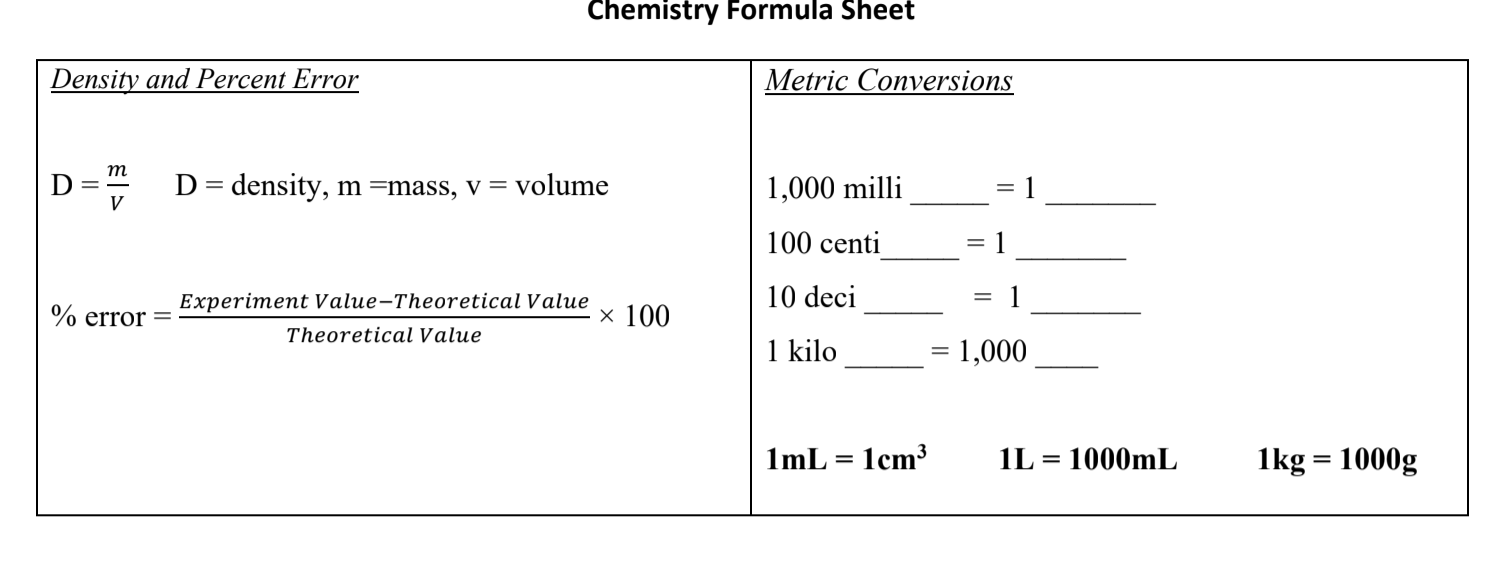
Use dimensional analysis to convert 2 Tablespoons(T) to cm3.
To receive full credit you MUST show your work including units!
Using the average mass and the volume in cm3 (using your answer from #2 above), calculate the density of your substance.
To receive full credit you MUST show your work including units!
Use the density that you calculated in question #3 above and the accepted density that is given below to calculate the percent error from your experiment.

Did your data have good precision? Explain your answer. Your answer must demonstrate that you understand what precision is using examples from your data.
Following the example above, make up your own dimensional analysis problem using your data from either this lab or the first one. The problem should include the following:
The problem should have a minimum of three steps (three conversions)!
Your data and the counterweight value from today’s lab or from “build your own balance lab”
One metric conversion (King Henry...)
One additional conversion unique to your substance (You can use nutritional information, cost, values in a recipe…)
Solve your problem. Show work using dimensional analysis.