Warm-up Quiz #2

Last updated about 5 years ago
20 questions
1

1. Scientists classify organisms by...
a) arranging the organisms in orderly groups
b) giving the organisms common names
c) deciding whether the organisms are useful
d) using only existing categories of classification

1

2. Which of the following is NOT one of the taxonomic levels?
a) Fungi
b) Phylum
c) Kingdom
d) Class

1

3. The more classification levels that two organisms share
a) the closer together on Earth they live
b) the easier it is to tell them apart
c) the more characteristics they have in common
d) the more distantly related they are

1

4. The largest classification group is
a) very exclusive
b) very inclusive
c) very small
d) very specific

1

5. What are the three domains in which organisms are classified?
a) animals, protista, fungi
b) bacteria, archaea, eukarya
c) prokaryotes, eukaryotes, autotrophs
d) heterotrophs, multicellular, unicellular

1

6. The smallest classification group consists of
a) organisms that are broadly similar
b) organisms that can reproduce with each other to produce viable offspring
c) organisms that have the same lifespan
d) organisms that live in the same region of the world.

1

7. Each genus of organisms is divided into
a) classes
b) kingdoms
c) phylums
d) species

1

8. What do we call the groups in which we classify organisms?
a) categories
b) classes
c) sets
d) taxons

1

9. Which organisms are multicellular, have no cell walls, and
consume food from a variety of sources?
a) protists
b) plants
c) fungi
d) animals

1

10. As the levels of classification move towards species,
organisms share ___ characteristics.
a) less
b) more
c) the same
d) none of these

1

11. Which of the following organisms are MOST closely related?
a) organisms that share a domain
b) organisms that share a family
c) organisms that share a genus
d) organisms that share an order

1

12. What kingdom is always multicellular, heterotrophic, and
has NO cell wall?
a) protista
b) plantae
c) fungi
d) animalia

1

13. Organisms whose cells have a nucleus enclosed within a
nuclear envelopes are called___.
a) eukaryotes
b) prokaryotes

1

14. This scientist is often called the Father of Taxonomy. His
system for naming, ranking, and classifying organisms is
still in wide use today.
a) Linnaeus
b) Pasteur
c) Redi

1

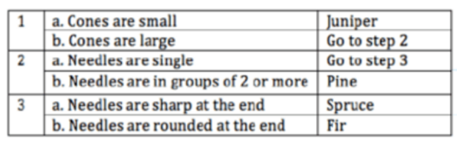
15. A dichotomous key for trees is provided. Hikers found a
tree that has large brown cones and single sharp needles.
What species of tree have the hikers found? 📷
a) juniper
b) pine
c) spruce
d) fir

1

16. The scientific name for bread mold is Rhixopus stonifer.
Which classification group is Rhizopus?
a) Genus
b) Class
c) Phylum
d) Species

1

17. Juan is developing a dichotomous key to classify the trees
around his home. Which of these questions would be MOST
useful for Juan to consider
a) Is it alive?
b) Does it grow?
c) Does its roots grow into the soil?
d) Does it have leaves or needles?

1

18. What kind of organism thrives in hot springs and other
extreme environments?
a) fungus
b) bacterium
c) archaea
d) protist

1

19. Kim is studying two different types of chimpanzee. Pan
troglodytes and Pan paniscus. Based on their scientic
names, Kim can conclude that the two types of
chimpanzees____________________.
a) belong to different genuses
b) belong to different species
c) belong to different domains
d) belong to different kingdoms

1

20. Which characteristic is NOT true of all organisms classified
as animals?
a) They are all autotrophic
b) They are all multicellular
c) They are all composed of cells
d) They have organelles in their cells.