In the graph below charting the growth of a population of organisms, the line K represents the
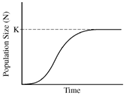
In the graph below charting the growth of a population of organisms, the line K represents the
Which graph best illustrates a population at its biotic potential?
Which graph best illustrates a population that has reached its carrying capacity?
The total fertility rate (TFR) is an estimate of
Members of an r-selected species characteristically
The K-selection reproductive strategy maximizes survival of offspring by producing
Which of the following is a density-independent event that could limit the size of a population?
Which of the following annual population growth rates is paired with the correct doubling time?
In a human population, the population momentum effect is most likely to occur in cases in which a large percentage of people in the population are in which age-group?
Which of the following describes the changes in a country’s demographics as it begins to transition from a pre-industrial state to an industrial state?
Which of the following diagrams represents a population that most likely has a negative growth rate?
Which of the following is generally true of K-strategist species as compared to r-strategist species?
If the population of a country grows at a rate of approximately 5 percent per year, the number of years required for the population to double is closest to
Which of the following pairs of statistics would most likely indicate the highest quality of life in a country?
Species that fulfill a narrow niche and depend on specific requirements for survival are considered
In the graph below charting the growth of a population of organisms, the line K represents the
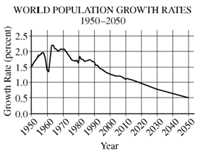
The world population growth rate in 2015 is about 1 percent. It is expected to drop to 0.5 by 2050, partly because of increased access to birth control in developing nations. Another likely cause for the expected decline is
A country currently has a population of 100 million and an annual growth rate of 3.5 percent. If the growth rate remains constant, what will be the population of this country in 40 years?
If a country has a crude birth rate of 24 per 1,000 and a crude death rate of 8 per 1,000, the natural annual percent increase of its population is
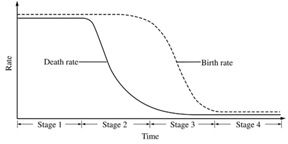
During which stage of the demographic transition shown below does a population begin to experience an explosive increase in growth?
In a human population undergoing the demographic transition, which of the following generally decreases first?
Which of the following is most typically associated with the transition from a rural society to an urbanized society?
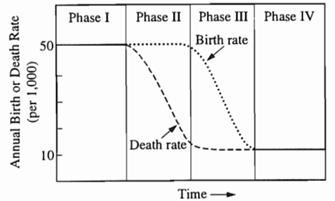
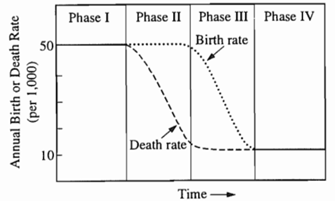
The rate of population growth starts to slow down at which point?
Which of the following is most likely the primary cause of high death rates in phase I?
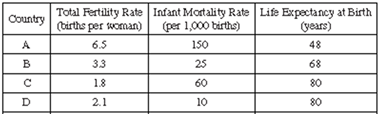
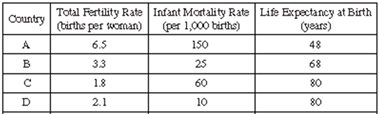
Which of the countries listed in the chart below is most likely experiencing a population decline?
Which of the countries listed in the chart below is most likely to have limited educational opportunities for women?