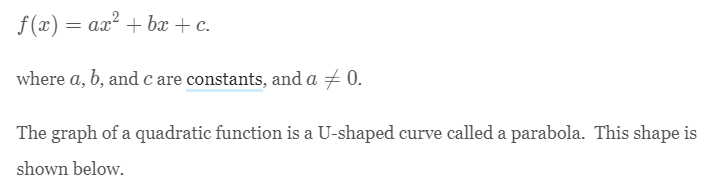
Intro to Quadratic Terminology
star
star
star
star
star
Last updated almost 6 years ago
21 Nsɛmmisa
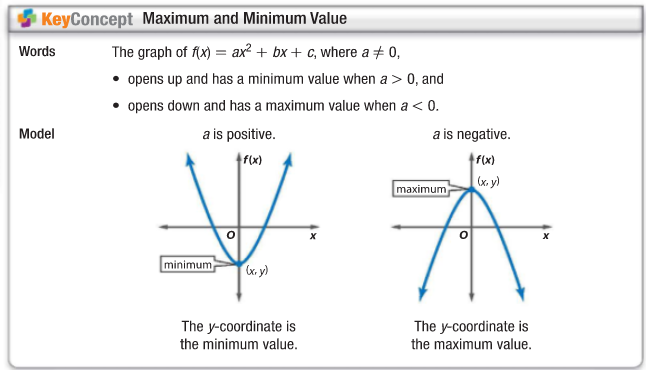
One important feature of the parabola is that it has an extreme point, called the vertex.
If the parabola opens up, the vertex represents the lowest point on the graph, or the minimum value of the quadratic function.
If the parabola opens down, the vertex represents the highest point on the graph, or the maximum value.
In either case, the vertex is a turning point on the graph.
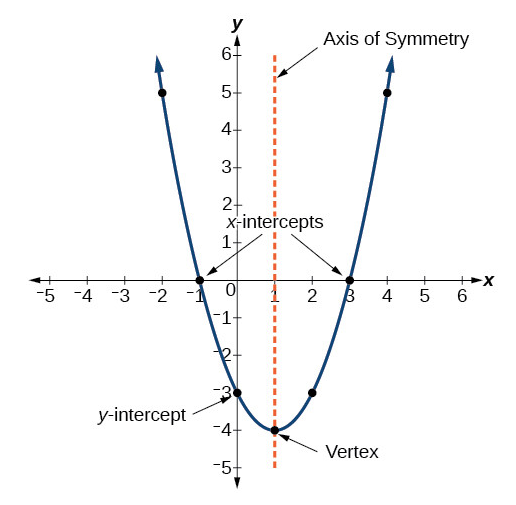
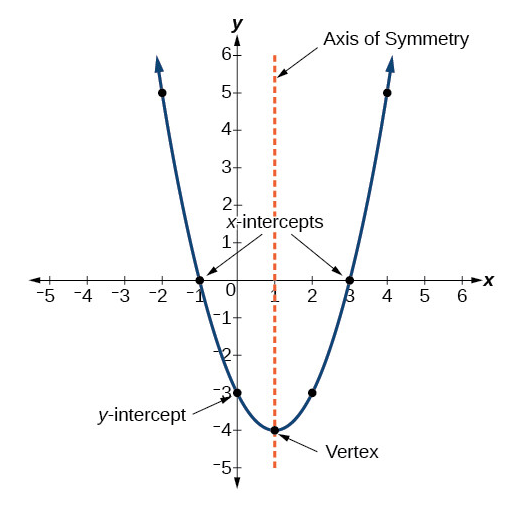
Parabolas also have an axis of symmetry, which is parallel to the y-axis. The axis of symmetry is a vertical line drawn through the vertex. Dotted red line in picture above. Axis of symmetry in above example is x = 1.
The y-intercept is the point at which the parabola crosses the y-axis. There cannot be more than one such point, for the graph of a quadratic function. If there were, the curve would not be a function, as there would be two y values for one x value, at zero.
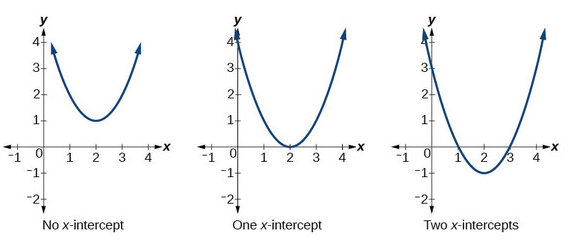
The x-intercepts are the points at which the parabola crosses the x-axis. If they exist, the x-intercepts represent the zeros, or roots, of the quadratic function, the values of x at which y=0. There may be zero, one, or two x-intercepts. The number of x-intercepts varies depending upon the location of the graph (see the diagram below).
Notice the parts of the Parabola below:
Vertex: (1,-4)
Axis of symmetry: x=1
Minimum: -4
Zeros or x-Intercepts: (-1,0) and (3,0)
y-intercepts: (0,-3)
Notice the parts of the Parabola below:
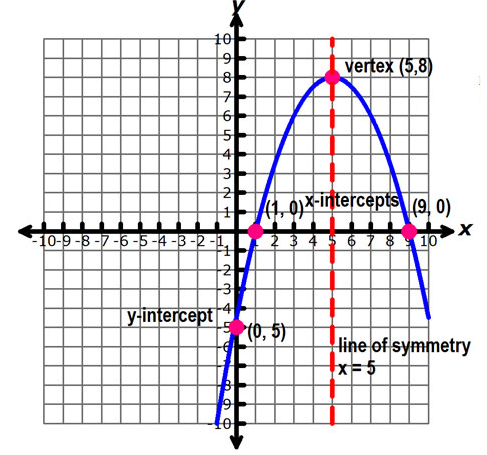
Vertex: (5,8)
Axis of symmetry: x=5
Maximum: 8
Zeros or x-Intercepts: (1,0) and (9,0)
y-intercepts: (0,5)

Is the parabola facing up or down?
Identify the axis of symmetry.
Identify the axis of symmetry.
Identify the axis of symmetry.

Is the vertex (-1,-4) a maximum or minimum?
Identify the vertex.
Identify the vertex.
Identify the vertex.

Identify the zeros as ordered pairs. For example, (2,0) and (-4,0).
Identify the zeros as ordered pairs. For example, (2,0) and (-4,0).
Identify the zeros as ordered pairs. For example, (2,0) and (-4,0).
Identify the axis of symmetry.
Identify the vertex.
Is the vertex minimum or maximum? What is the value?
Check all that apply.
Is the vertex minimum or maximum? What is the value?
Check all that apply.
Is the vertex minimum or maximum? What is the value?
Check all that apply.
Is the vertex minimum or maximum? What is the value?
Check all that apply.
Is the vertex minimum or maximum? What is the value?
Check all that apply.
How many zeros (x-intercepts) does the example function have?
How many zeros does the function have?
How many zeros does the function have?