2.4 Soil Formation

Last updated about 5 years ago
9 questions
Lesson - Soil Formation

Directions
1. Go to https://www.classzone.com/books/ml_science_share/v... and click through animations.
2. Answer the questions below.
1

What happens to the bedrock after 10 years? What are some things on Earth that might cause this? (Give examples of weathering).

1

How does the A horizon of soil form?

1

How is the B horizon different from the A and C horizon?
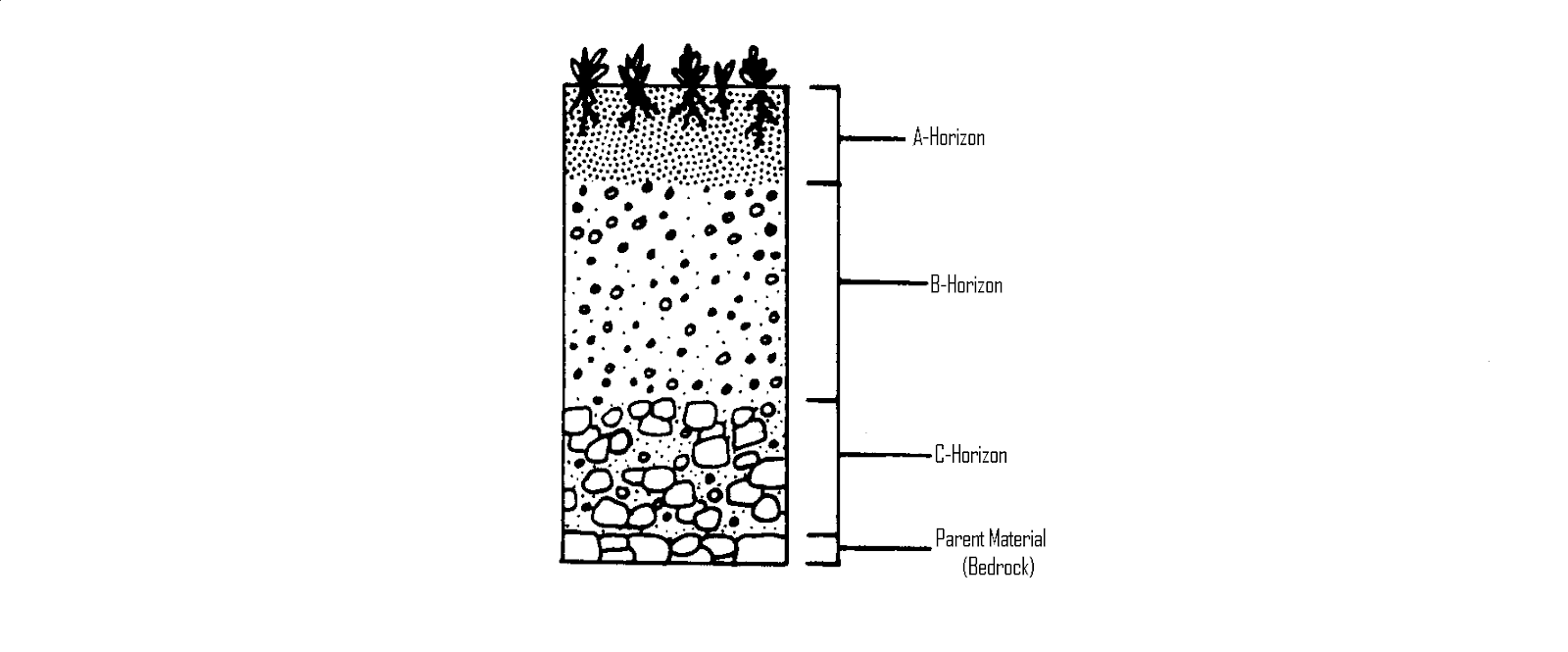
Read this and answer the questions below
Soil is a mixture of weathered rock & organic matter that usually covers bedrock (solid rock that underlies all soil). Both chemical & mechanical processes are involved in the development of soils.

  • Chemical weathering turns hard minerals into soft ones
  • Mechanical weathering breaks solid rock into smaller pieces
  • Plant & animals add organic materials in the form of waste products & dead organisms
  • The decay of organic matter produces acids which accelerate chemical weathering
  • Burrowing Animals, such as earthworms, insects, & rodents, help circulate air and water through the soil & mix mineral & organic remains


The material from which soil forms is called its parent material. Soil that has weathered directly from the bedrock beneath it and therefore matches its parent material is called residual soil.

Soil that does not match the bedrock it is over is called transported soil. It did not weather from the bedrock beneath it but was brought there by agents of erosion such as winds, rivers, or glaciers. Much of New England & the Midwest are covered by soil that was deposited by the movement of glaciers after the last Ice Age.


A cross section of soil exposed by digging is called the soil profile. The weathering of soil produces layers known as soil horizons. The topsoil or A horizon is usually rich in dark-colored organic remains called humus (labeled O horizon below). The subsoil or B horizon contains minerals that have been transported deeper by groundwater. Most of the clay in soil has also been washed down to this layer. The partially weathered bedrock or C horizon is composed of broken up bedrock on top of the solid bedrock (parent material).

Soil erosion is the removal of topsoil by the action of running water or wind. It takes between 100 & 400 years for one centimeter of topsoil to form.

Loss of topsoil can be caused when plants root are no longer present to hold down soil. Salting roads can raise the salinity of the soil and kill the plants. Over grazing can kill plants. Winds construction, & mining can all effect plant cover.
10

Which layer in the diagram above contains the most organic material?

10

How is soil created from rock?

10

Approximately how many years does one centimeter of topsoil take to form?

10

Which of the following is found in the greatest % in soil?

10

Which layer of a soil profile forms first from the bedrock?

10

For the soil profiles below, label the horizons (A, B, or C) for each of the soil profiles using the spaces provided next to each image. Use the big A button to write on the image At the bottom of each profile above, number the profiles in order from 1 (happened the longest time ago) to 3 (happened most recently).