US History Unit 1 Test
star
star
star
star
star
Last updated almost 6 years ago
18 Nsɛmmisa
1
1
1
1
1
1
2
1
2
1
1
1
1
1
1
1
1
1
Document A –“The Second Treatise of Government (Use for Questions 1-3)
“All men are naturally born in a state of perfect freedom. They are equal and independent, and can act how they want to. This state of nature is governed by a law of nature. The law of nature says that no one should harm another person in his natural rights to life, liberty, and property (possessions).
To maintain (keep) this natural state of freedom and equality, men agree to join together into a community to live comfortable, peaceful lives, and also to have security against any people that might desire to harm them and take away their natural rights. When every individual in a community has agreed to join together, the community has made a government.
Men agree to enter into society to preserve (keep) their natural rights to life, liberty, and property. Because of this, when the government tries to take away or destroy the life, liberty, or property of the people, the government puts itself in a state of war with the people. At this point, the people do not need to obey the government anymore.”
Source: John Locke, “The Second Treatise of Government” published 1689
According to Locke, what is one of the “natural rights” of all men?
According to Locke, why do people unite to form communities and governments?
What ideological movement is this excerpt an example of?
Documents B and C – Boston Massacre (Use for Questions 4-9)
Document B - Date of source: March 12, 1770
On the evening of Monday the 5th, several soldiers of the 29th Regiment were seen parading the streets with their drawn cutlasses and bayonets, abusing and wounding the inhabitants. A few minutes after nine o'clock four youths, named Edward Archbald, William Merchant, Francis Archbald, and John Leech, came down Cornhill St. together, and separating at Dr. Loring's corner, the two former were passing the narrow alley leading to Murray's barrack. There was a soldier with a broad sword of an uncommon size. A person of mean countenance armed with a large stick was with him. Archbald warned Merchant to take care of the sword, so the soldier turned around and struck Archbald on the arm, then pushed Merchant and pierced through his clothes inside the arm close to the armpit and grazed the skin. Merchant struck the soldier with a short stick he had; and the other person ran to the barrack and brought with him two soldiers, one armed with a pair of tongs, the other with a shovel. He with the tongs pursued Archbald back through the alley and hit him over the head with the tongs.
Document C- Date of Source: March 5, 1770.
On Monday night about 8 o'clock two soldiers were attacked. A group of the townspeople broke into two meeting houses and rang the alarm bells, which I thought was for fire. Some of the guard came and informed me the townspeople were assembling to attack the troops, and that the bells were ringing as the signal for that purpose and not for fire. As I was captain of the day, I went to the main guard. On my way there I saw the people in great commotion, and heard them use the most cruel threats against the troops. After I reached the guard, about 100 people passed it and went towards the custom house where the king's money is lodged. They immediately surrounded the sentry posted there, and with clubs and other weapons threatened to execute their vengeance on him. I was soon informed by a townsman their intention was to carry off the soldier from his post and murder him. He soon came back and assured me he heard the mob declare they would murder him. This I feared might be a prelude to their plundering the king's chest. I immediately sent an officer and 12 men to protect both the sentry and the king's money, and very soon followed myself to prevent all disorder, fearing the officer and soldiers, by the insults and provocations of the rioters, should commit some rash act. They soon rushed through the people, and by charging their bayonets in half-circles, kept them at a little distance. Nay, so far was I from intending the death of any person that I ordered the troops to go to the spot where the unhappy affair took place without any loading in their pieces; nor did I ever give orders for loading them. This remiss conduct in me perhaps merits censure; yet it is evidence that my intention was not to act offensively, but the contrary part.
Which event do these documents describe?
Is document B a primary or a secondary source?
Does document B represent the colonist or the British perspective?
Provide evidence from the text that supports your response to the previous question.
Does document C represent the colonist or the British perspective?
Provide evidence from the text that best supports your response to the previous question.
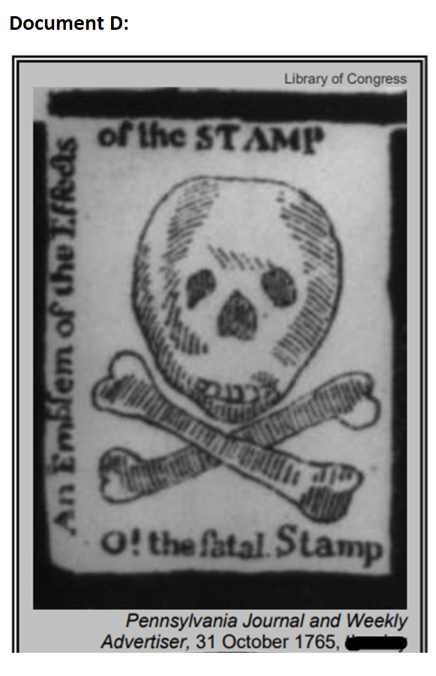
The following cartoon is a colonial response to which of the following acts?
Based on these cartoons how did colonists feel about increased taxation in the colonies?
What evidence from the cartoon supports your previous answer?
Document E (Use for Questions 13-15)
Will Alfred wrote this public letter to Secretary Henry Seymour Conway. Conway was one of two of Britain’s Secretaries of State and was responsible for relations with the American colonies. The letter was first published in a London newspaper and then was published in the Boston Gazette Supplement on January 27, 1766, nearly three months after the Stamp Act went into effect.
From a late London paper. To Mr. Secretary Conway: The riotous behavior of the people in Boston is remarkable. I would have been less surprised by their behavior if we had taxed their beer, because everyone drinks beer. But the Stamp Act is a tax on none of the necessities of life. It does not affect the poor. And even a poor person can afford this little amount of money. The tax on newspapers only affects the rich—common people do not purchase newspapers. Isn’t it surprising, then, that the mob in Boston has begun to riot against this tax even before it has officially gone into effect? I was expressing my wonder at this, when I was informed, that it was not the burden of the tax to be raised, but the manner in which it was imposed, that created the discontent: If this is so, the matter is more serious than it may first appear. . . . The colonists are our brethren and fellow-subjects. . . . We should ask therefore whether we have behaved to them as brethren. . . . The first birth right privilege of a Briton is, that he cannot be legally tried but by his peers. One of the next is, that he cannot be taxed but by a parliament in which he is represented. . . . Do these who impose taxes on the colonists pay also themselves a share of these taxes? If this is not the case, what have the colonists done that they are to be stripped of one of the most valuable privileges of Britons? Have the parliament of Great Britain a right to take from any, the lowest of the subjects, the smallest privilege, which he inherits by birth-right, unless forfeited by law?
Source: Will Alfred, “To Mr. Secretary Conway,” Boston Gazette Supplement, January 27, 1766.
Which of the following are reasons that the author believed Americans wouldn’t riot over the Stamp Act? (circle all that apply)
The speaker’s attitude towards the colonists can most accurately be described as
Which of the following quotations most accurately supports the correct answer to the previous question?
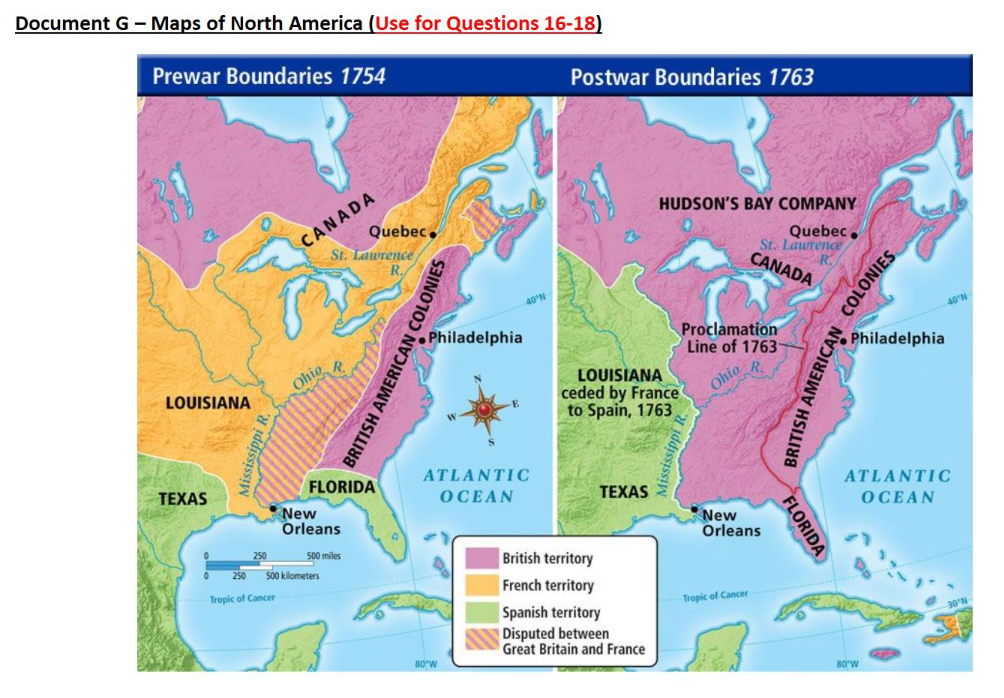
According to the postwar map, who controls the area immediately west of the Proclamation line?
Which descriptions are supported by the maps? (select all that apply)
What is the significance of the red line in the second map?