When Everything Changed: the Industrial Revolution (107.2)
star
star
star
star
star
Last updated almost 6 years ago
8 Nsɛmmisa
1
1
1

1
1
1
1
1
Abundant fossil fuels, like coal, led to innovative machines like engines. These inventions launched an era of accelerated change that continues to transform human society.
THE TRANSFORMATION OF THE WORLD
Try to imagine your life without any machines working for you. Make a list of the machines in your house. You may be surprised how many there are.
Imagine young people who grew up before machines. How did they move from place to place? How did they communicate? What foods did they eat?
At one time, humans provided most of their own energy. They ate plants and animals for fuel, burned wood, and were helped by domestic animals. Windmills and waterwheels captured some extra energy, but little could be saved. All life depended on the energy the Sun sent to the Earth.
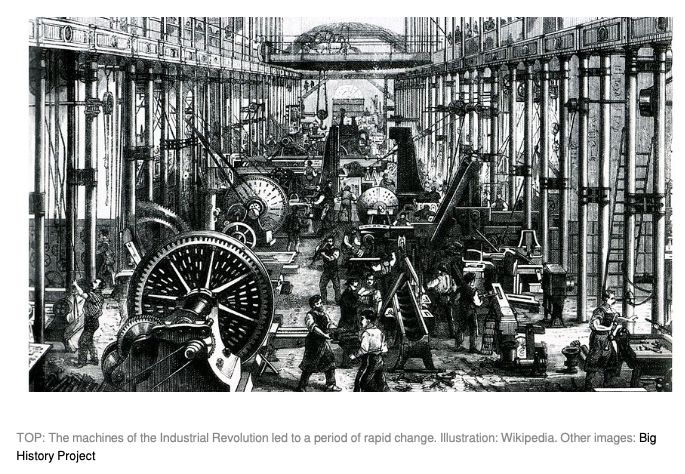
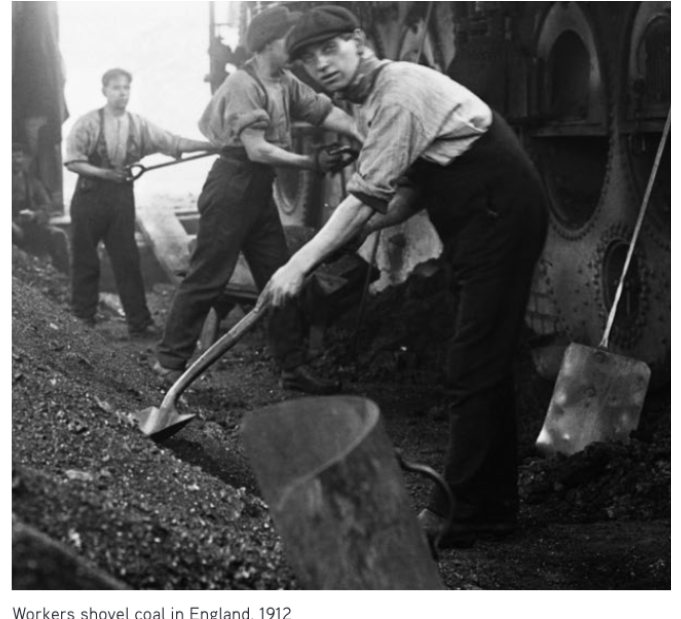
Everything changed during the Industrial Revolution, which began around 1750. People found an extra source of energy that could work for them. That source was fossil fuels — coal, oil, and natural gas. These formed underground from the remains of plants and animals from much earlier geologic times. When they were burned, they released energy, originally from the Sun, that had been stored for hundreds of millions of years.
Coal was formed when huge trees from the Carboniferous period (345 million to 280 million years ago) fell and were covered with water, so that oxygen and bacteria could not decay them. Materials pushing down compressed them into dark, carbonic, burnable rock.
Most of the Earth’s oil and gas formed over a hundred million years ago from tiny animal skeletons and plant matter that fell to the bottom of seas or were buried in sediment. This organic matter was compressed by the weight of water and soil.
Coal, oil, and gas are relatively common on Earth. But they are not evenly distributed. Some places have much more than others due to the diverse ecosystems that existed long ago.
EARLY STEAM ENGINES
The story of the Industrial Revolution begins on the small island of Great Britain. By the early eighteenth century, people there had cut down most of their trees to build houses or ships and for cooking and heating. They needed something else to burn. They turned to the hunks of black stone (coal) that they found near the surface of the Earth. Soon they were digging deeper to mine it. These coal mines, deep in the Earth, began to fill with water. Using horses to pull up bucketfuls of water was too slow.
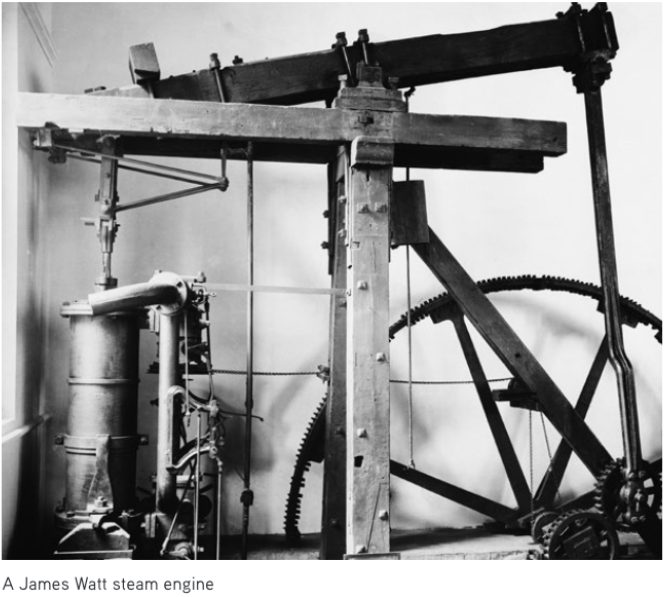
To the rescue came James Watt (1736–1819), a Scottish instrument-maker. In 1776, he designed an engine that used burning coal to produce steam. The steam drove a piston. This steam engine was first used to efficiently pump water out of coal mines. But his engine worked well, and it was put to other uses. He became a wealthy man. After his patent ran out in 1800, others improved on his engine. By 1900, engines burned 10 times more efficiently than they had a hundred years before.
At the beginning of the nineteenth century, British colonies in North America were producing lots of cotton. Machines were used to spin the cotton thread on spindles and to weave it into cloth on looms. Attaching a steam engine to these machines made the work go much, much faster. One steam engine could power many spindles and looms. This meant that people had to leave their homes and work together in factories.
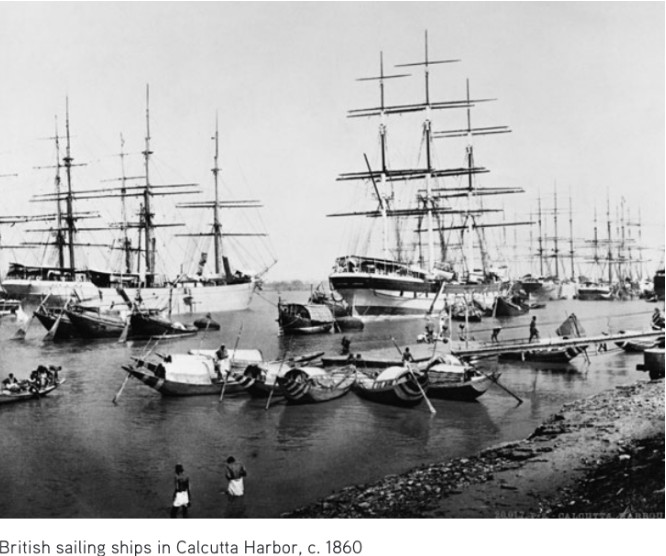
Early in the nineteenth century, the British also invented steam locomotives and steamships, which revolutionized travel. In 1851, they held the first world’s fair. They exhibited telegraphs, sewing machines, revolvers, reaping machines, and steam hammers to demonstrate that they were the world’s leading manufacturer of machinery. By this time, the characteristics of industrial society — smoke rising from factories, bigger cities and denser populations, railroads — could be seen in many places in Britain.
Using specific examples, was the environmental impact of the industrial revolution worth the cost?
WHY BRITAIN?
Britain wasn’t the only place that had deposits of coal. So why didn’t the Industrial Revolution begin in China, or somewhere else that had coal? Did it start in isolation in Britain, or were there global forces at work that shaped it? Did geography or cultural institutions matter more? Historians have vigorously investigated these questions.
Possible reasons why industrialization began in Britain include:
• Shortage of wood and an abundance of convenient coal deposits • Elites who were interested in business, a limited monarchy • A capitalist system; limited government involvement • Government support for business projects and a strong navy to protect ships • Cheap cotton produced by slaves in North America • High literacy rates • Rule of law; protection of assets • Valuable immigrants (Dutch, Jews, Huguenots [French Protestants]) Possible reasons why industrialization did not begin in China include: • Location of China’s coal — the north — while economic activity was centered in the south • A large, rapidly growing population, allowing for human labor instead of machines • Confucian ideals that valued stability and discouraged experimentation and change
• Lack of Chinese government support for sea explorations, thinking its empire seemed large enough to provide everything needed
• China’s focus on defending itself from nomadic attacks from the north and west Global forces influencing the development of industrialization in Britain include: • Britain’s location on the Atlantic Ocean • British colonies in North America, which provided land, labor, and markets
• Silver from the Americas, used in trade with China
• Social and ideological conditions in Britain, and new thoughts about the economy, that encouraged an entrepreneurial spirit
What were oil and natural gas doing while coal was powering the Industrial Revolution? They had been discovered long before and were in use, but mostly as fuels for lamps and other light sources. It wasn’t until the mid-twentieth century that oil caught up — and surpassed — coal in use.
What is the strongest reason why the industrial revolution started in Great Britain, provide evidence.
THE SPREAD OF THE INDUSTRIAL REVOLUTION
Britain wanted to keep secret how its machines were made. But visitors soon learned about them and took the techniques back home. Sometimes they smuggled machines out in rowboats.
The first countries after Britain to develop factories and railroads were Belgium, Switzerland, France, and the states that became Germany. Building a national railroad system was an essential part of industrialization. Belgium began its railroads in 1834, France in 1842, Switzerland in 1847, and Germany in the 1850s.
Industrialization came to the United States in 1789. Samuel Slater left Britain for Rhode Island, where he set up the first textile factory on U.S. soil. He couldn't bring any notes or plans from Britain, so he had to set up the factory from memory.
Railroad construction in America boomed from the 1830s to 1870s. The American Civil War (1861–1865) was the first truly industrial war. The increasingly urbanized and factory-based North was fighting against the agriculture-based South. Industrialization grew explosively after the war. By 1900, the United States had overtaken Britain in manufacturing, producing 24 percent of the world’s output.
Four decades before that, both Russia and Japan gave up their feudal systems to compete in the industrializing world. In Japan, the monarchy was flexible enough to survive early industrialization.
But in Russia, a rural country, the czar and nobles tried to industrialize the country while keeping a grip on their dominance. Factory workers often worked 13-hour days without any legal rights. Eventually, a revolution brought the Communist party to power in 1917.
Industrialized nations used their strong armies and navies to colonize many parts of the world that were not industrialized. They needed raw materials for their factories. This colonization is known as imperialism. In 1800, Europeans occupied or controlled about 34 percent of the land surface of the world. By 1914, this had risen to 84 percent.
What do you think of people poaching invention and innovation ideas from one another? Is it justified? Explain your position.
CONSEQUENCES OF THE INDUSTRIAL REVOLUTION
The effects of industrialization are staggering. In 1700, before fossil fuels were in use, the world’s population was 670 million. By 2011, it was 6.7 billion, a tenfold increase in only 300 years.
In the twentieth century alone, the world’s economy grew fourteenfold, per-capita income grew almost fourfold, and the use of energy expanded at least thirteenfold. This kind of growth has never before occurred in human history.
Many people around the world today enjoy the benefits of industrialization. With extra energy flowing through the system, many of us do much less physical labor than earlier generations. People today are able to feed more babies and bring them to adulthood. Many people vote and participate in modern states. These states provide education, social security, and health benefits. Large numbers of people enjoy levels of wealth, health, education, travel, and life expectancy unimagined before industrialization.
The benefits of industrialization, however, have come at great cost. For one thing, the rate of change (acceleration) is now so rapid that individuals and social systems struggle to keep up. And it can be argued that life has become depersonalized in the era of mass production.
As the industrial system has become more complex, it has also become more fragile. Industrialization needs many components to work together smoothly. Any one component could fail.
We know that many of the essential components of the industrial system, and the natural resources it depends on, are being undermined. The soil, the oceans, the atmosphere, the underground water levels, plants, and animals are all at risk.
Will uncontrolled growth continue, or are we approaching the end of an unsustainable industrial era? Whatever the future holds, we’ll be debating — and dealing with — the consequences of modernization for years to come.
Which section of the article BEST explains how various nations changed during the Industrial Revolution?
Read the following paragraph from the section "The spread of the Industrial Revolution".
Industrialized nations used their strong armies and navies to colonize many parts of the world that were not industrialized. They needed raw materials for their factories. This colonization is known as imperialism. In 1800, Europeans occupied or controlled about 34 percent of the land surface of the world. By 1914, this had risen to 84 percent.
Which of the following BEST explains the purpose of this paragraph?
Why did the author MOST LIKELY choose to end with the following paragraph?
Will uncontrolled growth continue, or are we approaching the end of an unsustainable industrial era? Whatever the future holds, we’ll be debating — and dealing with — the consequences of modernization for years to come.
Was the Industrial Revolution worth the costs? Explain using specific examples. (Did the benefits outweigh the costs?)
How did our paperchain activity compare to what was happening in the Industrial Revolution? Use specific examples.